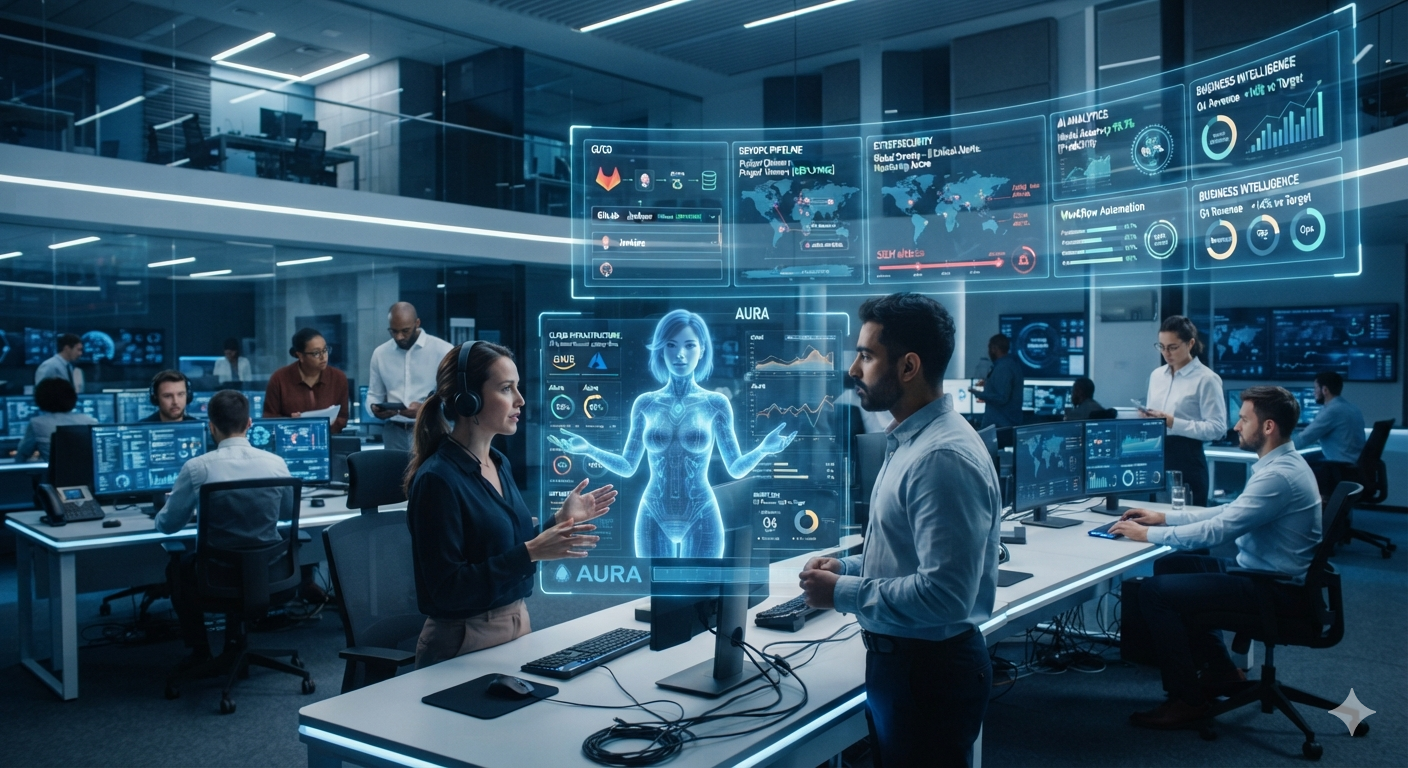
AI Agents Are Becoming Your New Digital Employees
Artificial intelligence has evolved far beyond answering questions and generating content. In 2026, organizations are entering a new era where AI agents are becoming active members of the workforce, performing tasks, making decisions, and collaborating with human employees.
Unlike traditional chatbots, AI agents can remember context, interact with multiple business applications, automate complex workflows, and even coordinate with other AI systems. From customer support and software development to cybersecurity and finance, these digital employees are transforming how businesses operate.
The question is no longer whether AI agents will become part of the workplace. The question is how quickly organizations can adapt to working alongside them.
What Makes an AI Agent Different?
A chatbot responds to questions.
An AI agent completes objectives.
Instead of waiting for prompts, AI agents can be assigned goals such as:
- Investigate a security incident.
- Schedule meetings and coordinate calendars.
- Analyze thousands of documents.
- Generate reports for executives.
- Monitor cloud infrastructure.
- Write, test, and improve software.
- Research vendors and compare pricing.
- Manage customer support tickets.
Modern AI agents connect to enterprise systems including Microsoft 365, Google Workspace, Salesforce, ServiceNow, GitHub, Jira, Slack, AWS, Azure, and countless other platforms. They retrieve information, execute approved actions, and continuously update users on progress.
The result is a digital worker capable of handling hours of repetitive work in minutes.
A New Workforce Is Emerging
Organizations are increasingly assigning AI agents roles that previously required full-time employees.
Imagine an IT department where one AI agent continuously monitors servers, another reviews security logs, another documents infrastructure changes, while another prepares compliance reports.
None of these systems replace human expertise entirely. Instead, they eliminate repetitive work that slows teams down.
Developers can focus on building new applications rather than documenting code.
Security analysts can investigate sophisticated threats instead of sorting through thousands of alerts.
Cloud engineers spend more time optimizing infrastructure and less time performing manual maintenance.
This shift allows businesses to accomplish significantly more without dramatically increasing headcount.
AI Agents Are Transforming DevOps
Few industries stand to benefit more than DevOps.
Modern software development requires monitoring applications, deploying updates, reviewing code, managing infrastructure, responding to incidents, and documenting every change.
AI agents now assist throughout the entire software lifecycle.
They can:
- Generate infrastructure-as-code templates.
- Review pull requests.
- Detect configuration errors before deployment.
- Recommend performance improvements.
- Monitor production environments.
- Automatically open incident tickets.
- Summarize outages for engineering teams.
- Suggest root causes based on historical data.
Instead of replacing DevOps engineers, AI agents become trusted assistants that reduce operational complexity while improving reliability.
Cybersecurity Gets an AI Teammate
Cybersecurity teams face an overwhelming number of alerts every day.
Many organizations simply lack enough analysts to investigate every potential threat.
AI agents are changing that.
Security-focused agents continuously examine network activity, endpoint behavior, cloud logs, email traffic, and identity systems to identify suspicious activity.
Rather than simply raising alerts, they can:
- Correlate events across multiple platforms.
- Prioritize high-risk incidents.
- Draft investigation summaries.
- Recommend containment actions.
- Generate compliance documentation.
- Assist with forensic analysis.
Human analysts remain responsible for final decisions, but AI dramatically reduces investigation time.
This faster response can significantly reduce the impact of ransomware, phishing campaigns, insider threats, and cloud attacks.
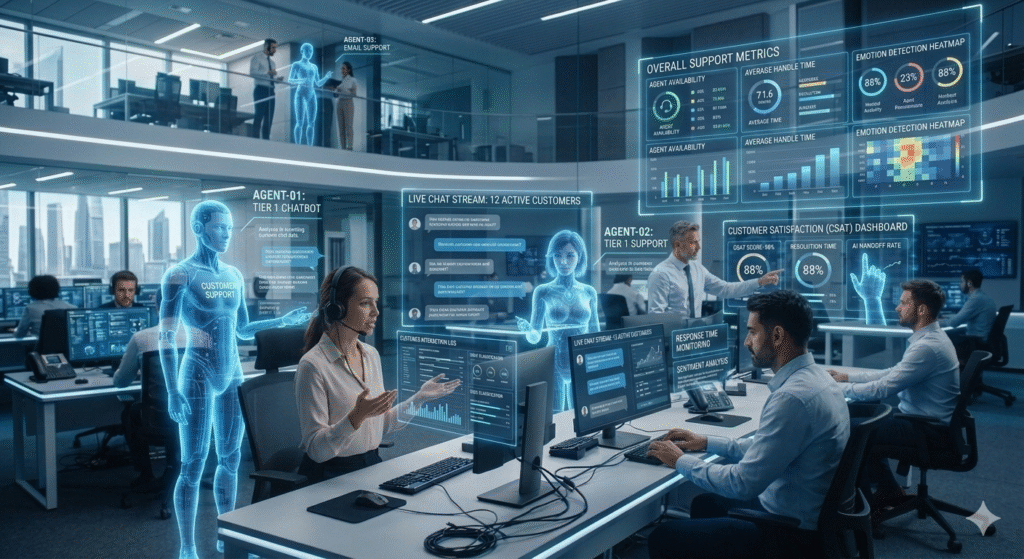
Customer Service Is Becoming Autonomous
Customer service is another area experiencing rapid transformation.
Traditional chatbots often frustrated users because they followed rigid scripts.
Today’s AI agents understand conversations, retrieve customer history, access internal knowledge bases, and resolve increasingly complex requests.
When necessary, they seamlessly transfer conversations to human representatives while providing complete summaries of previous interactions.
Customers spend less time repeating information, and support teams resolve issues faster.
Businesses benefit from lower costs while improving customer satisfaction.
AI Agents Need Supervision
Despite their impressive capabilities, AI agents are not infallible.
They can misunderstand requests, access outdated information, or make recommendations that conflict with company policies.
Organizations must establish clear governance that defines:
- Which systems agents may access.
- What actions require human approval.
- How decisions are logged.
- How sensitive data is protected.
- How AI-generated outputs are validated.
Human oversight remains essential, particularly in industries handling financial, healthcare, legal, or regulated information.
Successful companies will treat AI agents as employees that require management, training, auditing, and accountability.
The Rise of Multi-Agent Collaboration
Perhaps the most exciting development is the emergence of multiple AI agents working together.
Rather than relying on one general-purpose assistant, organizations deploy specialized agents with unique expertise.
One agent researches.
Another analyzes data.
A third creates reports.
A fourth verifies compliance.
Together, these digital teams complete sophisticated workflows with minimal human intervention.
This collaborative model enables businesses to automate processes that once required several departments.
Skills That Matter in the AI Era
As AI agents become more capable, human roles will evolve.
The most valuable employees will not compete with AI.
They will learn how to direct it.
Future professionals will need skills such as:
- Critical thinking
- Business strategy
- AI governance
- Prompt engineering
- Workflow automation
- Data analysis
- Security oversight
- Ethical decision-making
Understanding how to collaborate with AI agents will become as important as understanding email or spreadsheets is today.
Looking Ahead
The workplace of the future will not consist solely of human employees or fully autonomous AI systems.
Instead, organizations will build hybrid teams where humans and AI agents work together, each contributing their unique strengths.
Humans bring creativity, judgment, empathy, leadership, and ethical reasoning.
AI agents contribute speed, consistency, scalability, and the ability to process enormous amounts of information.
Companies that successfully combine both will gain significant competitive advantages.
The transition has already begun.
AI agents are no longer experimental tools sitting in research labs. They are becoming trusted collaborators that help businesses innovate faster, reduce operational costs, strengthen cybersecurity, improve customer experiences, and accelerate digital transformation.
For organizations willing to embrace this change responsibly, AI agents may become the most productive employees they have ever hired.
Related Articles
- AI Employees Are Arriving: The Rise of the Digital Workforce
- AI Agents in Enterprise: Transforming Workflows While Creating New Security Risks
- AI Agents Are Replacing Dashboards: The Rise of Autonomous Enterprise Operations
- AI-Driven DevOps: Why Enterprise Teams Are Rebuilding Around AI
- Agentic AI in DevOps Pipelines: From Assistants to Autonomous CI/CD
- AI in DevOps: Separating Hype from Enterprise Reality
- AI Infrastructure Wars: Why Enterprises Are Building Private AI Clouds
- The Agentic Web: AI Agents Become Internet Users