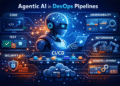
Why Enterprise DevOps Teams Are Rebuilding Around AI
Enterprise DevOps is entering a major transformation driven by artificial intelligence, automation, and operational intelligence. For years, DevOps teams focused heavily on speed, continuous delivery, infrastructure automation, and cloud-native scalability. But as enterprise environments become more complex, traditional DevOps workflows are struggling to keep up.
Today, organizations are rebuilding DevOps strategies around AI-driven DevOps, intelligent automation, predictive analytics, and autonomous infrastructure management. The rise of AI is not simply adding another tool to the DevOps pipeline—it is fundamentally changing how enterprise engineering teams build, deploy, secure, and operate software at scale.
Across cloud infrastructure, Kubernetes environments, CI/CD pipelines, and enterprise operations centers, AI is rapidly becoming the operational layer powering the next generation of DevOps.
The Traditional DevOps Model Is Reaching Its Limits
Modern enterprise infrastructure generates enormous amounts of operational data.
Cloud-native applications, microservices, Kubernetes orchestration, distributed workloads, and hybrid environments produce:
- millions of telemetry events
- constant infrastructure alerts
- security warnings
- performance anomalies
- deployment failures
- scaling events
- cost fluctuations
DevOps teams are now overwhelmed by operational complexity.
Traditional monitoring dashboards and manual workflows are no longer enough to manage environments operating at enterprise scale.
As systems become more dynamic, organizations are realizing that DevOps engineers cannot manually analyze every signal, troubleshoot every issue, or optimize every workload in real time.
This is one of the primary reasons enterprise DevOps teams are rebuilding around AI.
Internal Links:
- https://levelact.com/ai-agents-replacing-dashboards/
- https://levelact.com/ai-native-data-centers/
- https://levelact.com/regional-ai-data-centers/
AI Is Becoming the Intelligence Layer of DevOps
Artificial intelligence is transforming DevOps from reactive operations into predictive, intelligent automation.
Modern AI-driven DevOps platforms can:
- detect anomalies automatically
- predict infrastructure failures
- optimize deployments
- automate rollback decisions
- identify root causes faster
- improve CI/CD reliability
- reduce downtime
- optimize cloud spending
Instead of engineers spending hours analyzing logs and troubleshooting incidents manually, AI systems can rapidly process operational telemetry and recommend—or even execute—corrective actions automatically.
This dramatically improves:
- operational efficiency
- deployment speed
- system reliability
- developer productivity
- incident response times
External Links:
- https://github.com/features/copilot?utm_source=levelact
- https://cloud.google.com/devops?utm_source=levelact
AI-Driven Operations Are Replacing Manual Monitoring
One of the biggest changes happening in DevOps is the move away from passive monitoring toward autonomous operational intelligence.
Traditional observability platforms focused on displaying metrics and alerts.
AI-driven operations platforms go much further.
They can:
- interpret infrastructure behavior
- correlate events across systems
- prioritize operational risks
- automate remediation workflows
- coordinate cloud resources dynamically
This reduces operational fatigue and helps DevOps teams focus on innovation rather than repetitive maintenance work.
Many enterprises now view AI operations platforms as essential for managing modern cloud infrastructure.
Internal Links:
- https://levelact.com/cloud-cost-explosion-2026/
- https://levelact.com/vertical-cloud-infrastructure/
- https://levelact.com/ai-data-center-infrastructure-crisis/
Kubernetes and Cloud Complexity Are Accelerating AI Adoption
Kubernetes environments have introduced incredible flexibility into enterprise infrastructure—but also massive operational complexity.
Clusters constantly scale. Containers move dynamically. Multi-cloud deployments create unpredictable networking and performance patterns.
Managing these environments manually has become increasingly difficult.
AI systems are now being used to:
- optimize Kubernetes orchestration
- analyze cluster health
- improve resource allocation
- predict workload failures
- reduce infrastructure waste
- automate scaling decisions
As AI workloads continue expanding, DevOps teams are increasingly relying on machine learning systems to manage infrastructure that humans can no longer efficiently oversee alone.
External Links:
AI Is Reshaping CI/CD Pipelines
Continuous integration and continuous delivery pipelines are also evolving rapidly.
AI-enhanced CI/CD systems can:
- identify risky code changes
- predict deployment failures
- automate testing prioritization
- optimize build pipelines
- reduce release bottlenecks
- improve rollback accuracy
This creates faster and safer software delivery pipelines while reducing developer friction.
Many enterprises are now integrating AI directly into GitOps workflows and infrastructure-as-code operations.
Internal Links:
- https://levelact.com/openchoreo-1-0-kubernetes-ai-gitops/
- https://levelact.com/ai-networking-bottlenecks-next-gpu-shortage/
Cybersecurity Is Becoming Integrated Into AI-Driven DevOps
Security is another major factor driving AI adoption inside DevOps environments.
Modern DevSecOps workflows now require:
- continuous vulnerability detection
- infrastructure policy enforcement
- real-time threat analysis
- automated compliance monitoring
- identity security integration
AI systems are helping DevOps teams identify vulnerabilities earlier while automating portions of security response and governance.
This is especially important as enterprises adopt:
- Zero Trust architectures
- multi-cloud deployments
- AI-native infrastructure
- autonomous operations platforms
The future of DevOps and cybersecurity is becoming increasingly interconnected through intelligent automation.
External Links:
- https://www.ibm.com/topics/devsecops?utm_source=levelact
- https://learn.microsoft.com/en-us/devops/?utm_source=levelact
Enterprise Leadership Wants Faster Innovation
Beyond infrastructure complexity, business pressure is also accelerating the shift toward AI-driven DevOps.
Enterprise leadership expects:
- faster product delivery
- improved uptime
- lower operational costs
- stronger security
- increased scalability
- better customer experiences
AI-driven DevOps helps organizations achieve these goals by improving operational efficiency while reducing manual workloads.
Companies that successfully integrate AI into DevOps pipelines may gain significant competitive advantages in speed, resilience, and operational agility.
Human Engineers Are Still Critical
Despite rapid advances in AI automation, DevOps engineers are not disappearing.
Instead, their role is evolving.
Engineers are increasingly becoming:
- automation architects
- AI workflow supervisors
- infrastructure strategists
- operational intelligence managers
Human expertise remains essential for:
- governance
- architecture decisions
- business alignment
- compliance
- risk management
- complex troubleshooting
AI enhances DevOps teams—it does not replace them entirely.
The Future of Enterprise DevOps
Enterprise DevOps teams are rebuilding around AI because modern infrastructure demands intelligent operational systems capable of moving faster than humans alone.
The next generation of DevOps will be defined by:
- AI-driven automation
- predictive operations
- autonomous infrastructure management
- intelligent CI/CD pipelines
- cloud optimization
- integrated security intelligence
As AI continues reshaping enterprise IT, DevOps teams that embrace operational intelligence will likely become the foundation for the future of cloud infrastructure and software delivery.
The era of AI-driven DevOps has already begun.