
Anthropic Unveils Claude Opus 4.7
The race to dominate enterprise AI just accelerated again. Anthropic has officially unveiled Claude Opus 4.7, the latest evolution of its flagship large language model—and it’s clear this release is aimed directly at developers, security teams, and organizations pushing AI into production.
With Claude Opus 4.7, Anthropic is doubling down on three critical areas: AI-assisted coding, enhanced security, and more advanced creative reasoning. At a time when enterprises are struggling to balance rapid innovation with increasing risk, this release positions Claude as not just a productivity tool—but a more controlled and reliable AI system.
What Is Claude Opus 4.7?
Claude Opus 4.7 is the newest version in Anthropic’s Opus model line, designed to handle complex reasoning, long-context understanding, and real-world enterprise use cases. Unlike earlier models that focused heavily on general conversational ability, this version is clearly optimized for practical deployment—especially in development environments and security-sensitive workflows.
The model builds on the strengths of previous releases while refining performance in areas that matter most:
- More accurate code generation
- Improved instruction following
- Better handling of long documents and system prompts
- Enhanced guardrails for safer outputs
For organizations already experimenting with generative AI, Claude Opus 4.7 represents a shift toward more dependable and production-ready AI systems.
Why Claude Opus 4.7 Improves AI Coding
One of the biggest upgrades in Claude Opus 4.7 is its ability to assist with software development tasks at a higher level of precision. AI coding tools have exploded in popularity, but they’ve also introduced new risks—especially when models generate flawed or insecure code.
Anthropic appears to be addressing this directly.
Claude Opus 4.7 delivers:
- Cleaner, more structured code outputs
- Improved debugging and refactoring suggestions
- Better understanding of multi-file projects
- Reduced hallucinations in code generation
This is a major step forward, especially as developers increasingly rely on AI to accelerate workflows. However, the broader industry trend shows that faster coding also introduces new vulnerabilities.
For example, in our recent coverage of AI-driven threats, we highlighted how attackers are leveraging automation to scale attacks faster than ever:
This creates a new reality—AI isn’t just helping developers build faster; it’s also enabling attackers to move faster. Claude Opus 4.7’s improvements in accuracy and reasoning are designed to reduce that gap.
Security Enhancements in Claude Opus 4.7
Security is no longer optional in AI—it’s the battlefield.
Anthropic has made it clear that Claude Opus 4.7 includes stronger safety mechanisms and alignment improvements, aimed at reducing harmful outputs and limiting misuse. This is critical as organizations deploy AI into environments where sensitive data, infrastructure, and workflows are at risk.
Key security-focused improvements include:
- Stronger prompt handling to resist manipulation
- Improved filtering of unsafe or malicious outputs
- Better context awareness for sensitive data scenarios
- Reduced likelihood of generating exploitable code
This is especially important when you consider the growing number of real-world threats tied to AI ecosystems. Malicious actors are already exploiting weak points in software supply chains and browser environments.
A perfect example is the recent discovery of browser-based attacks affecting thousands of users:
These threats highlight why AI models must go beyond performance—they must be designed with defensive capabilities built in.
Claude Opus 4.7 represents a step toward that goal.
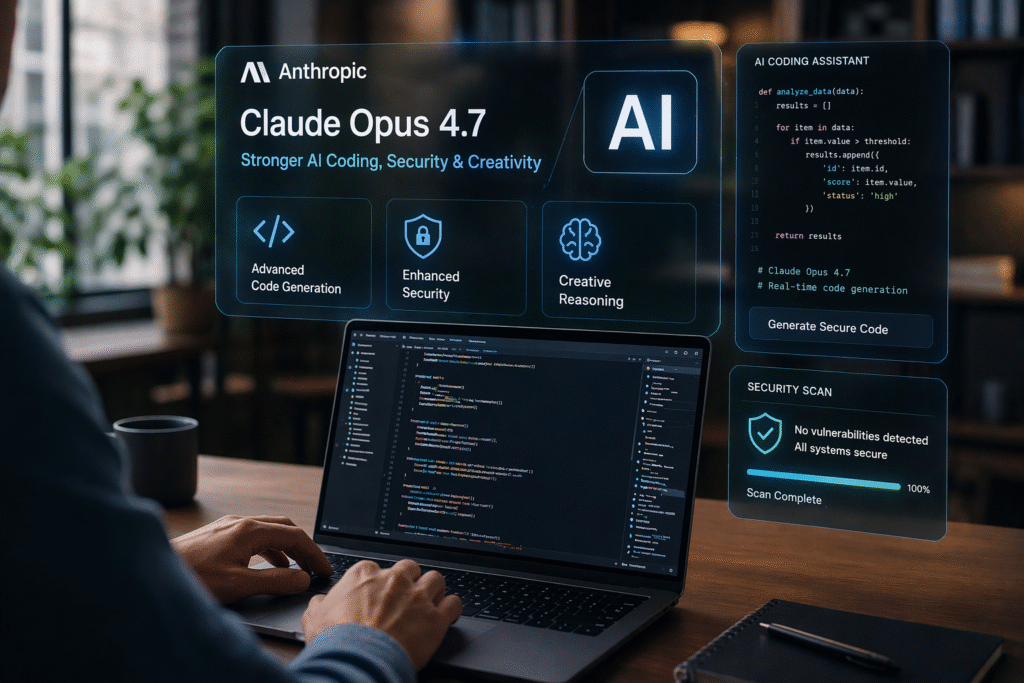
Claude Opus 4.7 is transforming AI coding by improving security, accuracy, and developer productivity in real-world environments.
Claude Opus 4.7 vs Previous Models
Compared to earlier versions, Claude Opus 4.7 is less about flashy improvements and more about refinement and reliability. That may not sound exciting—but for enterprises, it’s exactly what matters.
Here’s how it stands out:
1. More Stable Outputs
Previous models could produce inconsistent results across similar prompts. Opus 4.7 improves consistency, making it more predictable in real-world applications.
2. Better Long-Context Reasoning
Handling large documents, logs, and datasets is critical for enterprise use. This version improves how the model maintains context across long inputs.
3. Stronger Instruction Following
Developers and teams can now rely more on the model to follow precise directions without drifting off-task.
4. Security-First Design
While earlier models focused on capability, Opus 4.7 places a stronger emphasis on safe deployment and risk reduction.
This aligns with a broader shift happening across the industry—AI is moving from experimentation to infrastructure-level integration.
As we’ve explored in another LevelAct deep dive:
Organizations are rapidly deploying AI at scale, but infrastructure and security limitations are becoming major bottlenecks. Models like Claude Opus 4.7 are designed to operate within those constraints more effectively.
What This Means for Developers and Enterprises
Claude Opus 4.7 arrives at a critical moment.
Companies are no longer asking if they should use AI—they’re figuring out how to use it safely, efficiently, and at scale. That’s where this release has the most impact.
For Developers
- Faster coding with fewer errors
- More reliable AI-assisted debugging
- Better collaboration between human and AI workflows
For Security Teams
- Reduced risk of unsafe AI-generated outputs
- Improved alignment with security policies
- Stronger safeguards against misuse
For Enterprises
- More confidence deploying AI into production
- Better balance between innovation and risk
- A clearer path toward AI-driven transformation
But let’s be clear—no model is perfect.
Claude Opus 4.7 still exists in a rapidly evolving ecosystem where new vulnerabilities, attack methods, and edge cases are emerging daily. The real advantage comes from combining stronger AI models with smart architecture, monitoring, and governance.
The Bigger Picture: AI Is Maturing Fast
What makes Claude Opus 4.7 important isn’t just what it does—it’s what it represents.
We’re entering a new phase of AI:
- From experimentation → production deployment
- From speed → precision and reliability
- From innovation → accountability and security
Anthropic is clearly positioning itself as a leader in responsible AI development, focusing on systems that can be trusted—not just used.
And that’s exactly what the market needs right now.
Final Thoughts
Claude Opus 4.7 may not be the flashiest AI release—but it might be one of the most important.
By improving coding accuracy, strengthening security, and enhancing creative reasoning, Anthropic is pushing AI closer to what enterprises actually need: tools that work reliably in the real world.
As AI continues to reshape DevOps, cybersecurity, and cloud infrastructure, models like Claude Opus 4.7 will play a critical role in determining how safely—and how quickly—organizations can move forward.