

The Rise of AI-Powered Phishing Attacks
AI-powered phishing attacks are rapidly becoming one of the most dangerous cybersecurity threats in 2026. Unlike traditional phishing campaigns that rely on generic messages and poor grammar, these new attacks use advanced artificial intelligence to craft highly personalized, convincing, and nearly undetectable scams.
Attackers are leveraging generative AI tools to analyze massive amounts of public data, social media activity, and corporate communications. This allows them to create phishing messages that mimic real conversations, replicate writing styles, and even reference specific projects or internal processes.
The result? Victims are far more likely to trust these messages — and fall for them.
Why AI Makes Phishing So Much More Dangerous
Hyper-Personalization at Scale
AI-powered phishing attacks can generate thousands of unique, personalized emails in seconds. Instead of blasting generic messages, attackers now tailor each email to the recipient, increasing success rates dramatically.
Perfect Grammar and Tone
Gone are the days of obvious phishing emails filled with spelling errors. AI tools produce flawless language that matches corporate tone and communication styles, making detection much harder.
Real-Time Adaptation
Some advanced phishing systems can adapt responses in real time, engaging victims in conversations that feel completely authentic.
Deepfake Voice and Video Attacks Are Rising
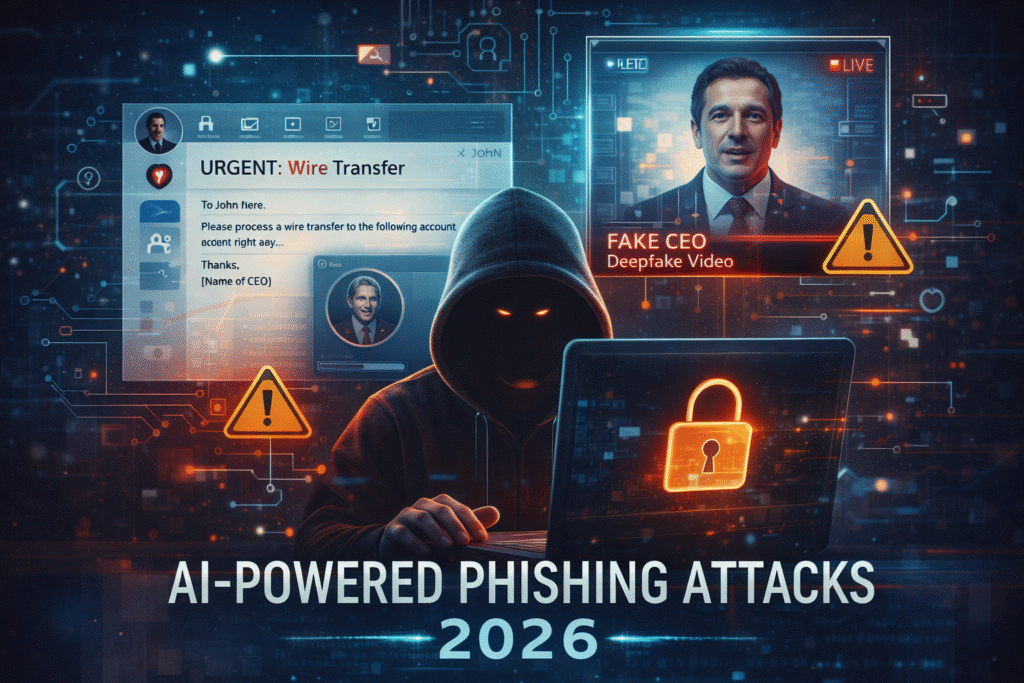
One of the most alarming developments in AI-powered phishing attacks is the use of deepfake technology.
Attackers can now:
- Clone executive voices
- Generate realistic video messages
- Impersonate trusted contacts in real time
Imagine receiving a phone call from your CEO asking for urgent action — except it’s not them. These attacks are already being used to authorize fraudulent payments, steal credentials, and manipulate employees.
How Attackers Target Businesses
AI-powered phishing attacks are especially dangerous for organizations because they target employees at every level.
Business Email Compromise (BEC)
Attackers impersonate executives or vendors to trick employees into sending money or sensitive data.
Credential Harvesting
Fake login pages powered by AI replicate real platforms like Google or Microsoft with near-perfect accuracy.
Supply Chain Attacks
Phishing campaigns target vendors and partners, creating a ripple effect across entire organizations.
Why Traditional Security Is Failing
Traditional email filters and security systems struggle to detect AI-powered phishing attacks because:
- Messages don’t match known attack patterns
- Content is unique and dynamically generated
- Language appears completely legitimate
This means organizations relying on outdated defenses are increasingly vulnerable.
How to Protect Against AI-Powered Phishing Attacks
1. Implement Zero Trust Security
Never assume any message is safe — verify everything.
2. Use Multi-Factor Authentication (MFA)
Even if credentials are stolen, MFA adds an extra layer of protection.
3. Train Employees Continuously
Human awareness is still one of the strongest defenses.
4. Deploy AI-Based Security Tools
Fight AI with AI — advanced detection systems can identify anomalies and suspicious behavior.
5. Verify Requests Independently
Always confirm sensitive requests through a second communication channel.
The Future of Phishing Is AI-Driven
AI-powered phishing attacks are not just a trend — they represent a fundamental shift in how cybercriminals operate. As AI technology continues to evolve, these attacks will become even more sophisticated, automated, and difficult to detect.
Organizations that fail to adapt will face increased risk, while those that embrace modern security strategies will be better positioned to defend against this new wave of threats.
Final Thoughts
AI-powered phishing attacks are exploding in 2026, and the stakes have never been higher. From deepfake impersonations to hyper-personalized email scams, attackers are using AI to outsmart traditional defenses.
The key to staying secure is awareness, adaptation, and proactive security measures. In this new era of cyber threats, understanding how AI is being weaponized is the first step toward staying protected.
Related
AI-generated code security risks