

Minnesota Water Cyberattacks Trigger New CISA Warning Over Internet-Exposed PLCs
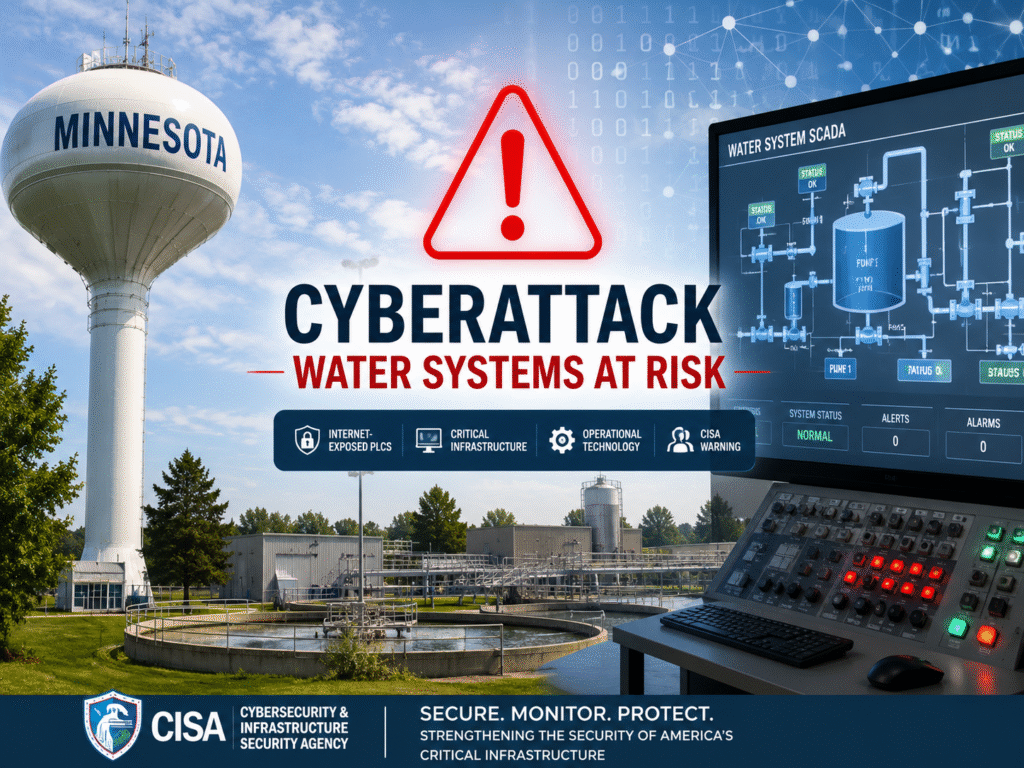
The recent Minnesota Water Cyberattacks have become another wake-up call for organizations responsible for operating America’s critical infrastructure. While there has been no indication that public drinking water was contaminated, the attacks disrupted operations at multiple municipal water facilities and prompted a new warning from the U.S. Cybersecurity and Infrastructure Security Agency (CISA) regarding internet-exposed programmable logic controllers (PLCs).
Water treatment facilities have long relied on industrial control systems to automate essential processes such as pumping, filtration, chemical treatment, and pressure management. These systems have helped utilities improve efficiency and reliability, but they have also created new cybersecurity challenges. As more operational technology becomes connected to corporate networks or the internet, attackers are finding new opportunities to exploit vulnerable devices.
Federal cybersecurity officials have repeatedly warned that operational technology is becoming a preferred target for both criminal groups and nation-state attackers. The incidents in Minnesota reinforce that warning and demonstrate why organizations responsible for critical services must continue strengthening their cybersecurity defenses.
What Happened in Minnesota?
Authorities reported that numerous municipal water systems across Minnesota experienced coordinated cyber incidents that affected operational technology used to manage water infrastructure. Although emergency procedures prevented any impact on water quality, several facilities temporarily shifted to manual operations while technical teams investigated the attacks and restored normal service.
The events attracted immediate attention from federal cybersecurity agencies because they highlighted how quickly attacks against operational technology can disrupt essential public services.
Unlike traditional cyberattacks that focus primarily on stealing data, attacks against industrial systems often seek to interrupt physical operations. Even a temporary disruption can require operators to activate emergency response plans, inspect equipment, and manually control processes until systems can be safely returned to normal operation.
Fortunately, the safeguards built into modern water treatment facilities prevented the incidents from becoming a public health emergency.
Why Water Utilities Are Increasingly Targeted
Water treatment facilities represent attractive targets because they provide services that communities depend on every day.
Even a brief interruption can create public concern, generate significant media attention, and force local governments to dedicate resources to incident response.
Many municipal utilities also face unique cybersecurity challenges. Smaller organizations often operate with limited budgets and small IT departments while maintaining equipment that may remain in service for decades. Some industrial devices were originally designed to operate in isolated environments and were never intended to be connected to modern networks.
As digital transformation continues across critical infrastructure, these legacy systems must now coexist with cloud services, remote monitoring platforms, and internet-connected management tools.
This combination of older operational technology and newer networking capabilities can introduce security gaps if systems are not properly configured and maintained.
Understanding Internet-Exposed PLCs
Programmable Logic Controllers, commonly known as PLCs, are specialized industrial computers responsible for controlling machinery and automated processes.
In water treatment facilities, PLCs regulate pumps, valves, chemical dosing equipment, storage tanks, and numerous other operational components.
These controllers are designed for reliability and continuous operation, but many were not originally built with modern cybersecurity threats in mind.
When PLCs become directly accessible from the internet without appropriate protections, attackers may attempt to identify vulnerable devices through automated scanning. Once discovered, poorly secured controllers can become entry points into operational environments.
This is one of the primary reasons CISA continues encouraging organizations to eliminate unnecessary internet exposure for industrial control systems.
Keeping operational technology isolated from public networks dramatically reduces the attack surface available to cybercriminals.
CISA’s Security Recommendations
Following the Minnesota incidents, federal cybersecurity officials reinforced several long-standing best practices for organizations operating critical infrastructure.
One of the most important recommendations is to remove direct internet access from operational technology whenever possible. Remote access should only occur through secure virtual private networks (VPNs), multi-factor authentication, and carefully monitored gateways.
Organizations should also:
- Maintain an accurate inventory of all operational technology assets.
- Regularly update firmware and software when security patches become available.
- Separate operational technology from traditional business networks.
- Continuously monitor industrial environments for unusual activity.
- Limit administrative privileges to authorized personnel.
- Develop and regularly test incident response plans.
These security controls significantly reduce the likelihood that attackers can gain unauthorized access to industrial systems.
The Growing Convergence of IT and Operational Technology
Historically, information technology (IT) and operational technology (OT) existed as separate environments.
Today, organizations increasingly integrate production systems with enterprise applications, cloud analytics, and remote management platforms to improve efficiency and reduce operating costs.
While this convergence creates valuable business opportunities, it also expands the potential attack surface.
An attacker who compromises a corporate workstation may attempt to move laterally into operational networks if adequate segmentation is not in place.
Modern cybersecurity strategies must therefore protect both business systems and industrial environments using a unified security approach.
Organizations should view operational technology as an essential component of their overall cybersecurity program rather than treating it as a separate responsibility.
Artificial Intelligence Is Changing Cyber Defense
Artificial intelligence is becoming an important tool for defending critical infrastructure.
Security platforms now use AI to analyze enormous volumes of network activity, identify suspicious behavior, and detect anomalies that traditional rule-based systems might overlook.
Instead of relying solely on predefined attack signatures, AI-powered security solutions continuously learn what normal industrial operations look like. When unexpected commands, unusual communications, or abnormal equipment behavior occur, security teams can receive alerts much faster than with conventional monitoring methods.
AI also assists incident response teams by correlating security events across multiple systems, helping analysts understand attacks more quickly and prioritize the most serious threats.
While attackers are also experimenting with artificial intelligence, defenders now have increasingly powerful technologies available to improve visibility across both IT and OT environments.
Lessons for Every Organization
The Minnesota Water Cyberattacks are not simply a concern for water utilities.
Every organization operating industrial control systems—including manufacturers, energy providers, transportation companies, healthcare organizations, and municipal governments—should view these incidents as an opportunity to evaluate their own security posture.
Cybersecurity is no longer limited to protecting databases and office computers.
It now includes safeguarding the operational systems responsible for delivering electricity, clean water, transportation, communications, and countless other services that communities depend upon every day.
Organizations that invest in network segmentation, continuous monitoring, employee training, and proactive vulnerability management will be significantly better prepared to respond when threats emerge.
Conclusion
The Minnesota Water Cyberattacks demonstrate that operational technology remains a high-value target for cybercriminals and nation-state actors alike. Although public safety was preserved through effective emergency procedures, the incidents illustrate how quickly attacks against industrial systems can disrupt essential services.
CISA’s renewed warning about internet-exposed PLCs should encourage every organization responsible for critical infrastructure to review its cybersecurity strategy, strengthen network protections, and reduce unnecessary exposure of industrial devices.
As digital transformation continues across critical infrastructure, cybersecurity must remain a continuous process rather than a one-time project. Organizations that combine strong operational practices with modern security technologies—including AI-powered threat detection—will be better positioned to defend the critical services that millions of people rely on every day.
Related Articles
- AI vs. Hackers: The Cybersecurity Arms Race in 2026
- The Silent Breach: Why AI-Powered Cyberattacks Are Becoming Impossible to Ignore
- AI Data Poisoning Is the Next Enterprise Cybersecurity Crisis
- AI Security Is Moving to the Endpoint — And CrowdStrike Sees It First