
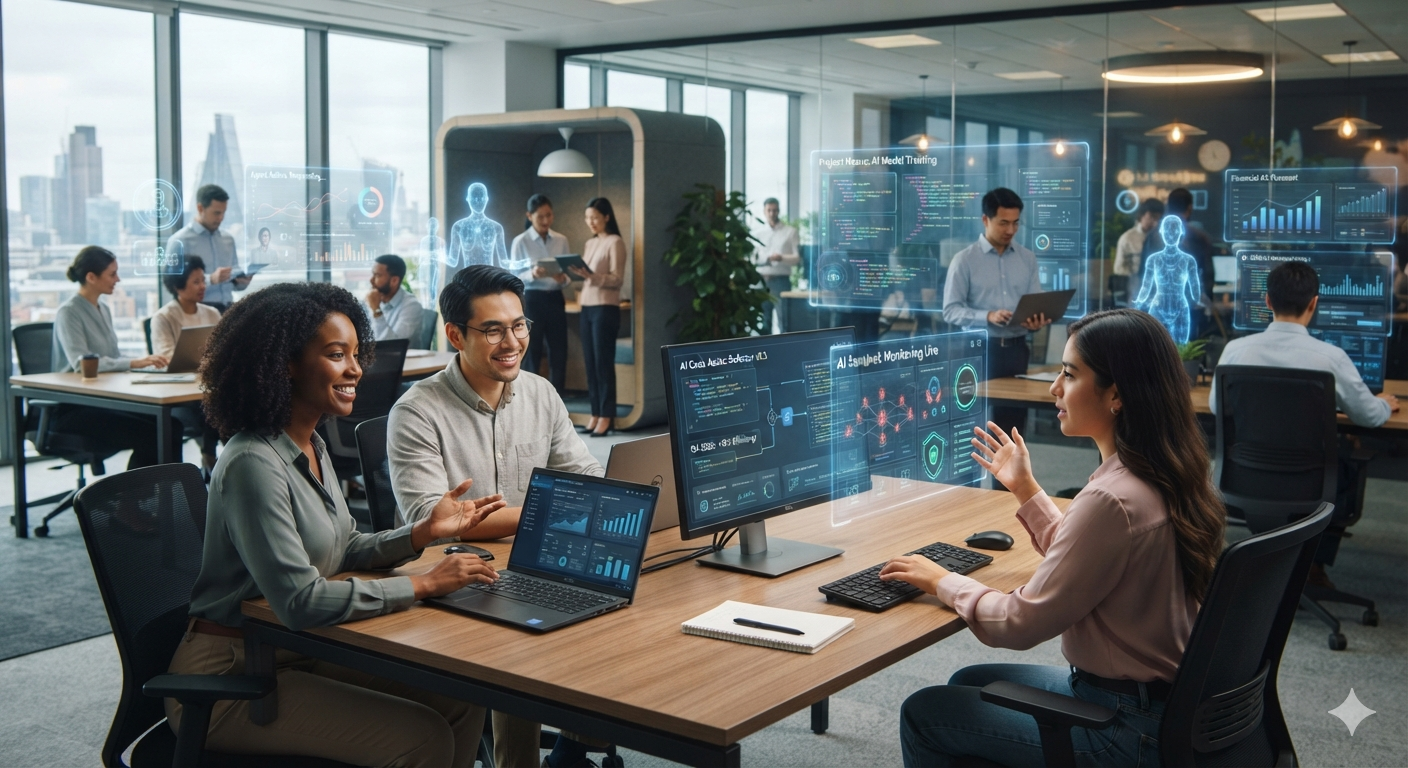
Synthetic Employees Are Here: How Digital Workers Are Transforming Business in 2026
For decades, automation promised to eliminate repetitive work while allowing employees to focus on creativity and innovation. Traditional automation tools delivered impressive gains, but they were limited by rigid workflows and predefined rules. They could only perform tasks exactly as they were programmed.
Artificial intelligence has fundamentally changed that equation.
Today’s digital workers are capable of understanding language, analyzing documents, writing software, researching information, making recommendations, interacting with enterprise systems, and collaborating with human employees. Unlike simple chatbots, these AI-powered workers continuously learn, adapt to new information, and perform increasingly sophisticated business functions.
Across every industry, organizations are beginning to deploy digital workers alongside their human workforce. Customer service departments use AI agents to resolve support tickets. Finance teams automate reporting and invoice processing. Developers rely on AI coding assistants to accelerate software delivery. Security teams investigate threats with autonomous AI analysts.
The enterprise workforce is expanding—not with additional employees, but with intelligent software capable of operating around the clock.
What Are Digital Workers?
Digital workers are AI-powered software agents that perform business tasks traditionally handled by people.
Unlike robotic process automation (RPA), which follows strict rules, digital workers understand context, interpret language, reason through problems, and interact with multiple applications simultaneously.
A modern digital worker can:
- Analyze emails
- Schedule meetings
- Write reports
- Generate presentations
- Create software code
- Review contracts
- Monitor cybersecurity alerts
- Process invoices
- Answer customer questions
- Coordinate business workflows
Many organizations now view digital workers as team members rather than software applications.
Why Businesses Are Investing in Digital Workers
Several factors are accelerating adoption.
Labor shortages
Many industries continue struggling to recruit experienced professionals. AI helps organizations maintain productivity without dramatically increasing hiring.
Rising operational costs
Digital workers reduce repetitive labor, improve efficiency, and lower operating expenses.
Growing data volumes
Organizations generate enormous amounts of information every day. AI excels at processing documents, emails, logs, and structured business data faster than humans.
Customer expectations
Customers expect instant responses, personalized experiences, and 24/7 support. Digital workers help companies meet those expectations.
Digital Workers Across Every Department
Customer Support
AI agents answer questions, troubleshoot problems, summarize conversations, escalate complex issues, and provide multilingual support.
Customers receive faster responses while human representatives focus on difficult cases.
Software Development
Developers increasingly use AI to:
- Generate code
- Write documentation
- Build test cases
- Identify bugs
- Explain legacy applications
- Review pull requests
Rather than replacing developers, digital workers significantly increase productivity.
Cybersecurity
Security teams face millions of alerts each year.
Digital workers help by:
- Investigating suspicious activity
- Correlating security events
- Prioritizing threats
- Recommending remediation
- Producing incident reports
AI dramatically reduces alert fatigue.
Human Resources
HR departments use digital workers for:
- Resume screening
- Candidate communications
- Benefits questions
- Employee onboarding
- Training recommendations
Recruiters spend more time evaluating people instead of paperwork.
Finance
Finance teams automate:
- Invoice approvals
- Expense reporting
- Financial summaries
- Forecasting
- Budget analysis
- Compliance documentation
Accuracy improves while processing time falls dramatically.
Human Employees Are Still Essential
One of the biggest misconceptions surrounding AI is that digital workers completely replace people.
In reality, most organizations are adopting a collaborative model.
Humans continue making strategic decisions, managing relationships, solving novel problems, and exercising judgment.
Digital workers perform repetitive, time-consuming tasks that previously consumed valuable employee hours.
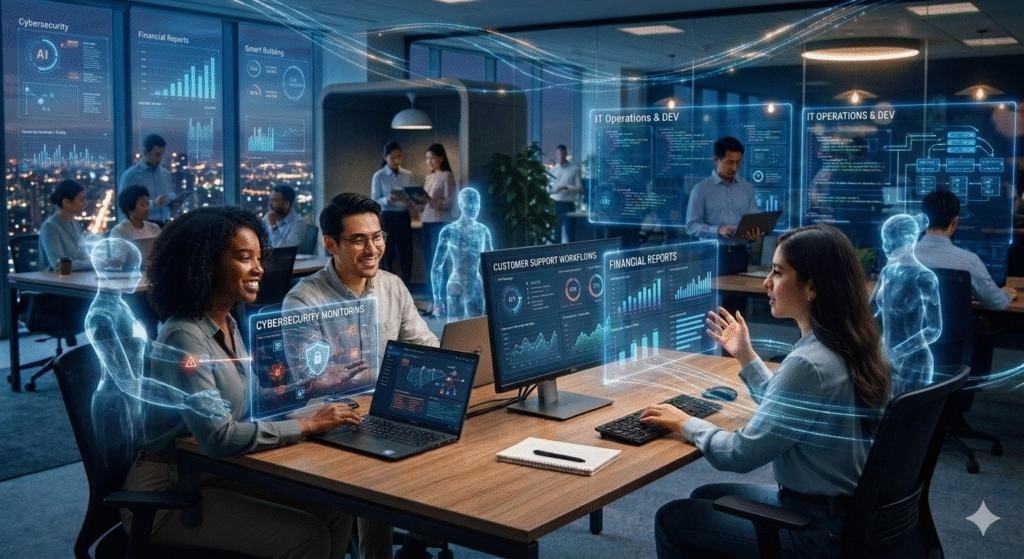
The result is a hybrid workforce where people and AI complement each other’s strengths.
The Technology Behind Digital Workers
Several technologies power today’s intelligent workforce.
These include:
- Large Language Models (LLMs)
- Machine Learning
- Natural Language Processing
- Knowledge Graphs
- Vector Databases
- Enterprise Search
- API Integrations
- Workflow Automation
- Cloud Computing
- Agentic AI Frameworks
Together, these technologies allow digital workers to interact naturally with business systems and users.
Challenges Businesses Must Address
Despite their advantages, digital workers introduce new risks.
Organizations must consider:
Security
AI systems require access to sensitive corporate information.
Strong identity management, encryption, and access controls are essential.
Governance
Businesses need clear policies governing AI decision-making, auditing, and compliance.
Accuracy
Generative AI can occasionally produce inaccurate responses.
Human oversight remains critical.
Privacy
Organizations must ensure confidential customer and employee information remains protected.
Measuring ROI
Companies adopting digital workers often report improvements in:
- Employee productivity
- Customer satisfaction
- Response times
- Operational efficiency
- Cost reduction
- Software delivery speed
- Incident resolution
- Revenue growth
While ROI varies, many organizations begin realizing measurable benefits within months.
What’s Next?
Digital workers are becoming increasingly autonomous.
Future generations will:
- Coordinate with other AI agents
- Execute complex business workflows
- Make limited operational decisions
- Manage projects
- Optimize supply chains
- Support executive decision-making
- Collaborate across departments
As reasoning models continue improving, digital workers will evolve from assistants into trusted enterprise collaborators.
Conclusion
The rise of digital workers represents one of the most significant shifts in business technology since the introduction of cloud computing.
Organizations that embrace AI responsibly can improve productivity, reduce operational costs, strengthen customer experiences, and empower employees to focus on higher-value work. Success, however, depends on balancing innovation with governance, security, and human oversight.
Rather than replacing people, digital workers are redefining how work gets done. Businesses that learn to integrate AI into their daily operations today will be better positioned to compete in an increasingly intelligent and automated future.