
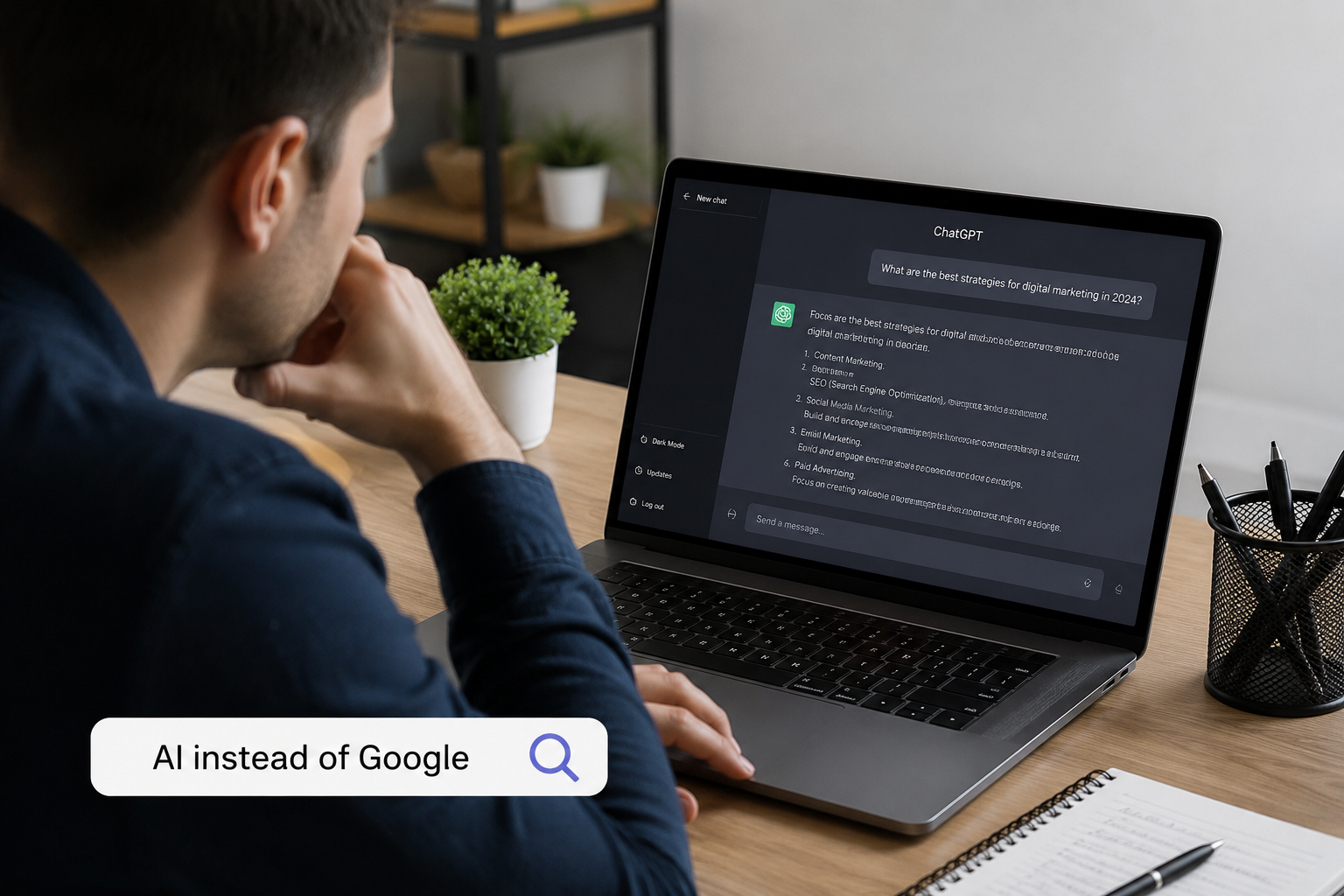
AI Instead of Google: Why the Shift Is Happening
AI instead of Google is becoming the new way millions of people search for information online. For more than two decades, Google has been the default gateway to the internet, but the rise of powerful artificial intelligence tools is changing that behavior. Instead of scrolling through pages of search results, users are increasingly turning to AI assistants for fast, conversational answers, personalized recommendations, and help with everything from writing emails to planning vacations. This shift is transforming how people discover information and redefining the future of online search.
The Shift From Search to Conversation
Google is built around links. You enter a query, and you get a list of blue links that may or may not contain the answer.
AI instead of Google, AI works differently.
Instead of returning pages, AI delivers answers.
Users can ask full questions, follow up naturally, and refine their request in real time without ever leaving the conversation.
For example:
- Google: You search, open multiple tabs, compare sources
- AI: You ask once and refine the answer instantly
This conversational model is one of the biggest reasons people are shifting away from traditional search.
Why Users Are Moving Away From Google
There are several key reasons behind this behavioral change.
1. Instant Answers Without Clicking Links
Modern users want speed.
Instead of scanning through ten websites, people now prefer a direct answer that summarizes everything in one place.
AI eliminates the need to click, scroll, and compare multiple sources manually.
2. Less SEO Noise, More Clarity
Search engines are heavily optimized for SEO. That means users often encounter:
- Sponsored content
- Clickbait articles
- SEO-optimized pages written for ranking, not clarity
AI reduces that noise by synthesizing information directly into a clean response.
3. Natural Language Understanding
AI tools understand how people actually speak.
Instead of typing keywords like:
“best VPN 2026 fast cheap”
Users can ask:
“What is the best affordable VPN for privacy and streaming in 2026?”
AI understands intent, not just keywords.
4. Follow-Up Questions
One of the biggest advantages of AI is context retention.
You can refine your question without starting over:
- “Explain it simply”
- “Give me an example”
- “Compare it to another option”
Google does not naturally support this kind of interactive learning experience.
The Rise of AI Search Engines
A new category of tools is emerging that blends search with AI reasoning.
Platforms like:
are redefining how information is delivered.
These systems don’t just index the web—they interpret it.
Instead of showing 10 links, they synthesize answers from multiple sources into one response.
This is especially powerful for:
- Research
- Coding
- Writing
- Learning new skills
- Business decision-making
More users are choosing AI instead of Google for everyday questions.
Why Google Is Still Powerful—but Changing
Google is not disappearing.
In fact, it is evolving into an AI-first company itself.
However, its core model is under pressure because:
- Users want fewer steps to answers
- Mobile users expect faster interactions
- Younger generations prefer chat-based interfaces
- AI tools reduce dependency on browsing multiple pages
Google is now integrating AI summaries directly into search results, signaling a shift toward hybrid search experiences.

What People Are Using AI For Instead of Google
The shift is not limited to technical users. Everyday people are adopting AI for practical tasks:
Learning and Education
Students use AI to:
- Explain complex topics
- Summarize textbooks
- Generate study guides
Work and Productivity
Professionals use AI to:
- Write emails
- Create reports
- Brainstorm ideas
- Analyze information
Shopping Decisions
Instead of searching reviews manually, users ask:
“What is the best laptop under $1000 for video editing?”
Travel Planning
AI can build entire itineraries in seconds based on preferences and budgets.
Health and General Knowledge
People ask AI to explain symptoms, concepts, or general guidance (non-medical diagnosis).
The Psychology Behind the Shift
The move from Google to AI is not just technological—it’s psychological.
Humans naturally prefer:
- Simplicity over complexity
- Conversation over navigation
- Answers over options
Google gives options.
AI gives answers.
That difference is driving adoption at scale.
Limitations of AI Compared to Google
Despite its advantages, AI is not perfect.
1. No Real-Time Web Indexing (in many cases)
Some AI tools do not always provide up-to-date information.
2. Source Transparency
Google shows sources directly. AI may summarize without clear attribution unless specified.
3. Hallucinations
AI can occasionally produce incorrect or overly confident answers.
4. Deep Research Still Requires Verification
For critical decisions, users still need to validate information.
Because of this, many users use both AI and Google together.
The Hybrid Future of Search
The future is not “AI vs Google.”
It is AI + Google.
Search is evolving into a layered experience:
- AI handles interpretation and summarization
- Search engines handle verification and source depth
- Users move between both depending on need
This hybrid model will likely dominate the next decade.
Final Thoughts
Millions of people are not abandoning Google entirely—but they are changing how they use it.
AI offers something search engines were never designed to provide: a direct conversation with knowledge.
As AI tools continue to improve, the gap between searching and thinking will continue to shrink.
We are moving from a world where people “search for answers” to a world where answers are generated instantly.
And that shift is only just beginning.
Releated articles
- AI IT Help Desk —
- AI Is Replacing the Corporate Intranet —
- AI Goes on the Offensive —
- Run at the Speed of Innovation