How AI Supply Chain Security Impacts Developers
AI supply chain security is quickly becoming one of the most critical challenges in modern software development. As AI-powered coding tools reshape how developers write, test, and deploy applications, they also introduce new risks that traditional security models struggle to address.
JFrog is stepping directly into this gap. With the launch of its new Cursor AI coding agent, the company is bringing enterprise-grade software supply chain security to a rapidly growing base of AI-driven developers—reportedly reaching over one million users.
This move signals a broader shift: security is no longer something that happens after code is written. It must now be embedded directly into the AI-driven development process itself.
The Rise of AI Coding Agents
AI coding assistants have evolved far beyond simple autocomplete tools. Platforms are now capable of generating entire functions, debugging complex systems, and even suggesting architectural decisions.
This transformation is accelerating productivity—but it also expands the attack surface.
Developers are increasingly relying on AI-generated code that may:
- Pull from unverified sources
- Introduce hidden vulnerabilities
- Include outdated or insecure dependencies
As explored in our coverage of AI-powered phishing attacks in 2026 attackers are already leveraging AI to scale malicious campaigns. The same principle applies to software development—automation amplifies both productivity and risk.
Why AI Supply Chain Security Matters Now
Traditional software supply chain security focuses on:
- Open-source dependencies
- Third-party libraries
- Build pipelines
But AI changes everything.
With AI-generated code:
- The origin of code becomes less transparent
- Trust boundaries become blurred
- Validation becomes more complex
This creates a new category of risk where vulnerabilities are introduced not by human developers, but by the tools they rely on.
AI supply chain security addresses this challenge by ensuring that every piece of generated code is:
- Verified
- Compliant
- Secure before deployment
JFrog’s Cursor AI Coding Agent: What It Does
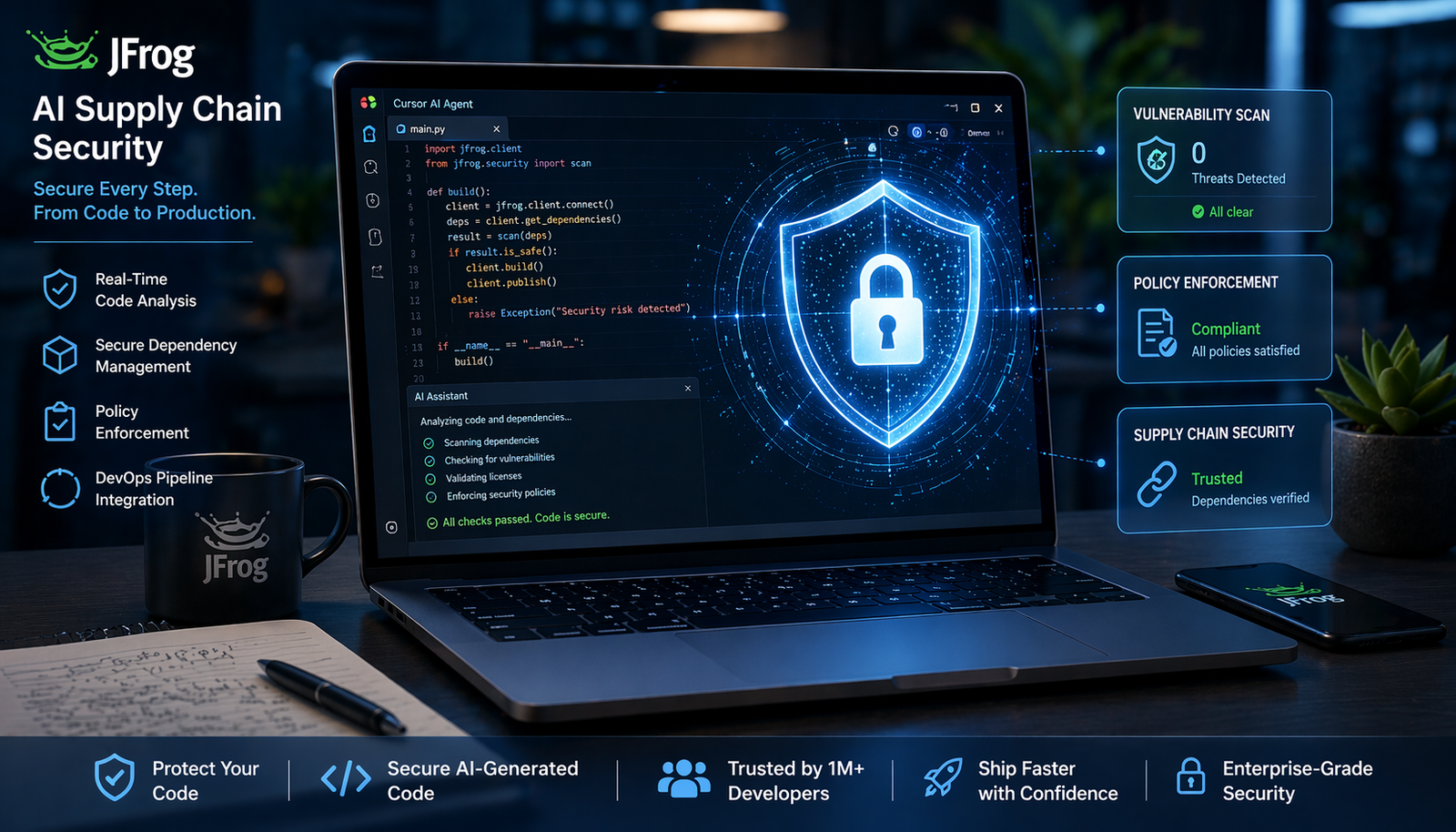
JFrog’s new Cursor AI coding agent is designed to bring security directly into the AI-assisted development workflow.
Instead of treating AI tools as external helpers, Cursor integrates security checks into the coding process itself.
Key capabilities include:
🔹 Real-Time Code Analysis
As developers generate or modify code, the system scans for:
- Vulnerabilities
- Misconfigurations
- Risky dependencies
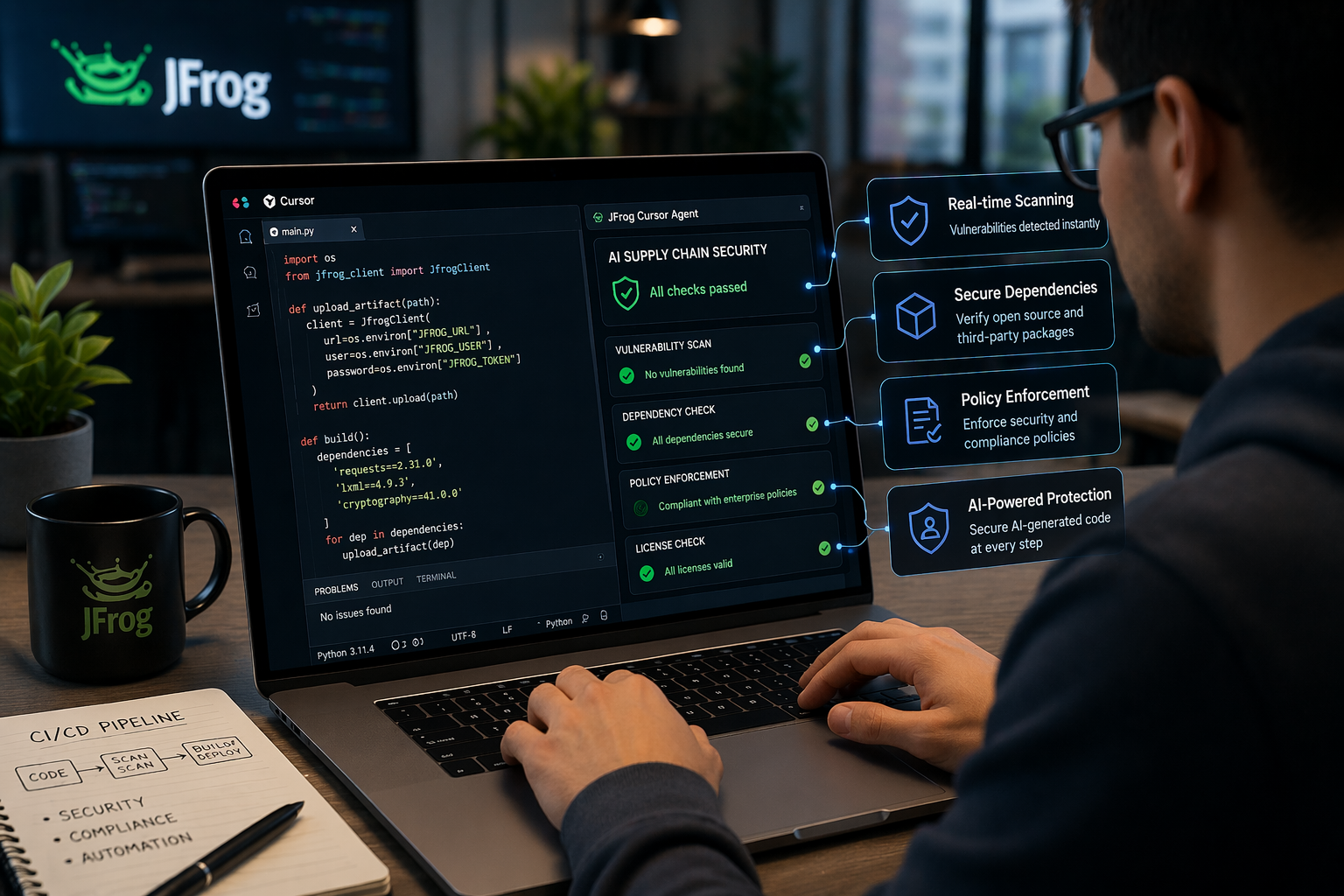
🔹 Secure Dependency Management
The agent evaluates libraries and packages in real time, ensuring that:
- Dependencies are up to date
- Known vulnerabilities are flagged immediately
🔹 Policy Enforcement
Organizations can enforce security policies automatically, ensuring that:
- Code meets compliance standards
- Risky patterns are blocked before deployment
🔹 Integration with DevOps Pipelines
Cursor doesn’t operate in isolation. It integrates with existing workflows, aligning with broader trends discussed in AI network deployments and infrastructure limits
Bringing Security to 1M+ Developers
One of the most significant aspects of this launch is scale.
JFrog is not targeting a niche audience—it’s aiming at a massive and growing developer base already using AI tools daily.
This matters because:
- AI adoption is accelerating rapidly
- Security practices are not keeping up
- Developers need built-in safeguards, not additional tools
By embedding security directly into the coding experience, JFrog is lowering the barrier to secure development.
The Shift Toward Embedded Security
This launch reflects a broader industry trend: security is moving left—deep into the development lifecycle.
Instead of:
- Scanning code after it’s written
- Fixing vulnerabilities post-deployment
Organizations are now:
- Preventing issues at the moment of creation
- Embedding controls into developer workflows
This approach aligns with the evolution of DevSecOps, where security becomes a shared responsibility across teams.
AI, Automation, and Risk Amplification
AI doesn’t just increase speed—it multiplies impact.
A single flawed prompt or insecure pattern can be replicated across thousands of lines of code in seconds.
This creates a new type of risk:
- Rapid vulnerability propagation
- Hard-to-trace code origins
- Increased dependency on automated outputs
As discussed in our analysis of AI infrastructure demand outpacing reality, the pace of AI adoption is outstripping the systems designed to manage it.
Security must evolve just as quickly.
What This Means for DevOps Teams
For DevOps and platform engineering teams, this shift introduces both challenges and opportunities.
Challenges:
- Managing AI-generated code at scale
- Ensuring compliance across automated workflows
- Maintaining visibility into code origins
Opportunities:
- Automating security checks
- Reducing manual review effort
- Accelerating secure deployments
Tools like JFrog’s Cursor agent help bridge this gap by embedding security directly into the tools developers already use.
The Future of AI Supply Chain Security
Looking ahead, AI supply chain security will become a foundational component of software development.
We can expect:
- Deeper integration between AI tools and security platforms
- More advanced real-time analysis
- Increased reliance on automated policy enforcement
The organizations that succeed will be those that treat security as part of the development process—not an afterthought.
Final Thoughts
AI supply chain security is no longer optional—it’s essential.
As AI coding agents continue to transform development workflows, the need for built-in, real-time security will only grow.
JFrog’s new Cursor AI coding agent is an early example of how the industry is responding. By embedding security directly into the development experience, it helps developers move faster without sacrificing safety.
The future of software development isn’t just AI-driven—it’s AI-secured.