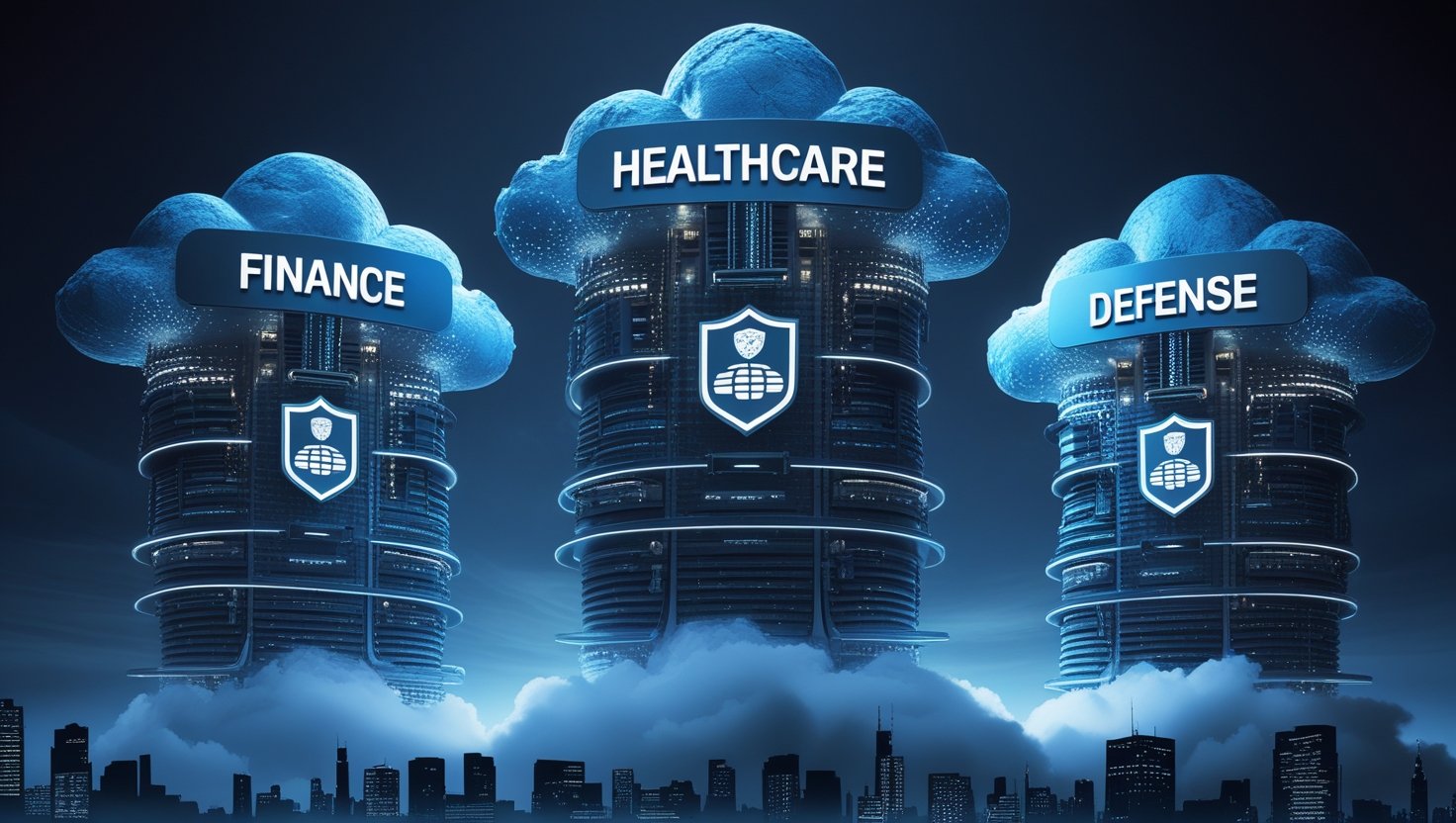
Cloud computing in 2025 is no longer just about scaling workloads or reducing on-prem costs. Today, enterprises are looking for specific outcomes—compliance, performance, and reliability tuned to their industry’s exact needs. That’s why a major shift is underway: from generalized infrastructure to vertical clouds.
Vertical clouds are industry-specific platforms designed to meet the unique demands of sectors like finance, healthcare, defense, manufacturing, and life sciences. They provide cloud-native services with regulatory alignment, custom APIs, and domain-focused integrations baked in.
Unlike horizontal platforms that try to serve everyone equally, vertical clouds are opinionated by design. They focus on the rules, regulations, latency thresholds, data types, and workloads that matter most to a given industry. And in 2025, adoption is accelerating.
🚀 What Are Vertical Clouds, Really?
A vertical cloud is a purpose-built cloud environment optimized for a specific industry’s use cases. That includes:
-
Pre-certified compliance (HIPAA, FedRAMP, PCI-DSS, GDPR, etc.)
-
Specialized APIs and workflows
-
Security and access models tailored to the field
-
Industry-aligned SLAs, monitoring, and auditing
-
Tooling and connectors for common sector platforms (e.g., EHRs, trading systems)
These aren’t just add-ons — they’re native components of the platform.
🏥 Key Drivers Behind the Rise of Vertical Clouds
1. Regulatory Pressure Is Constant—and Growing
Healthcare organizations must protect patient data (PHI), financial institutions must prove data integrity, and defense contractors need chain-of-custody for every byte. Vertical clouds build this into their DNA.
Instead of making customers piece together compliance from IAM policies, audit trails, and encryption layers, vertical clouds ship with certified, enforceable controls from day one.
2. Latency and Performance Demands Are Domain-Specific
A trading algorithm and a genomics pipeline don’t have the same tolerance for network jitter. A drone-control application and an MRI imaging service don’t need the same storage backend.
Vertical clouds provide performance-optimized architectures for these workloads—whether that’s ultra-low latency zones for finance, or data lake optimization for biotech research.
3. Security Requirements Are Not One-Size-Fits-All
Defense and aerospace organizations might require physically isolated zones or sovereign cloud instances. Healthcare organizations demand de-identified workflows for AI analysis. Financial platforms need real-time fraud detection pipelines.
Vertical clouds provide zero-trust frameworks and pre-built security policies designed around industry risks.
4. Tooling Must Match the Use Case
General-purpose cloud services like S3 and EC2 are powerful—but if you’re a hospital trying to manage DICOM medical imaging, you need something more targeted.
Vertical clouds offer:
-
Prebuilt connectors to EHRs or HL7 systems
-
Pipelines for genomics data
-
Real-time data engines tuned for trading and risk analytics
🛠 Examples of Vertical Cloud Use Cases
🏥 Healthcare Cloud
-
Native HIPAA-compliant storage and logging
-
De-identification and re-identification workflows for AI models
-
Support for medical imaging, HL7/FHIR integration
-
Built-in consent and audit systems
🛡 Defense Cloud
-
Isolated, air-gapped infrastructure
-
Multi-level security (MLS) for role-based access
-
Tamper-evident logs and secure mission data transport
-
Federated identity for classified/non-classified operations
💳 Finance Cloud
-
Co-location with exchanges and real-time data streams
-
PCI DSS and SOX compliance templates
-
AI for AML (anti-money laundering) and fraud detection
-
APIs for Know-Your-Customer (KYC) and transaction risk scoring
🏗️ Who’s Building Vertical Clouds?
The biggest players in tech are racing to go vertical:
-
AWS: Offers vertical solutions for healthcare, aerospace, manufacturing, and government (e.g., AWS HealthLake, AWS GovCloud)
-
Google Cloud: Retail Search, Bioinformatics APIs, Manufacturing Connect
-
Azure: Financial Services Cloud, Healthcare APIs, Confidential Computing for Government
-
Oracle Cloud: Deep Cerner integration for hospitals and patient management
-
Salesforce: Offers full-stack vertical CRMs for health, finance, education
-
IBM & Red Hat: Strong in regulated industries like telecom, finance, and public sector
Emerging players like NVIDIA, Dell, and HPE GreenLake are also customizing stacks for AI-heavy verticals.
💡 Benefits of Going Vertical
-
Speed to Compliance
No more duct-taping together policies — it’s built in. -
Faster Time to Value
Out-of-the-box integrations eliminate costly delays. -
Lower Operational Risk
Proven, validated templates reduce human error. -
Purpose-Built Performance
Designed for your workload, not a general use case. -
Competitive Differentiation
Vertical clouds help businesses meet standards others can’t, faster.
⚠️ What to Watch Out For
-
Vendor Lock-In
Specialized services may limit your flexibility. Choose vertical clouds that support open standards (e.g., Kubernetes, Terraform, HL7, FHIR). -
Less Customization
Some vertical platforms may not allow the same degree of infrastructure-level control as horizontal platforms. -
Tooling Maturity
Newer vertical solutions may still be developing key services or ecosystem support.
Final Thoughts: Specialization Is the Future of Cloud
Enterprises today don’t just want scale — they want solutions that understand the language, regulations, and nuances of their industry. That’s what vertical clouds offer: expertise built into infrastructure.
As organizations face pressure to innovate securely, prove compliance instantly, and differentiate through speed and specialization, vertical clouds are becoming not just strategic — but necessary.
In 2025, cloud is no longer a commodity. It’s a custom fit.