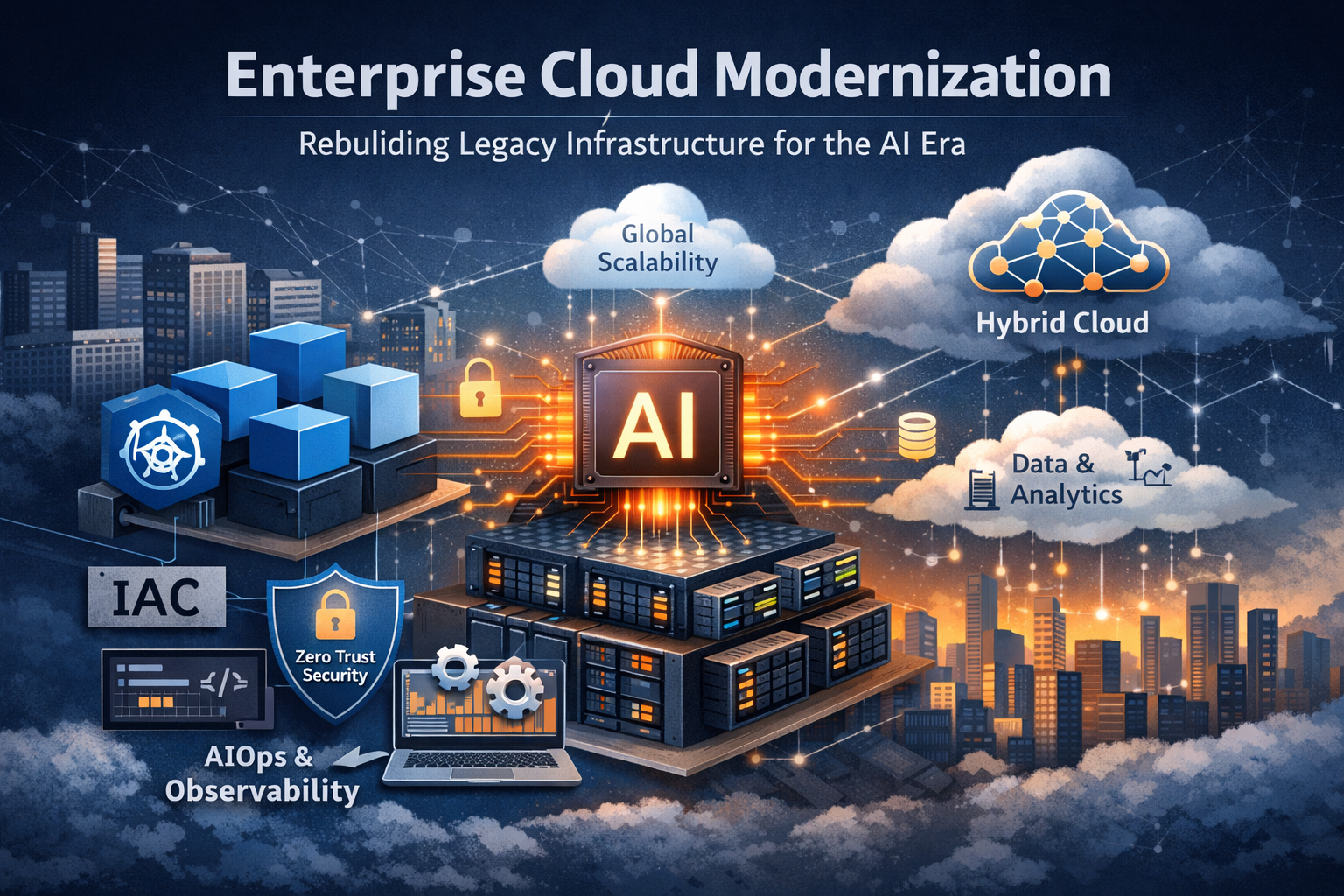
Enterprise cloud modernization is no longer a cost-efficiency initiative — it is a structural transformation required to compete in an AI-driven economy. Organizations that migrated to the cloud over the past decade often did so using lift-and-shift strategies, moving virtual machines from on-premises environments into IaaS platforms with minimal architectural change. While this reduced capital expenditures and improved elasticity, it preserved technical debt.
Today, that technical debt is colliding with the demands of artificial intelligence, real-time analytics, and cloud-native application development. Modernization is no longer about migration. It is about rebuilding foundational architecture to support scale, automation, and intelligent workloads.
Why Legacy Cloud Environments Are Breaking Under AI Pressure
Many enterprises operate hybrid environments that include:
-
VM-based workloads running in public cloud
-
Monolithic applications built for static infrastructure
-
Perimeter-based security controls
-
Manual operational workflows layered over automated platforms
These environments were never designed for GPU acceleration, distributed model training, or inference pipelines that scale elastically across regions.
AI workloads introduce unique requirements:
-
Massive parallel compute
-
High-throughput, low-latency storage
-
Dynamic scaling across global regions
-
Tight integration with data pipelines
Legacy cloud architectures struggle because they were optimized for stability and cost control — not intelligent compute elasticity.
The Four Structural Pillars of Cloud Modernization
1. Application Refactoring and Decomposition
Modernization begins at the application layer. Enterprises must move from monolithic architectures toward modular, service-oriented or microservices-based systems.
This allows:
-
Independent scaling of services
-
Faster feature releases
-
Improved resilience and fault isolation
-
Easier integration with AI services
Container orchestration platforms such as Kubernetes have become central to this transformation. By abstracting compute resources, enterprises gain portability across cloud providers and hybrid environments.
Without refactoring, AI integration becomes brittle and expensive.
2. Infrastructure as Code and Automation
Manual provisioning cannot scale in modern environments. Infrastructure must become programmable.
Infrastructure as Code (IaC) frameworks such as Terraform and native cloud templates allow enterprises to:
-
Version control infrastructure
-
Replicate environments consistently
-
Detect configuration drift
-
Enforce policy compliance automatically
When infrastructure is code, it becomes testable and auditable. This is essential in regulated industries where governance and compliance cannot be afterthoughts.
Automation reduces human error and enables rapid scaling during AI workload spikes.
3. Identity-Centric Security Architecture
Modernization also requires a fundamental security shift.
Traditional models relied on network perimeters. Cloud-native systems dissolve those perimeters. The new model centers around identity, access control, and zero-trust principles.
Modern security frameworks emphasize:
-
Least-privilege access
-
Continuous authentication
-
Micro-segmentation
-
Policy-as-code enforcement
-
Automated compliance validation
Security must be embedded in CI/CD pipelines rather than applied post-deployment. AI systems, especially those accessing sensitive enterprise data, demand tight access controls and continuous monitoring.
Modernization without security redesign creates amplified risk.
4. Observability and AIOps Integration
Modern cloud-native systems generate immense telemetry data. Distributed tracing, centralized logging, and real-time metrics are mandatory.
Enterprises must implement:
-
Unified observability platforms
-
AI-driven anomaly detection
-
Automated incident response
-
Cross-environment visibility
AIOps tools increasingly help organizations detect irregular infrastructure patterns before they cascade into outages.
Observability is no longer operational overhead — it is strategic risk mitigation.
AI as the Catalyst for Modernization
AI workloads are accelerating modernization timelines.
Training large models requires:
-
GPU clusters
-
Elastic storage backplanes
-
High-speed networking
-
Distributed processing
Inference workloads require:
-
Low-latency compute
-
Global edge deployment
-
Scalable API endpoints
Traditional VM-based systems cannot dynamically allocate GPU resources efficiently. Modern containerized GPU orchestration environments allow enterprises to scale AI workloads on demand.
Additionally, AI initiatives often require integration with existing enterprise systems, data lakes, and business applications. This integration is significantly easier within modular, API-driven architectures.
AI is not simply another workload class. It is reshaping how infrastructure must be designed.
Financial Realities of Modernization
Cloud modernization is not just technical — it is financial.
Enterprises that fail to modernize often experience:
-
Escalating cloud spend due to inefficient resource allocation
-
Increased operational overhead
-
Security incident remediation costs
-
Slower innovation cycles
Conversely, modernization enables:
-
Predictable scaling
-
Automated cost optimization
-
Better workload placement strategies
-
Improved ROI from AI initiatives
While modernization requires upfront investment in tooling, refactoring, and training, the long-term cost savings and innovation gains typically outweigh transitional expenses.
Organizational and Cultural Impact
Technology transformation requires cultural change.
Modernization often demands:
-
Cross-functional collaboration
-
DevSecOps integration
-
Platform engineering teams
-
Upskilling in containerization and automation
Enterprises that treat modernization as purely an IT project often fail. Executive sponsorship, governance alignment, and change management are essential components.
Cloud modernization is a business transformation initiative disguised as an infrastructure project.
The Strategic Imperative
The question facing enterprises is no longer whether to modernize — it is how quickly they can execute without destabilizing operations.
The most successful organizations adopt phased strategies:
-
Identify high-impact legacy systems
-
Refactor incrementally
-
Embed security and automation
-
Integrate AI workloads gradually
-
Measure outcomes continuously
This measured approach balances risk with acceleration.
Conclusion
Enterprise cloud modernization is the foundation for AI-driven innovation. Organizations that continue operating on legacy cloud architectures risk falling behind competitors that have embraced modular design, programmable infrastructure, identity-centric security, and intelligent observability.
Modernization is not migration.
It is reconstruction.
And in an era where AI capabilities increasingly define competitive advantage, the enterprises that rebuild their foundations today will lead tomorrow’s digital economy.