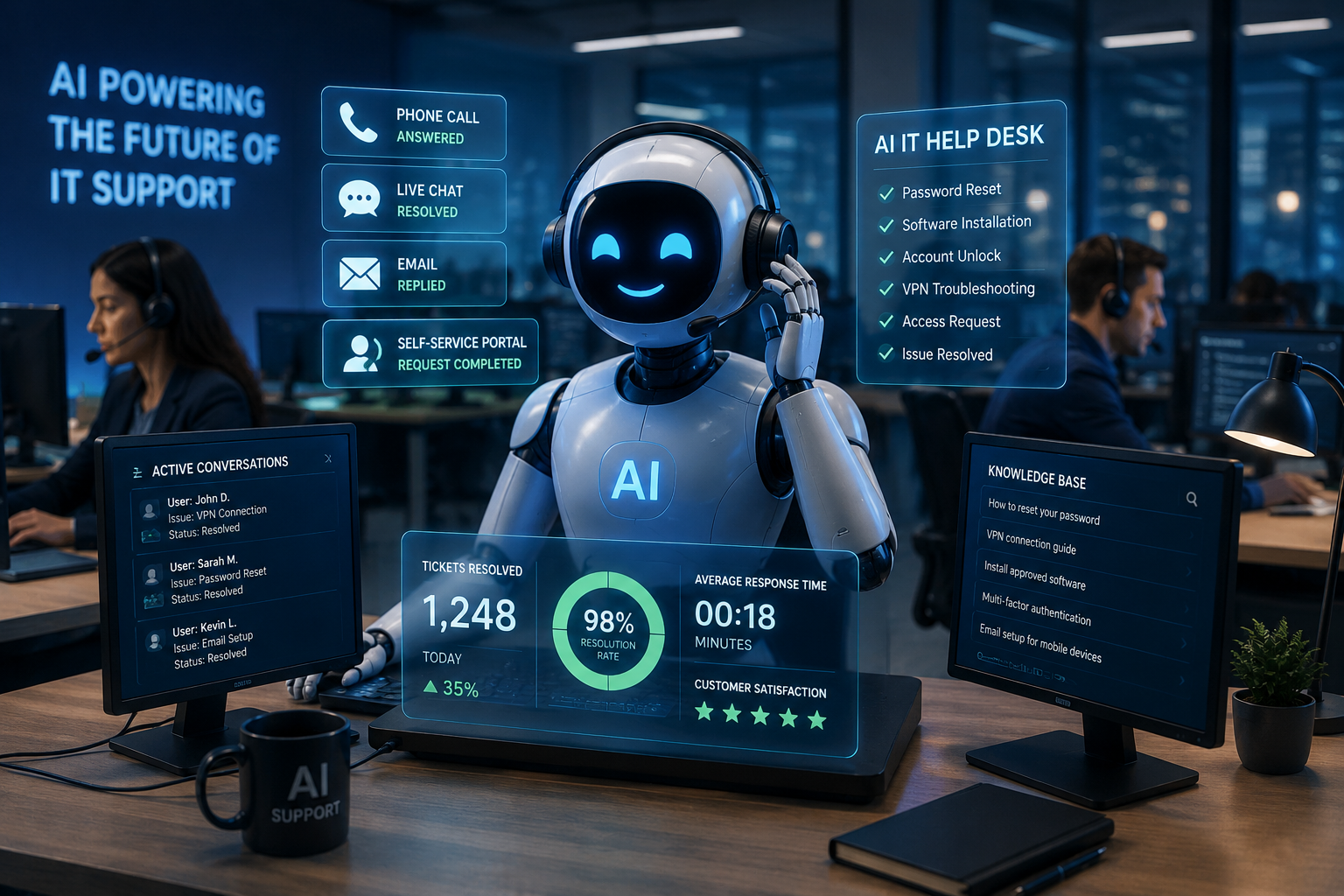
AI IT Help Desk Is Eliminating the Traditional Help Desk
For decades, the traditional IT help desk has been the first stop for employees experiencing technical problems. Whether resetting passwords, installing software, troubleshooting printers, or answering basic support questions, Tier 1 support teams have served as the backbone of enterprise IT operations. Today, however, artificial intelligence is fundamentally changing that model.
AI-powered assistants, conversational agents, autonomous workflows, and predictive analytics are rapidly replacing repetitive support tasks that once required human technicians. Instead of waiting in a queue for assistance, employees are increasingly interacting with intelligent AI systems capable of resolving issues within seconds. This transformation is not simply reducing costs—it is redefining how enterprise IT departments operate.
Organizations adopting AI-driven service management are discovering faster response times, improved employee satisfaction, and significantly lower operational expenses. While human expertise remains essential for complex engineering and infrastructure challenges, the traditional help desk is evolving into an AI-first support model.
The AI IT Help Desk is quickly becoming the standard model for enterprise support. Rather than relying entirely on human technicians to resolve every issue, organizations are using intelligent automation to answer employee questions, resolve incidents, reset passwords, and proactively identify infrastructure problems before they impact productivity.
The End of Manual Ticket Handling
One of the biggest inefficiencies in traditional IT support has always been ticket management. Employees submit requests through portals, email, chat systems, or phone calls before waiting for a technician to respond.
Artificial intelligence eliminates much of this workflow by immediately understanding natural language requests, identifying the problem, searching historical incidents, and recommending or executing the appropriate solution.
Modern AI service desk platforms can:
- Reset passwords automatically
- Unlock user accounts
- Provision software access
- Install approved applications
- Troubleshoot VPN connectivity
- Resolve email configuration issues
- Restart cloud resources
- Escalate only complex incidents to engineers
Instead of technicians spending hours resolving repetitive requests, AI handles routine work while human teams focus on higher-value projects.
From Reactive Support to Predictive IT
Traditional help desks react after users report problems. AI changes this approach by identifying issues before employees even notice them.
Using machine learning, infrastructure telemetry, endpoint monitoring, and historical performance data, AI can detect abnormal behavior across enterprise systems. Rather than waiting for servers, laptops, or applications to fail, predictive AI identifies warning signs and automatically begins remediation.
Examples include:
- Detecting failing hard drives
- Identifying memory leaks
- Recognizing abnormal login behavior
- Predicting storage shortages
- Monitoring network congestion
- Preventing cloud resource failures
This predictive approach dramatically reduces downtime while improving business continuity.
Conversational AI Is Becoming the New Help Desk
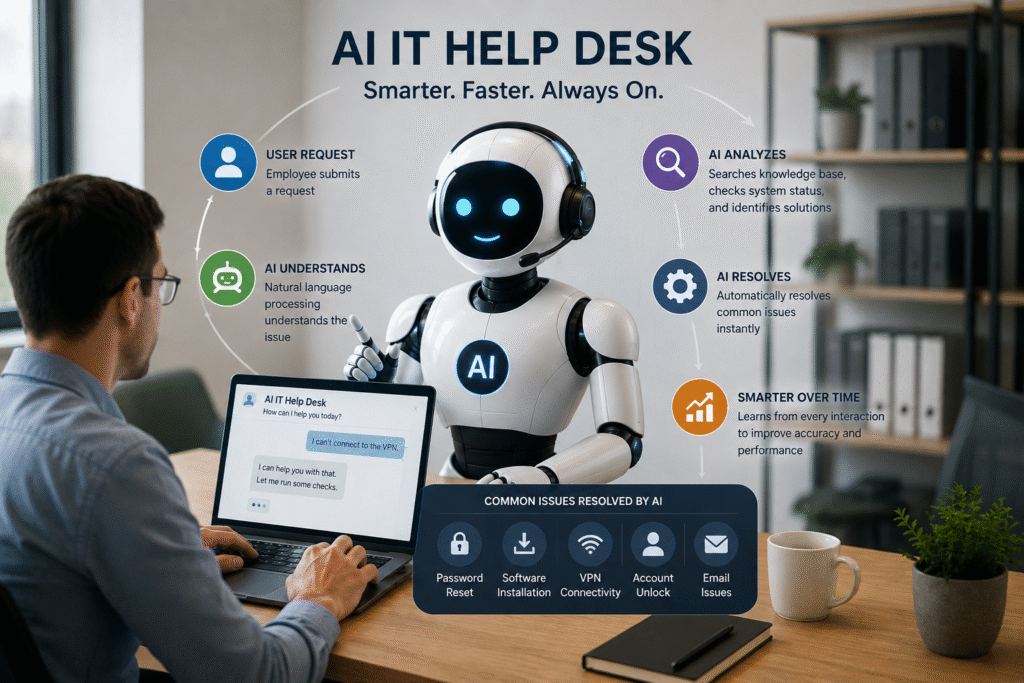
Employees increasingly expect IT support to operate like modern consumer AI assistants. Instead of opening tickets, users simply describe their problem using natural language.
An AI assistant understands context, searches enterprise knowledge bases, reviews device information, checks system status, and either resolves the issue automatically or routes it to the appropriate specialist.
These systems continuously improve by learning from millions of previous interactions, creating a support experience that becomes more accurate over time.
Large enterprises are integrating AI support directly into collaboration platforms, allowing employees to receive immediate assistance without leaving their daily workflow.
Reducing Enterprise IT Costs
Cost reduction remains one of the primary drivers behind AI adoption.
Large organizations often receive thousands of support requests every day. A significant percentage involve repetitive tasks requiring minimal technical expertise.
AI dramatically lowers operational costs by automating these common requests while enabling experienced engineers to focus on cybersecurity, infrastructure modernization, cloud optimization, and digital transformation initiatives.
Industry analysts estimate AI automation could eliminate millions of repetitive IT support interactions annually across global enterprises.
Security Benefits of AI Support
Artificial intelligence is also improving enterprise security.
Every help desk interaction involves identity verification, permissions, device information, and access controls. AI can continuously validate user identity while detecting suspicious behavior that might indicate compromised accounts.
Examples include:
- Impossible travel detection
- Abnormal login locations
- Unusual privilege requests
- Unauthorized software installations
- Suspicious endpoint activity
By combining IT support with intelligent security monitoring, organizations reduce both operational workload and cyber risk.
An AI IT Help Desk enables organizations to support thousands of employees without dramatically increasing IT staffing. By automating repetitive requests, enterprises improve response times while lowering operational costs and allowing technical teams to focus on strategic initiatives.
The Human Role Isn’t Disappearing
Although AI is eliminating many traditional help desk responsibilities, it is not eliminating IT professionals.
Instead, enterprise IT teams are shifting toward more strategic roles involving:
- AI governance
- Cloud architecture
- Platform engineering
- Infrastructure automation
- Cybersecurity
- Data engineering
- AI operations (AIOps)
Human expertise remains essential when solving complex infrastructure failures, designing enterprise architecture, responding to sophisticated cyberattacks, and managing large-scale digital transformation initiatives.
The future workforce will spend less time resetting passwords and more time building intelligent systems.
Challenges Enterprises Must Address
Organizations adopting AI support platforms must also address several important challenges.
- Protecting employee privacy
- Preventing inaccurate AI responses
- Maintaining compliance requirements
- Securing enterprise knowledge bases
- Avoiding automation bias
- Ensuring human oversight for critical decisions
Successful implementations combine automation with governance, transparency, and continuous monitoring.
The Future of Enterprise IT Support
The traditional IT help desk is evolving into an intelligent, autonomous service platform capable of resolving most employee requests without human intervention. AI is transforming enterprise support from a reactive cost center into a proactive business capability that improves productivity, strengthens security, and reduces operational expenses.
As organizations continue investing in AI-powered service management, the role of IT professionals will increasingly focus on innovation rather than routine support. Enterprises that embrace this transition will be better positioned to scale operations, improve employee experiences, and compete in an increasingly AI-driven business landscape.
Conclusion
AI IT Help Desk technology represents one of the most significant transformations in enterprise IT operations. The companies that successfully combine AI automation with skilled IT professionals will define the next generation of enterprise technology support.
Related Articles
- AI Employees Are Arriving: The Rise of the Digital Workforce
- AI in DevOps: An Enterprise Reality Check
- AI Agents Are Replacing SaaS
- The Agentic Web: AI Agents Are Becoming Internet Users
External Resources
“`