
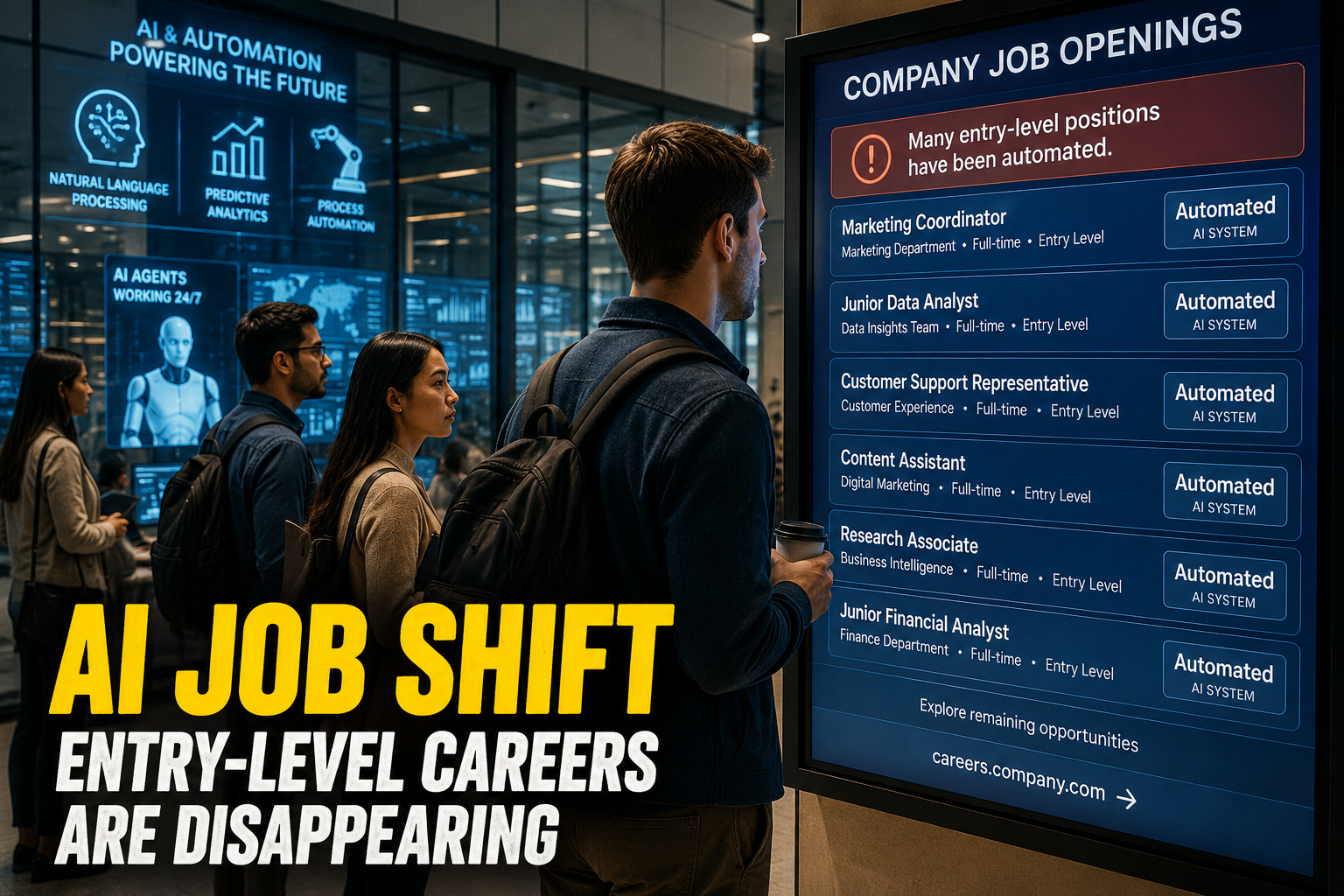
AI Job Shift: Entry-Level Careers Are Disappearing in 2026
For generations, entry-level jobs have served as the foundation of career development. Whether in customer service, marketing, finance, technology, or administration, these positions provided new workers with an opportunity to gain practical experience, learn workplace dynamics, and develop skills that would eventually lead to more advanced roles. In 2026, however, the traditional career ladder is beginning to change dramatically.
The AI Job Shift is transforming the workforce as artificial intelligence systems increasingly automate tasks that were once assigned to junior employees. From answering customer questions and generating reports to writing software code and conducting research, AI is now capable of performing many responsibilities that historically belonged to entry-level workers. While organizations are benefiting from improved efficiency and lower operational costs, the long-term implications for the workforce are becoming impossible to ignore.
Businesses around the world are embracing AI at a pace few predicted just a few years ago. According to McKinsey’s State of AI research, organizations continue to expand their AI investments as the technology demonstrates measurable gains in productivity and operational performance. At the same time, workers are beginning to feel the impact as automation changes hiring strategies across multiple industries.
The Traditional Career Ladder Is Changing
For decades, companies relied on entry-level positions as a way to identify and develop future talent. Junior employees learned directly from experienced colleagues while gaining valuable knowledge about business operations. These roles often served as stepping stones toward management positions, specialized technical careers, and leadership opportunities.
Today, many of those foundational responsibilities can be completed by AI systems in seconds. Tasks such as data entry, document summarization, scheduling, research, content drafting, and basic customer interactions are increasingly being handled by software rather than newly hired workers.
This shift is creating a fundamental question for employers: If AI performs entry-level work, how will organizations develop the next generation of experienced professionals?
Why Companies Are Accelerating AI Adoption
The answer is simple: economics. Organizations face constant pressure to improve efficiency, reduce costs, and remain competitive. Artificial intelligence offers businesses the ability to accomplish more work with fewer resources.
The AI Job Shift is accelerating because organizations can now automate many tasks that were traditionally assigned to entry-level workers. As AI systems become more capable, companies are reevaluating hiring strategies and workforce planning.
Modern AI systems can operate around the clock, analyze massive amounts of information, and complete repetitive tasks with remarkable speed. Customer support chatbots can answer thousands of inquiries simultaneously. AI-powered marketing tools can generate campaign ideas, create content drafts, and analyze performance metrics. Software development teams increasingly use AI coding assistants to accelerate programming tasks.
According to research from Gartner, AI-driven automation remains one of the top strategic priorities for enterprises seeking productivity gains and operational efficiency.
For executives, the business case is compelling. For workers entering the job market, the picture is more complicated.
Industries Facing the Greatest Disruption
While AI is impacting nearly every sector, some industries are experiencing particularly rapid changes.
Customer Service
AI chatbots and virtual assistants are handling an increasing percentage of customer interactions. Many routine support requests can now be resolved without human intervention, reducing demand for large teams of entry-level representatives.
Marketing
Generative AI tools can create blog outlines, advertising copy, social media content, and market research summaries in minutes. Tasks once assigned to junior marketing professionals are increasingly automated.
Finance
AI systems can analyze financial data, generate reports, detect anomalies, and assist with forecasting. Many administrative and research-oriented responsibilities traditionally performed by entry-level analysts are becoming automated.
Software Development
AI coding assistants are helping developers write, review, and debug software faster than ever. While experienced engineers remain essential, many basic programming tasks are no longer as labor-intensive as they once were.
Human Resources
Recruiting platforms now use AI to screen resumes, evaluate candidates, schedule interviews, and generate communications, reducing the need for certain administrative HR functions.
The Emerging Experience Gap
One of the most significant challenges created by the AI Job Shift is what many experts describe as the “experience gap.”
Organizations still need future managers, architects, engineers, analysts, and executives. Traditionally, these professionals gained knowledge by starting in junior positions and gradually expanding their responsibilities over time.
One of the biggest concerns surrounding the AI Job Shift is how future professionals will gain practical experience if fewer entry-level opportunities are available. Many business leaders worry that today’s automation decisions could create tomorrow’s talent shortages.
If fewer entry-level opportunities exist, companies may eventually face shortages of experienced talent. The workforce pipeline that has historically produced skilled professionals could become significantly smaller.
This concern has led some business leaders to question whether excessive automation could create long-term talent development challenges even while delivering short-term productivity gains.
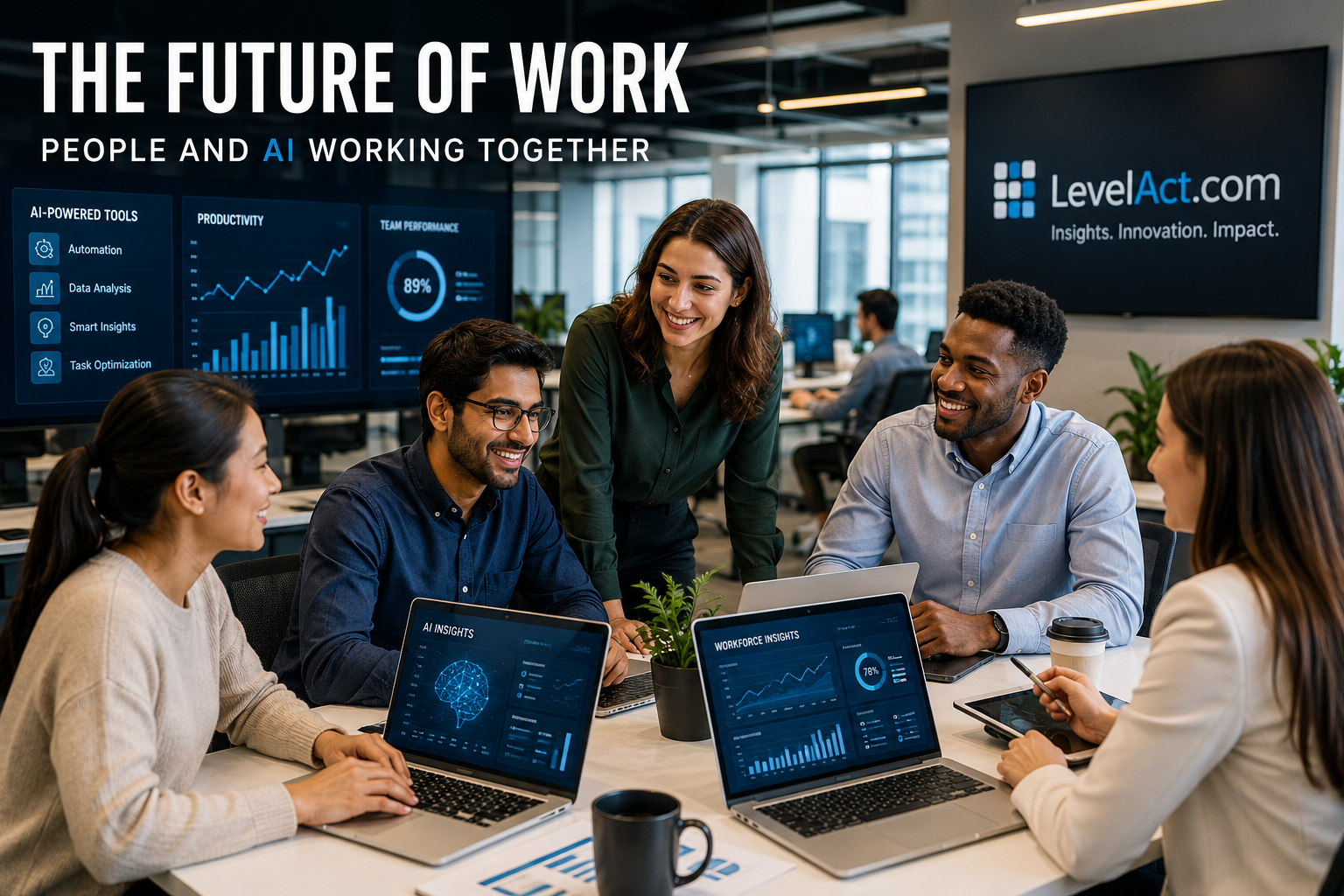
Jobs That Still Require Human Judgment
Despite rapid advances in AI, many roles continue to depend heavily on human skills that technology cannot easily replicate.
- Leadership and team management
- Strategic decision making
- Complex negotiations
- Relationship building
- Creative problem solving
- Healthcare and patient care
- Skilled trades and field services
- High-level consulting and advisory roles
These positions require emotional intelligence, contextual understanding, ethics, and interpersonal communication—areas where humans continue to hold a significant advantage.
How Workers Can Adapt
The rise of AI does not mean workers are becoming obsolete. Instead, the skills required for career success are evolving.
Professionals entering the workforce should focus on developing capabilities that complement AI rather than compete directly against it.
- AI literacy and prompt engineering
- Data analysis and interpretation
- Communication and presentation skills
- Project management
- Industry-specific expertise
- Critical thinking and problem solving
- Leadership and collaboration
Workers who understand how to leverage AI tools effectively may find themselves more valuable than those who avoid the technology altogether.
Research from The World Economic Forum suggests that while some jobs will disappear, many new roles will emerge as organizations adapt to increasingly AI-driven operations.
The Future Workforce Will Look Different
The AI Job Shift represents one of the most significant transformations in the modern labor market. Organizations are gaining unprecedented efficiency through automation, but they are also redefining how careers begin and evolve.
The future workforce will likely require new training models, new educational approaches, and new pathways for developing professional experience. Companies may need to create alternative methods for cultivating talent as traditional entry-level opportunities become less common.
Rather than eliminating work entirely, AI is changing the nature of work itself. The challenge for businesses, educators, and workers will be adapting quickly enough to ensure that opportunity remains accessible in an increasingly automated economy.
Conclusion
The AI Job Shift is no longer a future prediction—it is already underway. As artificial intelligence continues to automate tasks across customer service, marketing, finance, software development, and other industries, entry-level careers are becoming harder to find. While businesses benefit from greater productivity, the workforce faces new questions about experience, career development, and long-term opportunity. Organizations that successfully balance automation with human talent development will be best positioned to thrive in the next era of work.
Sources:
- McKinsey – The State of AI
- Gartner – Strategic Technology Trends
- World Economic Forum – Future of Jobs Report

- AI Agents Are Replacing SaaS: The Next Enterprise Software Revolution
- People vs Technology: Why Human Talent Will Always Win
- AI Accountability: Who’s Responsible When AI Fails in 2026?
- AI in DevOps: An Enterprise Reality Check
- The Agentic Web: AI Agents Are Becoming Internet Users
- The Future of Agentic Software Delivery: Unifying Source & Binaries