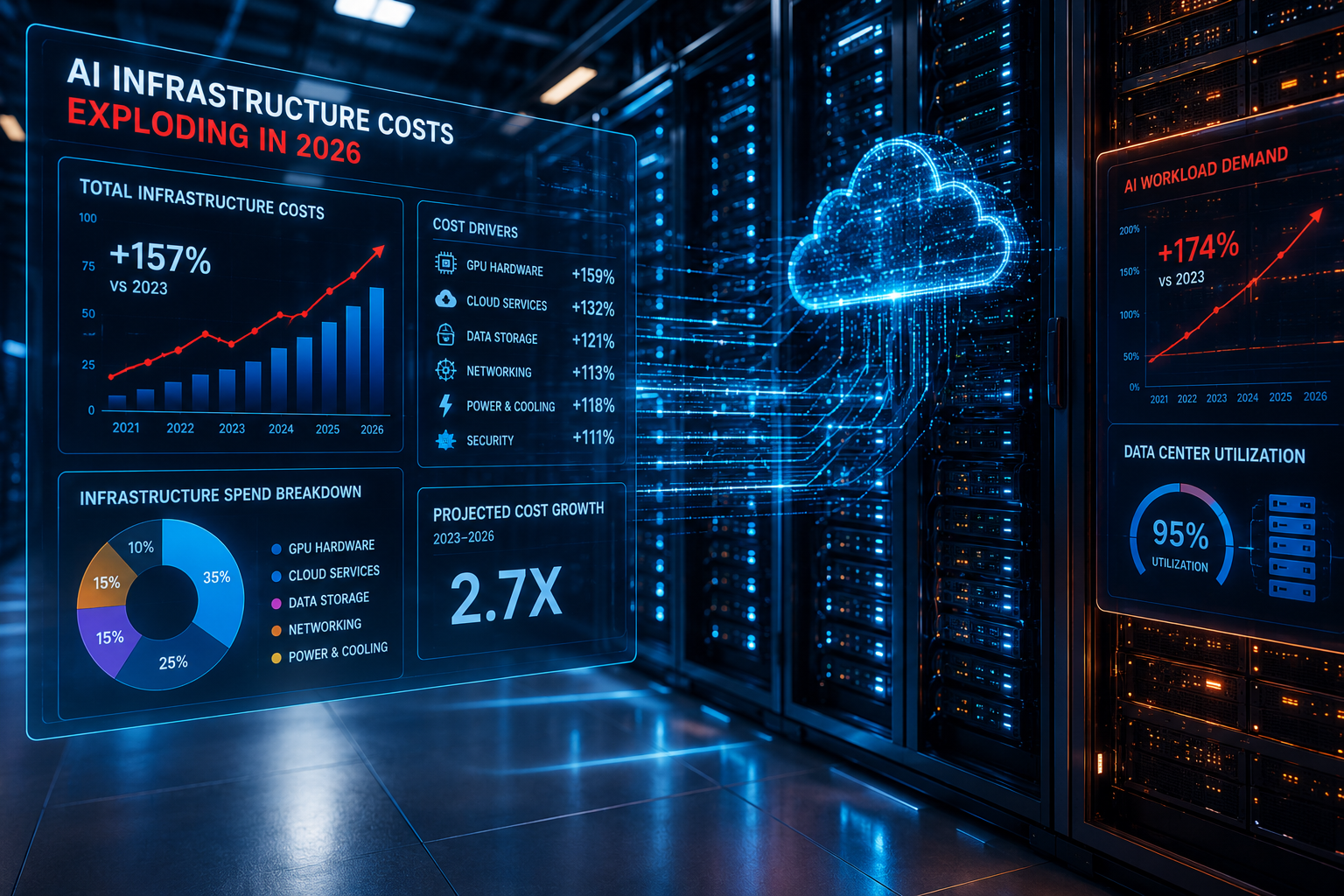
AI Infrastructure Costs Are Exploding in 2026
AI infrastructure costs are becoming one of the biggest challenges facing enterprise technology leaders in 2026. While artificial intelligence continues to drive innovation across industries, organizations are discovering that deploying and maintaining AI systems requires far greater investment than many initially anticipated.
From AI-ready data centers and GPU clusters to advanced networking equipment, cloud services, storage platforms, and security controls, the cost of supporting modern AI workloads is increasing at an unprecedented rate. As enterprises race to deploy generative AI, machine learning, and autonomous agents, many are facing difficult questions about return on investment and long-term sustainability.
The Rising Cost of Enterprise AI
The rapid growth of artificial intelligence has triggered a global infrastructure spending boom. Organizations are investing heavily in new hardware, cloud resources, networking upgrades, and specialized software platforms designed to support AI workloads.
Many enterprises that initially experimented with AI through small pilot programs are now attempting to scale those projects across multiple departments and business units. As a result, infrastructure requirements are growing dramatically.
Companies are purchasing expensive GPU resources, expanding storage capacity, increasing network bandwidth, and redesigning data center environments to accommodate AI processing demands.
This trend is closely connected to the growing demand for AI-Native Data Centers: The Future of AI Infrastructure, where facilities are being specifically designed to support next-generation AI applications.
Why AI Infrastructure Costs Keep Rising
Unlike traditional business applications, AI systems consume massive amounts of computing power. Large language models, generative AI platforms, and machine learning workloads require significant processing resources to train, deploy, and maintain.
Several factors are driving AI infrastructure costs higher:
- High-performance GPU requirements
- Advanced cooling systems for AI hardware
- Increased energy consumption
- Massive data storage requirements
- Specialized networking infrastructure
- Enhanced cybersecurity controls
- Cloud AI service expenses
As AI deployments expand, these costs often grow much faster than expected.
The Hidden Cost of AI Networking
One area that is frequently overlooked is networking. AI workloads move enormous amounts of data between storage systems, compute resources, and distributed environments.
Many organizations discover that networking infrastructure becomes a major bottleneck as AI projects scale.
Modern AI clusters require low-latency, high-bandwidth connectivity capable of supporting continuous data movement. Without these upgrades, even expensive AI hardware can sit idle waiting for data.
Our analysis of AI Networking Bottlenecks explains why networking is rapidly becoming one of the most critical components of successful AI deployments.
Private AI Clouds Are Gaining Momentum
To control escalating expenses, many enterprises are reevaluating their cloud strategies.
While public cloud platforms offer flexibility and rapid deployment, long-term AI workloads can become extremely expensive when running continuously in cloud environments.
As a result, organizations are increasingly exploring private AI infrastructure and hybrid cloud models.
Private AI environments provide several potential benefits:
- Predictable infrastructure costs
- Improved security and compliance
- Greater control over sensitive data
- Reduced dependence on cloud vendors
- Long-term cost optimization
This shift is discussed in greater detail in AI Infrastructure Wars: Why Enterprises Are Building Private AI Clouds.
Power and Cooling Challenges
AI infrastructure costs are not limited to servers and software. Organizations must also address significant power and cooling requirements.
Modern AI hardware consumes substantially more electricity than traditional enterprise workloads. Data centers supporting AI environments often require upgraded power systems, advanced cooling technologies, and expanded facility capacity.
These operational expenses can dramatically increase the total cost of AI ownership.
Many enterprises are now realizing that power availability and cooling efficiency may become larger constraints than computing hardware itself.
AI Security Spending Is Increasing
As AI adoption grows, security spending is rising alongside infrastructure investments.
Organizations must protect AI models, training data, inference environments, APIs, and proprietary information from emerging threats.
Security leaders are becoming increasingly concerned about attacks targeting AI systems, including model manipulation, prompt injection, and malicious training data.
The growing threat landscape is explored in AI Data Poisoning Is the Next Enterprise Cybersecurity Crisis.
Protecting AI environments requires additional investments in monitoring, governance, security tools, and skilled personnel.
The ROI Question Facing Every Enterprise
Perhaps the biggest concern surrounding AI infrastructure costs is whether organizations are achieving measurable business value.
Many enterprises continue to increase spending despite struggling to demonstrate clear returns from AI initiatives.
Technology leaders are under growing pressure to justify investments by connecting AI projects to business outcomes such as:
- Revenue growth
- Operational efficiency
- Customer experience improvements
- Faster software delivery
- Reduced costs
- Competitive differentiation
Organizations that fail to establish clear performance metrics often find themselves investing heavily in infrastructure without achieving meaningful results.
The Future of AI Infrastructure Costs
AI infrastructure costs are expected to continue rising throughout 2026 as enterprises expand deployments and AI workloads become more sophisticated.
However, successful organizations will focus not only on infrastructure investments but also on governance, security, operational efficiency, and measurable business outcomes.
Artificial intelligence remains one of the most transformative technologies in enterprise IT, but controlling AI infrastructure costs will become a defining challenge for technology leaders over the next several years.
The companies that successfully balance innovation with cost management will be best positioned to capture the full value of AI while maintaining sustainable growth.