OpenChoreo 1.0 Kubernetes Is Redefining Developer Platforms
OpenChoreo 1.0 Kubernetes is changing how modern developer platforms operate by combining AI agents with GitOps automation.
With the introduction of AI agents and deeply integrated GitOps workflows, OpenChoreo 1.0 isn’t just another platform—it represents a shift toward intelligent, self-operating cloud-native environments. This release signals a broader transformation happening across DevOps, where automation is no longer just scripted—it’s adaptive, context-aware, and increasingly autonomous.
OpenChoreo 1.0 Kubernetes Platform Explained
Kubernetes has become the backbone of modern infrastructure. But as adoption grows, so does the operational burden.
Teams are dealing with:
- Fragmented toolchains
- Complex CI/CD pipelines
- Manual configuration management
- Limited visibility across environments
Even with GitOps in place, many organizations still struggle to fully automate deployments without introducing risk or bottlenecks.
The reality is simple: Kubernetes is powerful—but it’s not simple. And that’s exactly what OpenChoreo 1.0 aims to fix.

Introducing OpenChoreo 1.0: A Smarter Developer Platform
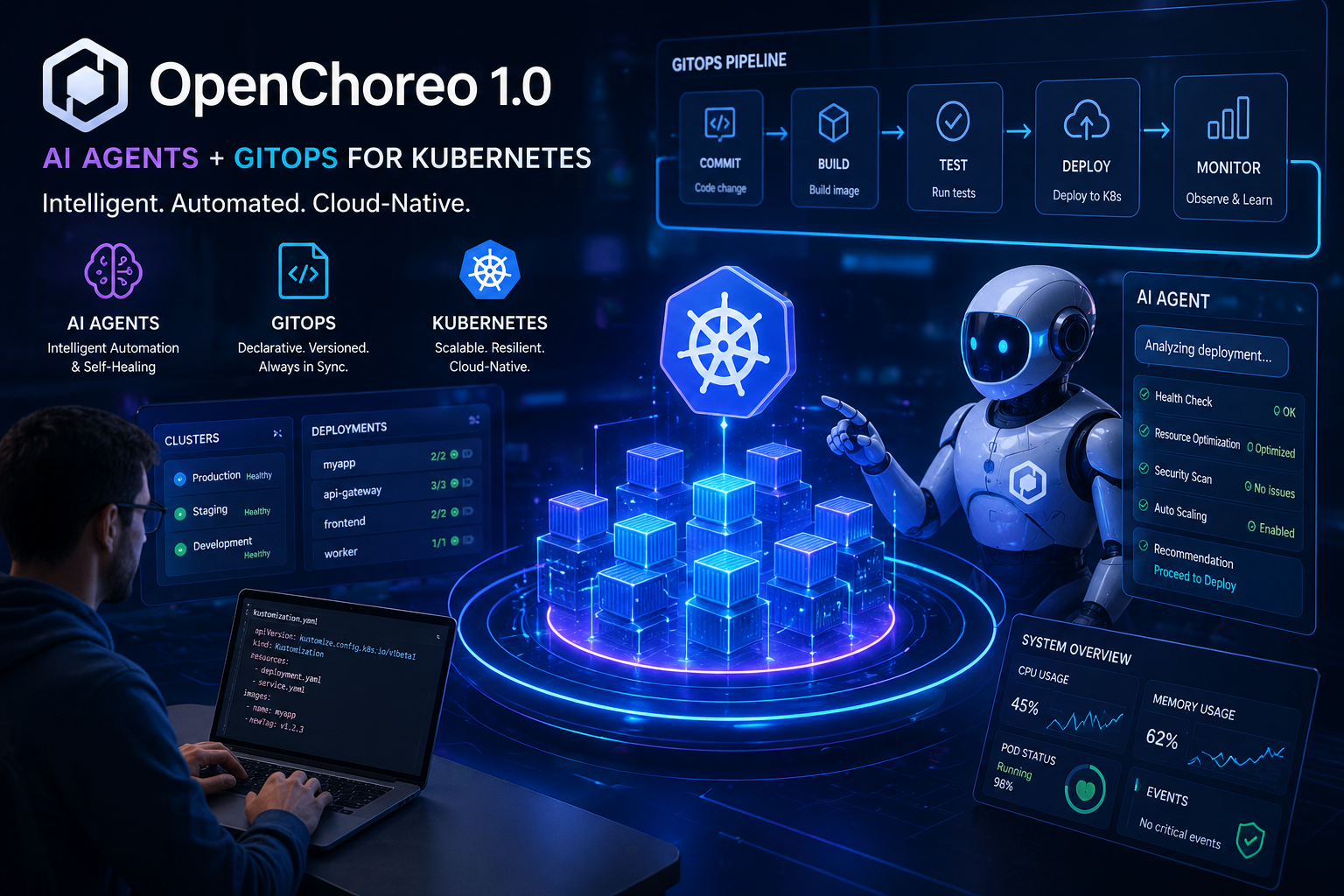
OpenChoreo 1.0 brings together three critical components into a unified experience:
- AI-powered agents for intelligent automation
- GitOps-native workflows for continuous deployment
- Platform engineering principles to abstract infrastructure complexity
The result? Developers can focus on building applications instead of managing pipelines, clusters, and deployment logic.
Instead of manually configuring environments, OpenChoreo enables teams to define everything declaratively—and then lets AI handle the execution.
AI Agents: From Automation to Autonomy
The most transformative part of OpenChoreo 1.0 is the introduction of AI agents into the DevOps workflow.
These aren’t basic automation scripts. They are intelligent systems capable of:
- Interpreting deployment intent
- Detecting anomalies in pipelines
- Suggesting optimizations in real-time
- Automatically remediating failures
This shift from automation to autonomy is massive.
Traditional DevOps pipelines rely heavily on predefined rules. But AI agents bring adaptability—allowing the system to respond dynamically to changes in workloads, infrastructure, and application behavior.
For example, instead of a failed deployment requiring manual intervention, an AI agent can:
- Identify the root cause
- Roll back safely
- Adjust configurations
- Retry deployment intelligently
This drastically reduces downtime and accelerates delivery cycles.
GitOps at the Core: Declarative Everything
OpenChoreo 1.0 doubles down on GitOps as the foundation of its platform.
Everything—from infrastructure to application deployment—is managed through Git repositories. This ensures:
- Version-controlled environments
- Consistent deployment pipelines
- Full auditability
- Simplified rollback mechanisms
By integrating AI agents with GitOps workflows, OpenChoreo takes things further.
Now, changes committed to Git don’t just trigger pipelines—they trigger intelligent decision-making processes that optimize how those changes are applied.
This creates a system where:
- Code defines intent
- Git tracks state
- AI executes intelligently
It’s a powerful combination that aligns perfectly with modern DevOps strategies.
Platform Engineering Done Right
One of the biggest trends in 2026 is the rise of platform engineering—and OpenChoreo 1.0 is clearly built with this in mind.
Instead of every team building their own DevOps pipelines, platform engineering creates a standardized internal developer platform (IDP).
As demand increases, companies are also hitting AI infrastructure limits that impact performance and scalability.
OpenChoreo acts as that platform.
It provides:
- Pre-configured environments
- Built-in security controls
- Scalable deployment templates
- Unified observability
This removes the burden from developers while ensuring consistency across the organization.
The result is faster onboarding, fewer errors, and a much smoother development experience.
Built for AI-Driven Workloads
As AI applications continue to grow, infrastructure demands are changing rapidly.
OpenChoreo 1.0 is designed to handle:
- Dynamic scaling for AI workloads
- Resource-intensive deployments
- Real-time data processing pipelines
By combining Kubernetes orchestration with AI-driven optimization, the platform ensures that workloads are deployed efficiently and cost-effectively.
This is especially important as organizations race to deploy generative AI, agentic systems, and real-time analytics applications.
Security and Governance at Scale
With increased automation comes increased risk—unless security is built into the platform from the start.
OpenChoreo 1.0 integrates security directly into its workflows by:
- Enforcing policy-as-code
- Monitoring deployments continuously
- Detecting anomalies through AI
- Ensuring compliance across environments
This approach aligns with modern DevSecOps practices, where security is not an afterthought—it’s embedded into every stage of the pipeline.
Why This Matters for the Future of DevOps
OpenChoreo 1.0 isn’t just an incremental improvement—it represents where DevOps is heading.
We’re moving toward a world where:
- Pipelines manage themselves
- Infrastructure adapts automatically
- AI handles operational decisions
This reduces the need for manual intervention and allows teams to scale faster without increasing complexity.
This shift aligns with the broader trend of AI-driven DevOps transformation where automation is becoming increasingly intelligent and adaptive.
The combination of:
- Kubernetes
- GitOps
- AI agents
…creates a foundation for truly autonomous software delivery.
The Bottom Line
OpenChoreo 1.0 is more than just another Kubernetes platform—it’s a glimpse into the future of developer platforms.
By bringing together AI agents and GitOps automation, it simplifies complexity while unlocking new levels of efficiency, scalability, and control. OpenChoreo 1.0 Kubernetes continues to gain attention as organizations look for smarter ways to manage cloud-native infrastructure.
For organizations struggling with Kubernetes sprawl, pipeline inefficiencies, and scaling challenges, this is exactly the kind of innovation needed to move forward.
OpenChoreo 1.0 Kubernetes is quickly emerging as a key platform for teams looking to combine AI-driven automation with GitOps at scale. And for the broader DevOps ecosystem, it’s a clear signal:
The era of intelligent, self-operating platforms has officially begun.