By Marc Mawhirt | LevelAct.com
As organizations double down on AI-driven capabilities in 2025, the demand for real-time, production-grade machine learning has reached new heights. But one of the most persistent blockers in scaling ML across teams and environments isn’t the model itself—it’s the data.
That’s where the feature store for machine learning comes in.
A feature store is a centralized data platform that simplifies, standardizes, and accelerates how features are created, stored, and served for ML models. As real-time inference becomes the norm in fraud detection, personalization, and operational automation, feature stores are becoming critical infrastructure for any serious AI pipeline.
What Is a Feature Store?
A feature store is a specialized data system that manages the end-to-end lifecycle of features:
-
Feature engineering and transformation
-
Versioning and lineage
-
Training-serving consistency
-
Batch and real-time data delivery
The core value is simple: build features once and reuse them everywhere—across teams, use cases, and environments.
Tools like Tecton, Feast, and Amazon SageMaker Feature Store have emerged as foundational platforms, helping enterprises bridge the messy gap between raw data pipelines and reliable model inputs.
Why Feature Stores Matter in 2025
In today’s world of real-time AI, models need fresh data, fast. Traditional data warehouses can’t serve features quickly enough to support low-latency predictions.
Feature stores solve this by:
-
Storing pre-computed features in low-latency online stores for live inference
-
Providing batch and streaming support for consistent data across training and production
-
Enabling governance and reproducibility through version control and metadata
-
Supporting deployment across multicloud and hybrid architectures
Imagine a fraud detection model that needs a customer’s transaction history, device fingerprint, and risk score—all computed and available within milliseconds. That’s the power of a real-time feature store.
Real-Time Use Cases Across Industries
Here’s how different industries are leveraging feature stores:
-
Finance: Detecting fraud and risk in under 50ms
-
Retail: Powering personalized recommendations and dynamic pricing
-
Healthcare: Real-time patient monitoring and alerting systems
-
Telco: Optimizing network traffic with ML-driven routing
-
Cybersecurity: Enabling behavioral anomaly detection via user profiling
And it’s not just massive companies—mid-sized organizations are now adopting feature stores as they shift to real-time ML operations (MLOps) to stay competitive.
Key Components of a Feature Store
| Component | Description |
|---|---|
| Offline Store | Stores batch features for training |
| Online Store | Serves real-time features for inference |
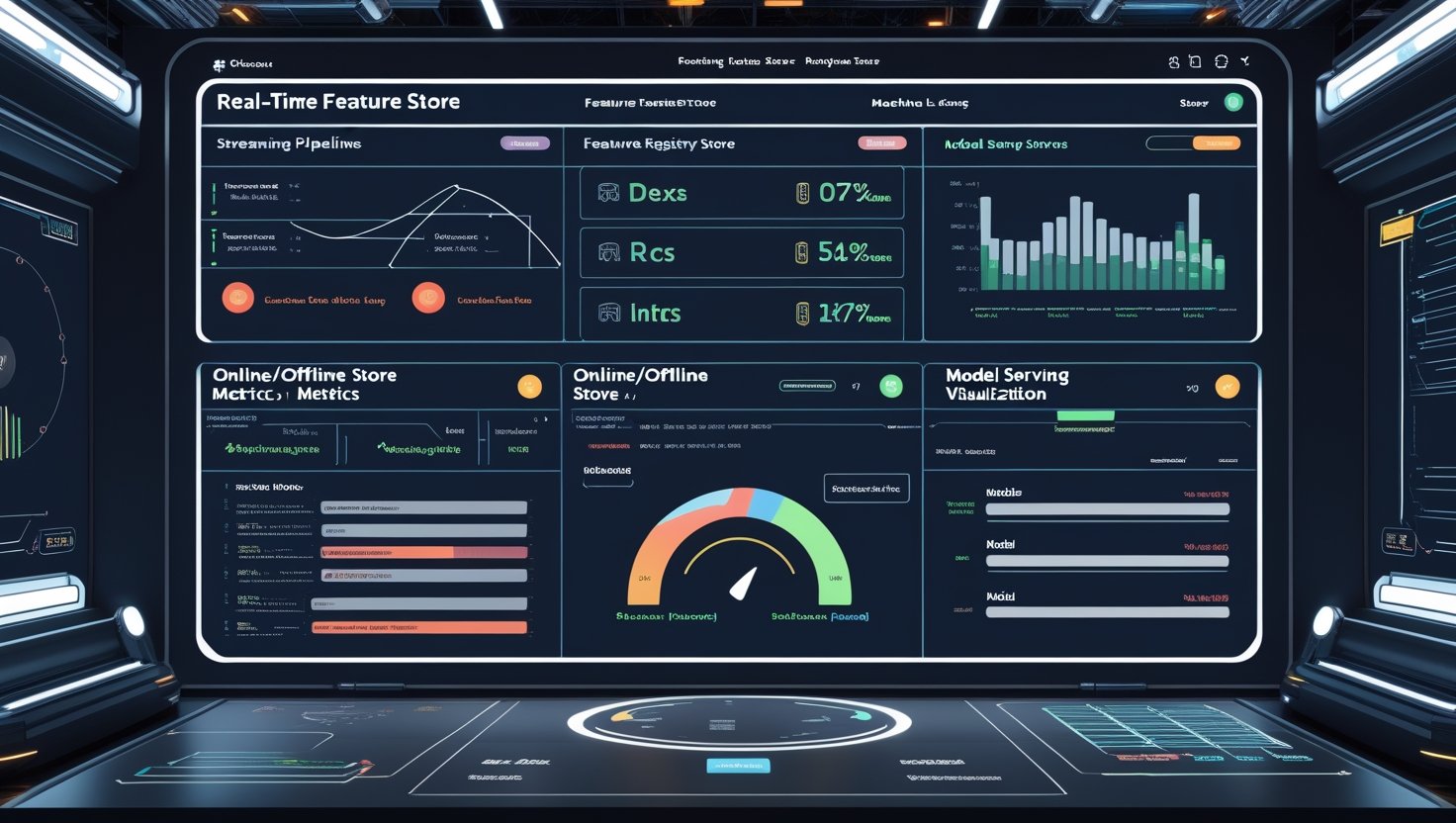
| Transformation Engine | Computes and materializes features from raw data |
| Feature Registry | Metadata, versioning, and discoverability |
| Access Layer | SDKs/APIs for training pipelines and production models |
This architecture ensures that training-serving skew—a major pain point in ML—is minimized or eliminated altogether.
The Rise of Streaming and On-Demand Features
Feature stores are now embracing streaming-first design. Platforms like Tecton 2.0 and Databricks Feature Store can:
-
Compute on-the-fly features from Kafka, Flink, or Spark streams
-
Join multiple sources in real time
-
Serve features under 10ms for ultra-low-latency use cases
This is opening the door for next-gen use cases like AI copilots, real-time logistics optimization, and adaptive cybersecurity systems.
Integration with MLOps Pipelines
Feature stores don’t live in a vacuum—they plug into the broader MLOps stack:
-
Model training pipelines via integration with tools like SageMaker, Vertex AI, or MLflow
-
CI/CD for ML with Git-based versioning and Terraform integration
-
Model monitoring and retraining loops using feature drift detection
The result? More reliable, reproducible, and scalable ML workflows—without reinventing the wheel.
Challenges and Considerations
While feature stores offer massive benefits, they do come with challenges:
-
Complexity: Requires upfront investment in architecture and engineering
-
Cost: Real-time stores (like Redis, DynamoDB) can be expensive at scale
-
Data quality: Poor feature quality still leads to garbage in, garbage out
-
Team adoption: Data scientists need training to leverage feature stores fully
Despite these, the ROI is clear for teams that want to productionize ML without slowing down.
The Road Ahead: Feature Stores + Foundation Models
In 2025, we’re also seeing feature stores evolve beyond tabular data. Teams are experimenting with:
-
Multimodal feature stores (text, images, sensor data)
-
Semantic search capabilities across feature registries
-
Integration with LLM workflows for real-time context injection
With the rise of LLM-powered systems, feature stores will play a key role in grounding models with real-world data—making predictions more relevant, secure, and aligned with business logic.