Why Enterprises Are Racing to Deploy Private AI
Artificial intelligence has become one of the most important technology investments of the decade, but many organizations are discovering that public AI services are not always the best fit for enterprise environments. As companies adopt generative AI across customer service, software development, cybersecurity, finance, healthcare, and manufacturing, concerns about data privacy, regulatory compliance, and intellectual property are driving a new trend: Private AI.
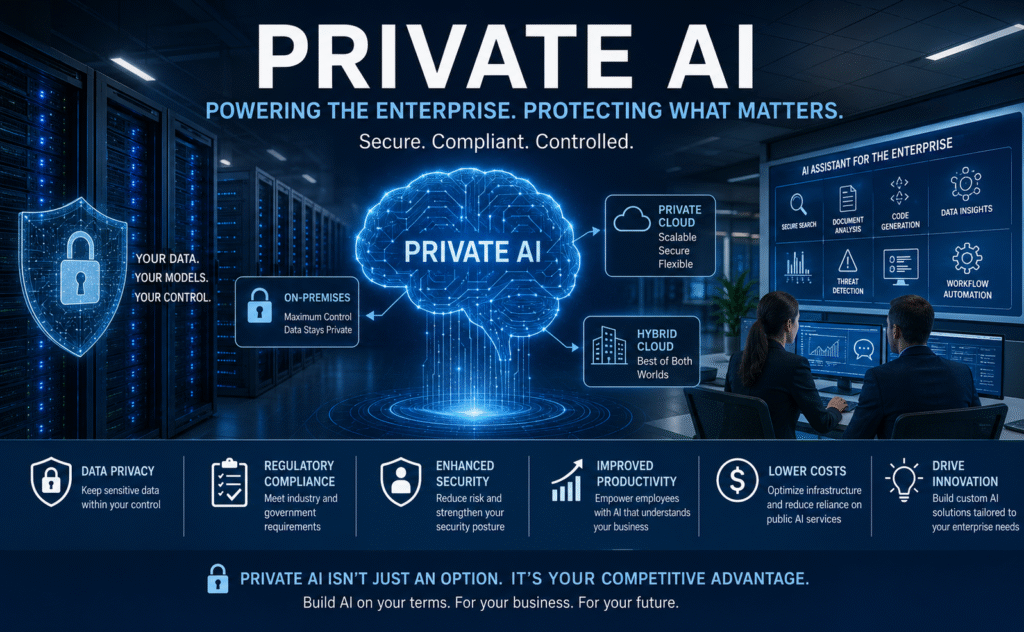
Unlike public AI platforms that process prompts through shared cloud environments, Private AI allows organizations to deploy large language models within their own infrastructure or trusted cloud environments. This approach gives businesses greater control over sensitive information while allowing employees to take advantage of AI-powered productivity tools without exposing confidential data.
Over the past year, nearly every major enterprise technology vendor has expanded its Private AI offerings. Hardware manufacturers, cloud providers, software companies, and cybersecurity vendors are all investing heavily in platforms that allow organizations to build secure AI environments tailored to their specific business needs.
Private AI is quickly becoming more than a technology trend. For many enterprises, it is becoming a strategic business requirement.
What Is Private AI?
Private AI refers to artificial intelligence models that operate within an organization’s own controlled environment rather than relying entirely on publicly available AI services.
Instead of sending company documents, customer information, software code, financial records, or research data to external AI platforms, businesses can deploy AI systems inside their own data centers, private cloud environments, or hybrid cloud infrastructures.
Employees continue receiving the benefits of conversational AI, document analysis, software development assistance, and intelligent search while organizations maintain control over how information is stored, processed, and protected.
This approach significantly reduces concerns about sensitive information being unintentionally exposed outside the organization.
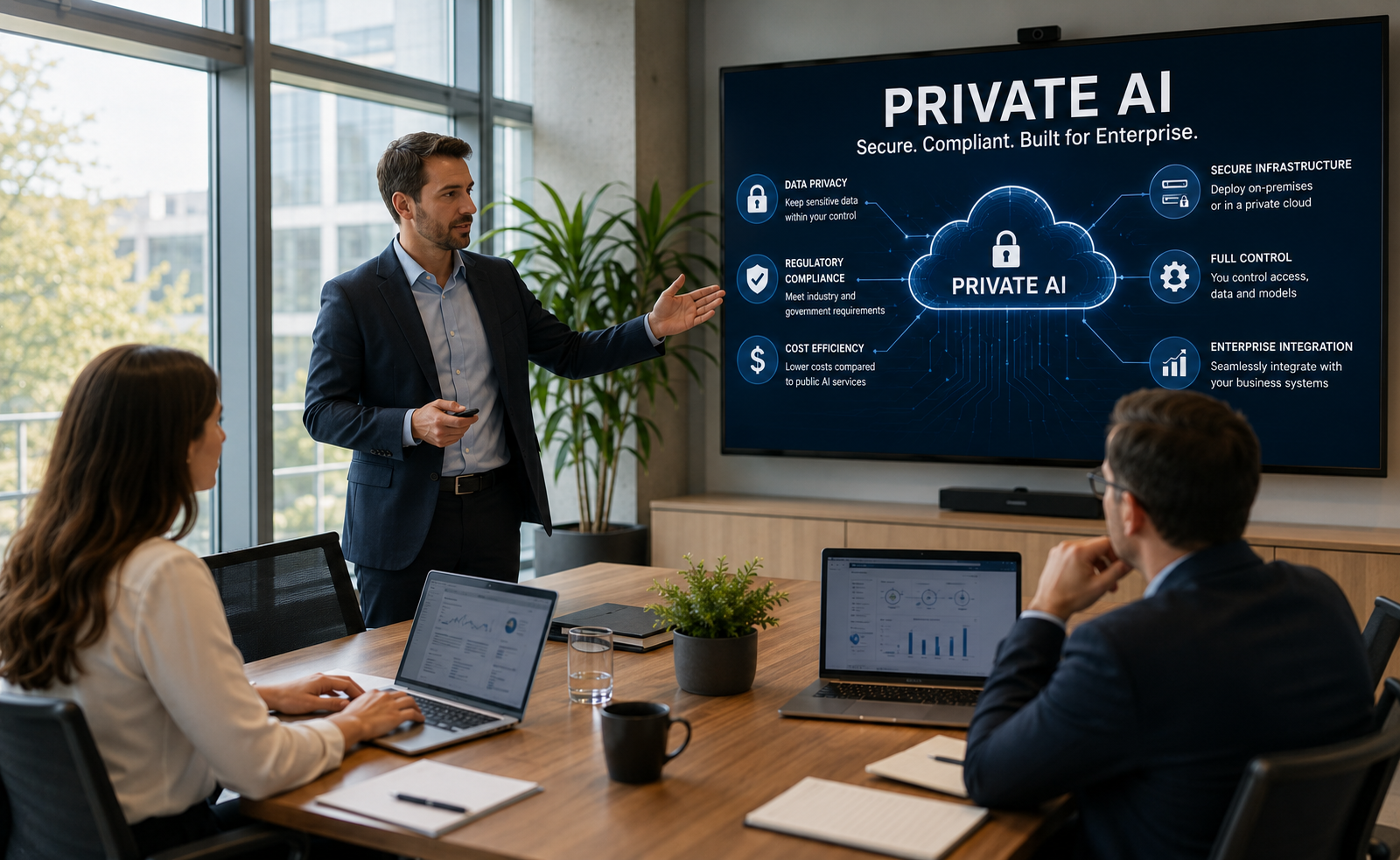
Data Privacy Is Driving Enterprise Adoption
One of the biggest reasons organizations are investing in Private AI is data protection.
Every day, employees work with confidential customer records, financial reports, healthcare information, engineering designs, legal documents, source code, and internal business strategies.
Sending that information to public AI services may violate internal security policies or regulatory requirements depending on the industry.
Private AI allows organizations to establish clear governance policies while maintaining complete visibility into how enterprise information is accessed and processed.
For industries such as healthcare, banking, government, defense, and manufacturing, this level of control is becoming increasingly important.
Regulatory Compliance Is Becoming More Complex
Governments around the world continue introducing new regulations surrounding artificial intelligence, privacy, and cybersecurity.
Organizations operating under regulations such as HIPAA, GDPR, PCI, and emerging AI governance frameworks must carefully evaluate how AI systems process sensitive information.
Private AI provides organizations with greater flexibility to configure security controls, auditing, encryption, access management, and logging based on regulatory requirements.
Rather than adapting business processes to fit public AI platforms, enterprises can design AI environments that support existing compliance programs.
Better Performance Through Enterprise Integration
Private AI becomes significantly more valuable when connected to internal business systems.
Organizations can integrate AI directly with document management platforms, customer relationship management systems, enterprise resource planning software, cybersecurity platforms, software repositories, and internal knowledge bases.
Instead of providing generic answers based on public information, Private AI can deliver responses using company-specific policies, procedures, technical documentation, and historical business data.
This creates a much more accurate and useful assistant for employees across the organization.
Cybersecurity Teams Are Embracing Private AI
Security operations centers generate enormous amounts of information every day.
Security alerts, vulnerability reports, endpoint telemetry, threat intelligence feeds, firewall logs, cloud events, and compliance reports often overwhelm cybersecurity analysts.
Private AI can summarize incidents, prioritize alerts, recommend remediation steps, generate executive reports, and help analysts investigate threats more efficiently.
Because sensitive security information never leaves the organization’s controlled environment, security teams gain the benefits of AI without increasing unnecessary risk.
Infrastructure Vendors Are Expanding Private AI Platforms
The rapid growth of Private AI has created significant opportunities across the technology industry.
Companies such as NVIDIA, Dell Technologies, Hewlett Packard Enterprise (HPE), Microsoft, Red Hat, VMware, Cisco, and Lenovo continue expanding infrastructure designed specifically for enterprise AI deployments.
These platforms combine high-performance GPUs, optimized networking, secure storage, and AI software frameworks into integrated solutions that simplify deployment while supporting enterprise security requirements.
Many organizations are choosing hybrid environments that combine on-premises infrastructure with trusted cloud services to balance flexibility, scalability, and regulatory compliance.
Challenges Still Remain
Deploying Private AI is not as simple as installing new software.
Organizations must evaluate computing infrastructure, GPU availability, storage capacity, networking performance, model selection, governance policies, employee training, and long-term operational costs.
Running advanced language models requires substantial computing resources, and many enterprises continue facing challenges related to power consumption, cooling capacity, and skilled AI personnel.
However, improvements in AI hardware, model optimization, and deployment platforms are making Private AI more accessible every year.
The Future of Enterprise AI
Private AI represents the next phase of enterprise digital transformation.
Rather than choosing between public cloud services and complete isolation, organizations are building intelligent hybrid environments that balance innovation with security.
Future enterprise AI platforms will assist employees with software development, customer support, cybersecurity, financial analysis, engineering, legal research, and strategic planning while operating securely within trusted infrastructure.
As organizations become more comfortable integrating AI into everyday operations, Private AI will increasingly become a core component of enterprise technology strategies.
Final Thoughts
Private AI is rapidly moving from an emerging technology to a business necessity. Enterprises want the productivity benefits of artificial intelligence without sacrificing data privacy, intellectual property, regulatory compliance, or cybersecurity.
Organizations that invest in secure AI infrastructure today will be better positioned to innovate faster, protect sensitive information, and gain a competitive advantage in the years ahead.
For many business leaders, the question is no longer whether to adopt AI. The question is how quickly they can deploy Private AI in a secure, scalable, and well-governed way.
Related Articles
- AI vs. Hackers: The Cybersecurity Arms Race in 2026
- The Hidden Cost of Free AI Tools: What Every Business Should Know
- AI Employees Are Arriving: The Rise of the Digital Workforce
- AI Is Eliminating the Traditional IT Help Desk