
• About Us
  • Advertise With Us

Friday, July 24, 2026

  • Home
  • AI
  • Cloud
  • DevOps
  • Security
  • Webinars
  • Videos
  • Home
  • AI
  • Cloud
  • DevOps
  • Security
  • Webinars
  • Videos
Home Cloud

7 Ways the Cloud Gaming Battle Is Changing: Amazon and Microsoft Chart Different Courses

Billy Nicholson by Billy Nicholson
July 24, 2026
in Cloud
0
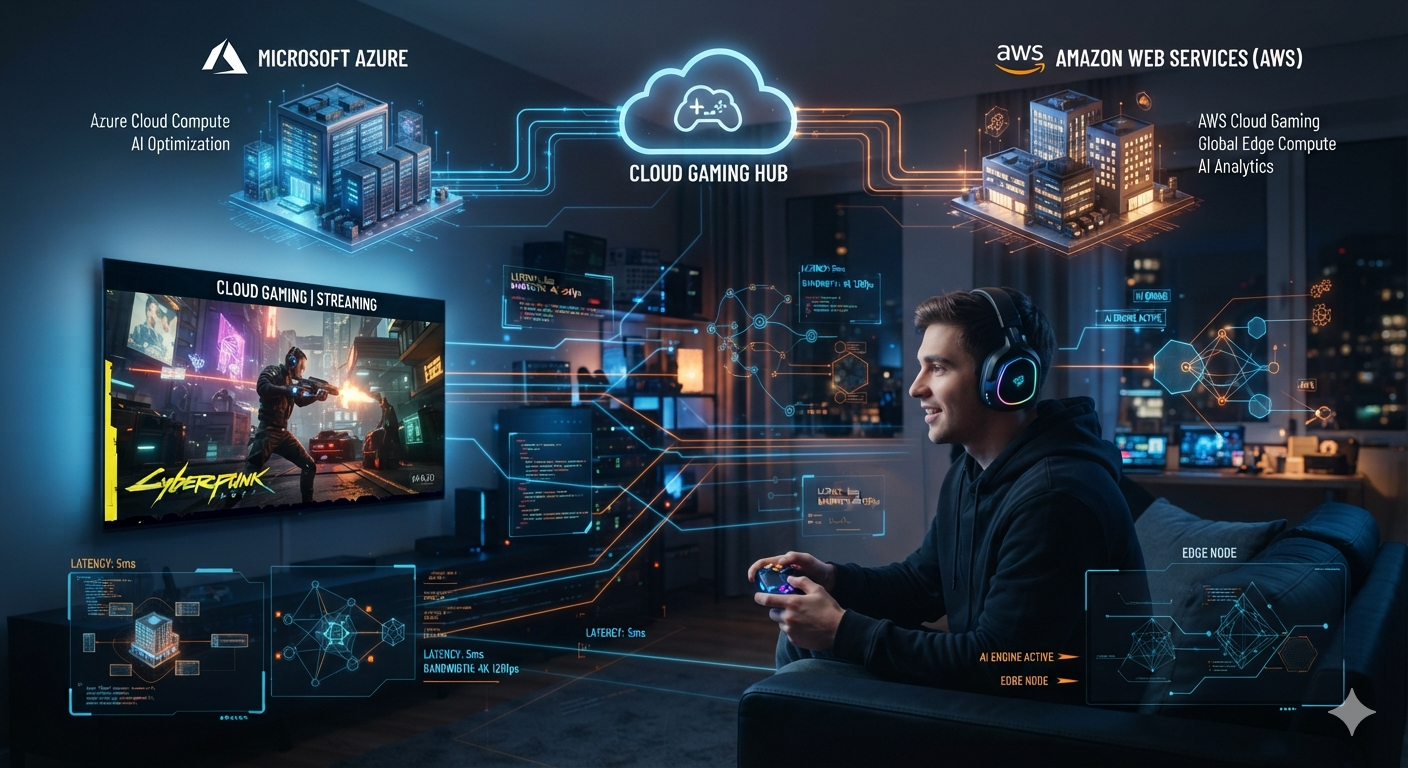
Cloud Gaming powered by Microsoft Azure and Amazon AWS cloud infrastructure

Cloud gaming is transforming how games are delivered by using cloud infrastructure, AI, and edge computing instead of traditional gaming hardware.

150
SHARES
3k
VIEWS
Share on FacebookShare on Twitter

Cloud Gaming Is Becoming a Strategic Technology Battleground

Gaming Is Driving the Next Generation of Cloud Computing

Cloud gaming is no longer simply about playing games without downloading them. It has become a strategic showcase for modern cloud infrastructure.

Unlike traditional gaming, where processing happens inside a console or gaming computer, cloud gaming performs every calculation inside massive data centers. Every button press, movement, and action must travel across the internet to a remote server, where the game is rendered before being compressed into a video stream and sent back to the player’s screen—all within milliseconds.

That level of performance requires enormous computing power.

Microsoft and Amazon are investing heavily in new GPU clusters, faster networking, larger storage systems, and intelligent load-balancing technologies to support millions of simultaneous players. Every improvement they make benefits not only gamers but also enterprise customers using Azure and AWS for artificial intelligence, analytics, and mission-critical business applications.

Cloud gaming has effectively become a live demonstration of what modern cloud infrastructure can accomplish under extreme workloads.

As these platforms continue to grow, the innovations developed for gaming will increasingly influence enterprise cloud services across every major industry.


2. Microsoft Is Building a Complete Cloud Gaming Ecosystem

Xbox, Azure, and Game Pass Work Together

Microsoft’s strategy is much broader than simply offering a cloud gaming platform.

Instead of focusing on hardware alone, Microsoft has built an integrated ecosystem that connects Xbox consoles, Windows PCs, smartphones, tablets, smart televisions, and web browsers through Xbox Cloud Gaming.

Players can begin a game on one device and continue playing on another almost instantly without transferring files or purchasing multiple versions of the same game. This seamless experience encourages users to remain within Microsoft’s ecosystem regardless of the hardware they choose.

Behind the scenes, Azure powers every gaming session using one of the world’s largest cloud infrastructures.

Microsoft has also strengthened its position through major acquisitions of game development studios, giving Game Pass access to an expanding library of exclusive titles. Rather than competing only on console sales, Microsoft now competes through subscriptions, cloud services, exclusive content, and long-term customer relationships.

This strategy reflects a broader industry trend in which recurring subscriptions are becoming more valuable than one-time hardware purchases.

The result is an ecosystem designed not only to attract gamers but also to demonstrate Azure’s ability to handle some of the most demanding real-time workloads in cloud computing.


3. Amazon Is Taking a Different Cloud Gaming Approach

Flexibility Is Amazon’s Biggest Competitive Advantage

While Microsoft built its strategy around Xbox, Amazon has taken a very different path.

Amazon Luna is designed to remove as many barriers as possible between players and their games. Instead of requiring consumers to purchase another console, Luna allows games to stream directly to Windows PCs, Macs, Fire TV devices, tablets, smartphones, and many smart televisions.

This device-independent approach reflects Amazon’s long-standing business philosophy of delivering services wherever customers already spend their time.

Amazon also benefits from one significant advantage: Amazon Web Services.

AWS already operates one of the largest cloud infrastructures in the world, supporting millions of businesses across nearly every industry. That existing infrastructure provides the computing capacity required for cloud gaming without forcing Amazon to build an entirely separate global network.

The company is also integrating Luna with Twitch and Amazon Prime, creating opportunities to connect game streaming, live content, subscriptions, and online communities into one unified platform.

Although Luna currently trails Microsoft’s Xbox Cloud Gaming in market share, Amazon continues investing for the long term. The company has repeatedly demonstrated its willingness to grow businesses patiently, and cloud gaming appears to be following that same strategy.


4. Artificial Intelligence Is Making Cloud Gaming Smarter

AI Is Improving Performance Without Players Even Noticing

Artificial intelligence has quietly become one of the most important technologies supporting cloud gaming.

Most players never realize how much AI is working behind the scenes. Machine learning systems constantly analyze network conditions, predict player demand, allocate computing resources, improve video compression, detect cheating, and recommend new games based on user behavior.

When millions of players log in after the release of a popular title, AI systems can predict demand before servers become overloaded. Instead of reacting to problems after they occur, cloud platforms automatically increase computing capacity where it is needed most.

Artificial intelligence also helps improve streaming quality.

Modern compression algorithms use machine learning to reduce bandwidth requirements while maintaining sharp graphics and smooth gameplay. This allows cloud gaming services to deliver high-quality experiences even on slower internet connections.

Security is another area benefiting from AI.

Cloud gaming providers process millions of user accounts every day, making them attractive targets for cybercriminals. Artificial intelligence continuously monitors for suspicious activity, account takeovers, cheating software, fraud, and unusual login patterns. These automated systems identify threats much faster than traditional manual security methods.

As AI technology continues advancing, cloud gaming platforms will become even more efficient, personalized, and secure. Many of the machine learning innovations developed for gaming are already finding their way into enterprise cloud services, helping businesses optimize workloads, strengthen cybersecurity, and improve customer experiences.

5. Cloud Gaming and Edge Computing Are Reducing Latency

Edge Computing Is Making Cloud Gaming Feel More Responsive

One of the biggest obstacles facing cloud gaming has always been latency. Unlike streaming a movie, cloud gaming requires instant interaction between the player and the game. Every movement, button press, or command must travel across the internet to a remote server, be processed, and return to the player’s screen in a fraction of a second. Even a slight delay can affect gameplay, particularly in competitive titles.

To overcome this challenge, both Microsoft and Amazon are investing heavily in edge computing.

Instead of processing every gaming session inside distant data centers, edge computing places computing resources much closer to users. Regional edge locations shorten the distance data must travel, significantly reducing latency while improving responsiveness.

Microsoft continues expanding its Azure Edge Zones, while Amazon leverages AWS Local Zones and other regional infrastructure to bring computing power closer to gamers around the world.

The benefits extend beyond gaming. Lower latency improves video conferencing, remote collaboration, autonomous systems, financial trading, healthcare applications, and industrial automation. The same edge technologies developed for cloud gaming are becoming increasingly valuable to enterprise organizations that depend on real-time applications.

As 5G networks continue expanding and edge infrastructure grows, cloud gaming will become even more responsive, making it increasingly difficult for users to distinguish between locally installed games and those streamed from the cloud.


6. Cloud Gaming Subscriptions Are Changing the Industry

Recurring Services Are Replacing Traditional Game Sales

The business model behind cloud gaming is changing just as rapidly as the technology itself.

For decades, gamers purchased individual titles for full retail price. Today, companies are increasingly shifting toward subscription services that provide access to extensive game libraries for a monthly fee.

Microsoft has led this movement through Xbox Game Pass. Subscribers gain access to hundreds of games across consoles, PCs, and cloud devices without purchasing each title individually. The service has become one of Microsoft’s strongest competitive advantages because it encourages long-term customer loyalty while generating predictable recurring revenue.

Amazon is following a similar path with Luna. Rather than focusing solely on exclusive games, Amazon is building a flexible subscription platform that integrates naturally with Prime memberships, Fire TV devices, and Twitch. This allows the company to deliver entertainment as part of a broader digital ecosystem instead of relying exclusively on game sales.

The subscription model also benefits developers.

Independent studios gain exposure to millions of subscribers who might never have purchased their games outright. Larger publishers enjoy steady licensing revenue while reaching new audiences across multiple devices.

For consumers, subscriptions reduce upfront costs and encourage experimentation. Players can explore new genres and titles without making individual purchasing decisions every time a game is released.

Cloud gaming subscriptions are reshaping the economics of the gaming industry, transforming games from standalone products into continuously delivered cloud services.


7. Cloud Gaming Is Shaping the Future of Cloud Computing

Gaming Innovation Is Influencing Enterprise Technology

Although cloud gaming is often viewed as entertainment, its impact reaches far beyond the gaming industry.

Supporting millions of simultaneous gaming sessions requires solving some of the most complex challenges in cloud computing. Providers must deliver extremely low latency, massive scalability, continuous availability, advanced cybersecurity, intelligent resource allocation, and real-time graphics processing.

Those same technologies are becoming increasingly important across enterprise IT.

Artificial intelligence platforms require enormous GPU clusters similar to those powering cloud gaming. Engineering firms are using remote visualization to collaborate on complex designs. Manufacturers rely on digital twins to simulate production environments. Healthcare organizations increasingly depend on cloud-based imaging and real-time diagnostics. Financial institutions require ultra-fast processing for trading platforms and fraud detection.

Many of these workloads benefit directly from the same infrastructure improvements originally developed for cloud gaming.

GPU virtualization is another example. Hardware once optimized primarily for gaming is now accelerating AI model training, scientific research, high-performance computing, and advanced analytics. Likewise, investments in edge computing are improving everything from smart cities to connected vehicles and industrial automation.

Cybersecurity also plays a critical role. Protecting millions of cloud gaming users from fraud, account takeovers, distributed denial-of-service attacks, and other threats has driven significant innovation in identity management, behavioral analytics, and automated threat detection. Enterprise organizations are now benefiting from many of those same security technologies.

The competition between Microsoft and Amazon is ultimately helping advance cloud computing for everyone—not just gamers. Every improvement made to cloud gaming infrastructure strengthens the broader cloud platforms that businesses depend on every day.


Conclusion

Cloud gaming has evolved into much more than a new way to play video games. It has become one of the most demanding real-world applications of cloud computing, artificial intelligence, edge computing, and global networking.

Microsoft and Amazon are pursuing different strategies, but both companies recognize that the technologies powering cloud gaming will influence far more than entertainment. Microsoft continues building an integrated ecosystem around Xbox, Azure, and Game Pass, while Amazon is leveraging the scale of AWS, Luna, Prime, and Twitch to create a flexible cloud-first platform that reaches users across virtually every connected device.

For enterprise organizations, this competition offers valuable insights into where cloud technology is heading. The innovations driving cloud gaming today—including AI-powered infrastructure management, GPU virtualization, edge computing, subscription-based services, and advanced cybersecurity—are rapidly becoming foundational technologies across every industry.

As investments continue to grow, cloud gaming will remain a powerful catalyst for innovation, pushing cloud providers to build faster, smarter, and more resilient platforms. The companies that learn from these advancements won’t simply improve gaming experiences—they’ll help define the future of cloud computing itself.

Related Articles
  • Vertical Cloud Infrastructure Is Reshaping Enterprise IT
  • AI Infrastructure Wars: AWS, Google Cloud, and Azure Battle for Enterprise Dominance
  • AI Data Centers Are Rewriting the Future of Cloud Computing
  • Cloud Giants vs. Regional AI Data Centers: The New Battle for Compute
Previous Post

AI Online Shopping Is Changing Retail Forever in 2026

  • Trending
  • Comments
  • Latest
AI in DevOps automation concept with cloud, pipelines, and artificial intelligence systems

Agentic AI Is Reshaping DevOps and Enterprise Automation in 2026

March 19, 2026
Agentic AI managing automated DevOps CI/CD pipeline infrastructure

Agentic AI in DevOps Pipelines: From Assistants to Autonomous CI/CD

March 9, 2026
AI cybersecurity systems detecting and defending against AI-powered cyber threats

The AI Cybersecurity Arms Race: When Intelligent Threats Meet Intelligent Defenses

March 10, 2026
DevOps feedback loops in a modern CI/CD pipeline

DevOps Feedback Loops: The Hidden Bottleneck Slowing CI/CD

March 9, 2026
Microsoft Empowers Copilot Users with Free ‘Think Deeper’ Feature: A Game-Changer for Intelligent Assistance

Microsoft Empowers Copilot Users with Free ‘Think Deeper’ Feature: A Game-Changer for Intelligent Assistance

0
Can AI Really Replace Developers? The Reality vs. Hype

Can AI Really Replace Developers? The Reality vs. Hype

0
AI and Cloud

Is Your Organization’s Cloud Ready for AI Innovation?

0
Top DevOps Trends to Look Out For in 2025

Top DevOps Trends to Look Out For in 2025

0
Cloud Gaming powered by Microsoft Azure and Amazon AWS cloud infrastructure

7 Ways the Cloud Gaming Battle Is Changing: Amazon and Microsoft Chart Different Courses

July 24, 2026
Woman using AI online shopping assistant to compare products and receive personalized recommendations on a laptop.

AI Online Shopping Is Changing Retail Forever in 2026

July 23, 2026
Hidden Cost of Free AI Tools

The Hidden Cost of Free AI Tools Every Business Should Know

July 17, 2026
AI agents collaborating with human employees inside a modern enterprise operations center with cloud dashboards, DevOps monitoring, and cybersecurity analytics.

AI Agents Are Becoming Your New Digital Employees

July 16, 2026
ADVERTISEMENT

Welcome to LevelAct — Your Daily Source for DevOps, AI, Cloud Insights and Security.

Follow Us

Linkedin

Browse by Category

  • AI
  • Cloud
  • DevOps
  • Security
  • AI
  • Cloud
  • DevOps
  • Security

Quick Links

  • About
  • Advertising
  • Privacy Policy
  • Editorial Policy
  • About
  • Advertising
  • Privacy Policy
  • Editorial Policy

Subscribe Our Newsletter!

Be the first to know
Topics you care about, straight to your inbox

Level Act LLC, 8331 A Roswell Rd Sandy Springs GA 30350.

No Result
View All Result
  • About
  • Advertising
  • AI Accountability Crisis, Video Briefing with Veronica
  • AI Agents Are Replacing Dashboards: The Rise of Autonomous Enterprise Operations
  • AI Agents Are Replacing SaaS: Enterprise Software Disruption
  • AI Browser Wars: Colton Reed Reveals the Future of Search
  • AI Data Center Infrastructure Crisis: Power, Cooling, and Scaling Limits
  • AI Data Centers Face Growing Water Crisis Video
  • AI Data Poisoning Is the Next Enterprise Cybersecurity Crisis
  • AI Governance Is Becoming a Competitive Advantage | Jennifer Briefing
  • AI Infrastructure Wars: Why Enterprises Are Building Private AI Clouds
  • AI IT Help Desk: The End of Traditional Enterprise Support | Video Briefing with Veronica
  • AI Job Interviews Are Changing Forever | Video Briefing with Naomi
  • AI Privacy Crisis: How Much Does AI Know About You?
  • AI-Driven DevOps: Why Enterprise Teams Are Rebuilding Around AI
  • AI-Native Data Centers: The Future of AI Infrastructure
  • AI-Powered Cyberattacks Video Briefing with Jennifer
  • Autonomous AI Agent Security Crisis of 2026
  • Calendar View
  • Cloud Giants vs. Regional AI Data Centers: The New Battle for Compute

  • Editorial Policy
  • Events
  • Everyday People Using AI
  • Home
  • LevelAct Webinars
  • LevelAct Webinars: Expert Insights on AI, Cloud, DevOps, and Security
  • Meta Quietly Launches ‘Forum’ — A New Reddit-Style Community Platform
  • Privacy Policy
  • The Agentic Web: AI Agents Are Becoming Internet Users
  • The End of Search: Are AI Assistants Replacing Google?
  • The Future of Agentic Software Delivery: Unifying Source & Binaries
  • Vertical Cloud Infrastructure Is Reshaping Enterprise IT
  • Videos
  • Webinar Solutions
  • Why Platform Engineering Is Replacing Traditional DevOps

© 2026 JNews - Premium WordPress news & magazine theme by Jegtheme.