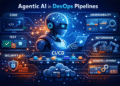
In the ever-evolving world of DevOps, speed, scalability, and automation are everything. And now, GitHub has quietly rolled out a game-changer that could redefine how development teams operate: Agent Mode. Paired with multi-model support, this new functionality empowers developers and DevOps engineers to go beyond traditional automation, ushering in a new era of AI-native development workflows.
Let’s dive deep into what GitHub’s Agent Mode really is, how multi-model support reshapes collaboration, and what it means for your CI/CD pipeline.
🧠 What Is GitHub Agent Mode?
At its core, Agent Mode is a leap from assistive AI (think Copilot) to autonomous AI agents that can take on complex, multi-step tasks with minimal human input. While Copilot has already changed the game for individual developers by suggesting code in real time, Agent Mode goes further. It doesn’t just assist—it acts.
With Agent Mode enabled, GitHub users can spin up intelligent agents that:
- Analyze issues and pull requests
- Generate and refactor code
- Enforce compliance or style guides
- Manage builds and even update documentation
These agents operate with task memory, contextual understanding, and the ability to plan actions—not unlike how a skilled DevOps engineer would operate across Git, CI tools, and ticket systems.
💥 Multi-Model Support: Bringing Intelligence to the Stack
Traditionally, tools like GitHub Copilot rely on a single AI model (like OpenAI’s Codex or GPT-4). With multi-model support, GitHub allows dynamic switching between models based on task complexity, project type, or user preferences.
This has major implications:
- Flexibility: Teams can route tasks to models optimized for frontend, backend, infrastructure, or security.
- Precision: Higher accuracy in recommendations thanks to model specialization.
- Redundancy: No single point of failure—if one model underperforms, another can take over.
This model-mixing unlocks new levels of quality assurance, customization, and confidence in auto-generated work.
🔧 Why This Matters for DevOps
DevOps thrives on automation. But traditional CI/CD automation still relies heavily on scripted logic, event triggers, and manual oversight. Agent Mode disrupts this by introducing contextual, intelligent agents that adapt to changes, learn from outcomes, and optimize the pipeline.
Imagine:
- An agent that flags and fixes security vulnerabilities before your build fails
- An AI that auto-generates unit tests tailored to recent pull requests
- An agent that continuously monitors performance regressions and adjusts infrastructure-as-code templates in response
This is intelligence woven into automation—and it’s exactly what DevOps teams need to stay competitive in 2025 and beyond.
🔐 Security and Governance Considerations
While the potential is massive, Agent Mode also raises questions about trust, auditing, and control. Thankfully, GitHub has anticipated this with features like:
- Permission scopes for agents
- Action logs for every AI-initiated change
- Governance policies to restrict or monitor model behaviors
This means enterprises can confidently scale agent-based workflows without compromising on compliance or security posture.
🌐 GitHub’s Vision for the Future
GitHub’s implementation of Agent Mode is just the beginning. According to the platform’s roadmap, we can expect future iterations to support:
- Agent-to-agent collaboration (AI agents handing off tasks like human teams)
- Full integration with GitHub Actions, Codespaces, and Copilot Chat
- Embedded learning loops where agents refine their output over time
In short: GitHub is building a DevOps ecosystem powered by self-improving intelligence. If you’re not preparing for this now, you risk being left behind.
🛠️ How to Get Started
Agent Mode is currently being rolled out to select users and organizations. But here’s how to prepare:
- Enable Copilot for Teams and sign up for early Agent Mode access.
- Identify repetitive DevOps tasks in your workflows that could be delegated.
- Map responsibilities to model capabilities—think testing, documentation, CI/CD config, etc.
- Start small: Build and monitor your first agent on a non-critical repo.
- Iterate based on feedback, and gradually expand scope.
The goal isn’t to replace your DevOps engineers—it’s to free them from the mundane so they can focus on what matters most: velocity, resilience, and innovation.
🚀 Final Thoughts: A New Age of DevOps Has Arrived
With Agent Mode and multi-model support, GitHub is proving that AI isn’t just a productivity boost—it’s an evolution in how software gets built, secured, and shipped. The smartest teams in the world will use these tools not to replace talent, but to amplify it.
As DevOps continues to blend with platform engineering, observability, and AI-native operations, these new GitHub capabilities will become mandatory, not optional.
The future is automated. The future is intelligent. The future is now—and GitHub just handed you the keys.