
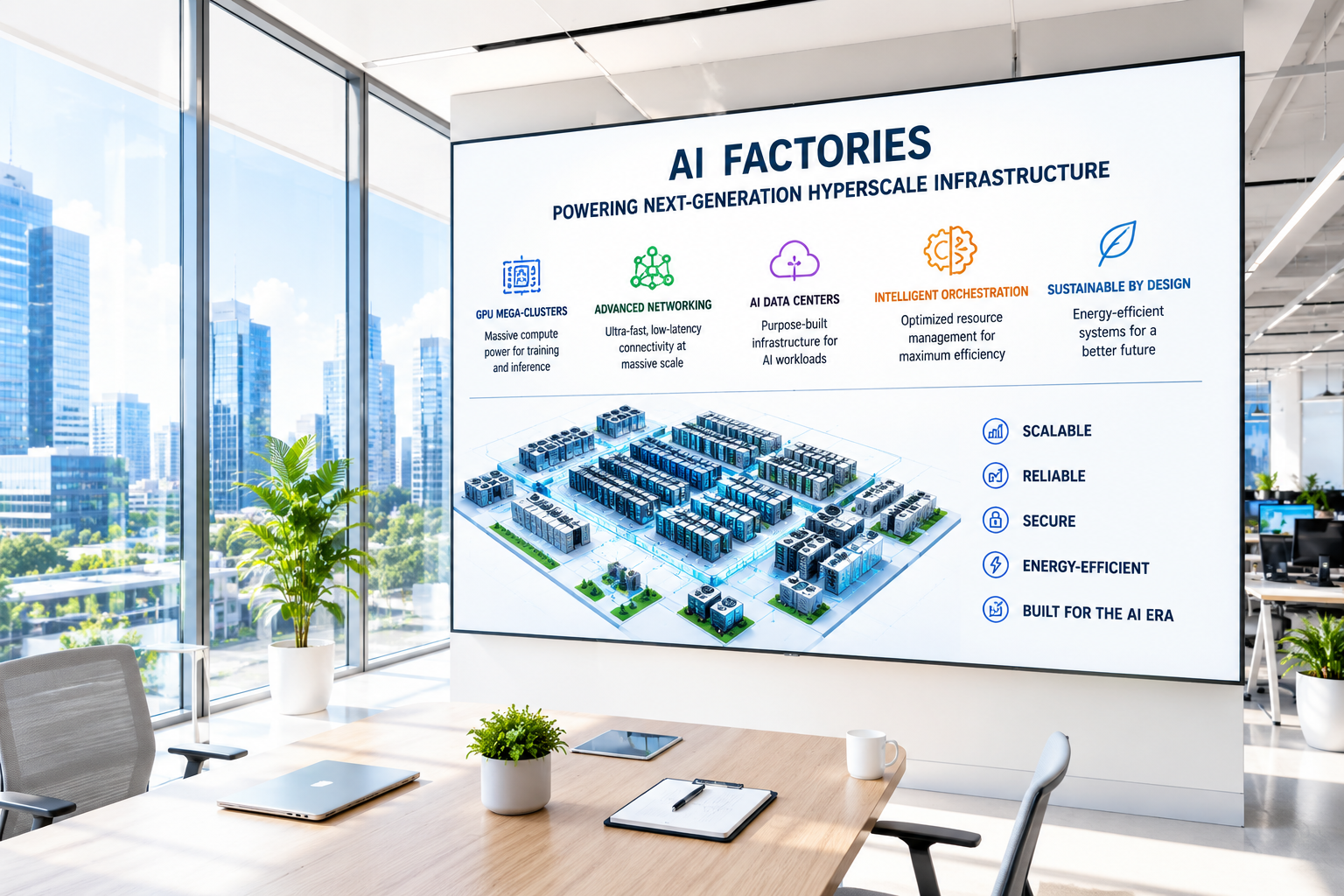
AI Factories Are Becoming the New Digital Backbone
AI factories are rapidly emerging as one of the most important infrastructure shifts in modern cloud computing. As enterprises and hyperscalers race to scale artificial intelligence globally, traditional data center models are evolving into massive AI-focused environments purpose-built for training, inference, automation, and intelligent computing at unprecedented scale.
The rise of generative AI has fundamentally changed infrastructure requirements across the technology industry.
Modern AI workloads require:
- enormous GPU clusters
- ultra-fast networking
- advanced cooling systems
- AI-optimized storage
- hyperscale cloud architectures
- massive power distribution
Traditional enterprise infrastructure was never designed to support the explosive growth of artificial intelligence.
As a result, hyperscalers are now building entirely new infrastructure ecosystems known as AI factories.
What Are AI Factories?
AI factories are hyperscale infrastructure environments specifically engineered to support large-scale AI operations.
Unlike traditional data centers focused primarily on storage and virtualization, AI factories are optimized for:
- AI model training
- AI inference
- generative AI platforms
- machine learning operations
- autonomous systems
- large language models
- AI orchestration
These environments combine:
- GPU mega-clusters
- AI accelerators
- high-speed interconnects
- advanced cooling systems
- massive energy infrastructure
- intelligent workload management
The goal is simple:
maximize AI performance at hyperscale levels.
GPU Mega-Clusters Are Driving AI Infrastructure Growth
At the center of modern AI factories are GPU mega-clusters.
Artificial intelligence systems depend heavily on GPU acceleration to process massive parallel workloads required for:
- generative AI
- neural networks
- AI analytics
- real-time inference
- intelligent automation
Demand for GPU infrastructure has exploded globally as enterprises deploy AI across nearly every industry.
Major hyperscalers including Amazon Web Services, Google Cloud, and Microsoft Azure are aggressively expanding AI infrastructure to remain competitive in the growing AI cloud market.
The ongoing hyperscaler battle for AI dominance was explored in our article on AI Infrastructure Wars between AWS, Google Cloud, and Azure.
GPU demand has become so intense that AI infrastructure expansion is now reshaping global semiconductor supply chains and enterprise cloud strategies.
AI Data Centers Are Evolving Rapidly
AI factories are forcing a complete redesign of the modern data center.
Traditional cloud facilities focused on virtualization and web applications are being replaced by AI-first architectures designed around:
- high-density compute
- AI networking fabrics
- advanced thermal management
- distributed GPU environments
- AI workload optimization
Modern AI data centers consume dramatically more power than conventional facilities due to the enormous processing demands created by artificial intelligence.
This transformation was explored further in our coverage of AI Data Centers Rewriting the Future of Cloud Computing.
AI factories are increasingly being designed from the ground up around:
- liquid cooling
- AI accelerators
- energy optimization
- low-latency networking
- massive GPU scalability
The future of cloud computing is becoming deeply tied to AI-specific infrastructure engineering.
AI Networking Is Becoming Mission Critical
Networking performance has become one of the most important components of AI factories.
Large-scale AI environments require extremely fast communication between:
- GPU clusters
- storage systems
- AI accelerators
- distributed inference engines
Traditional networking architectures often cannot support the low-latency requirements of hyperscale AI operations.
This is driving rapid innovation in:
- AI fabrics
- high-bandwidth interconnects
- software-defined networking
- AI traffic optimization
- intelligent workload orchestration
As AI workloads scale globally, networking infrastructure is becoming just as important as compute performance itself.
The AI Power Crisis Is Accelerating
AI factories are also contributing directly to growing concerns surrounding global energy consumption.
Large AI clusters require:
- enormous electrical capacity
- continuous cooling
- redundant infrastructure
- high-density power delivery
The explosive growth of AI infrastructure is now placing increasing pressure on global energy systems, as discussed in our article on The AI Power Crisis.
Some AI factories now consume energy at levels comparable to small cities.
As AI adoption accelerates, power infrastructure may become one of the defining limitations of future AI scalability.
Enterprises Are Building Private AI Factories
Hyperscalers are not the only organizations investing in AI factories.
Large enterprises are increasingly deploying:
- private AI infrastructure
- dedicated GPU clusters
- hybrid AI environments
- on-prem AI systems
- sovereign AI platforms
Organizations in industries including:
- healthcare
- finance
- insurance
- defense
- manufacturing
are seeking greater control over:
- AI security
- governance
- compliance
- latency
- infrastructure costs
This trend is contributing to the rise of enterprise AI infrastructure strategies focused on long-term scalability and operational independence.
AI Factories Will Define the Next Era of Cloud Computing
The rise of AI factories represents one of the biggest infrastructure transformations in the history of cloud computing.
Artificial intelligence is no longer simply another workload operating inside traditional data centers.
AI is becoming the foundation around which next-generation infrastructure is being designed.
Over the next decade, AI factories will likely shape:
- cloud computing
- enterprise IT operations
- semiconductor innovation
- networking infrastructure
- global energy demand
- digital transformation strategies
Organizations capable of building scalable, efficient, and intelligent AI infrastructure may ultimately become the dominant technology leaders of the AI era.
The future of enterprise computing is increasingly being built inside AI factories.