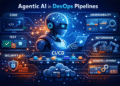

Artificial intelligence in the enterprise is undergoing a profound shift. For years, organizations have deployed AI primarily as a passive assistant — answering questions, generating content, summarizing data, or offering recommendations. But a new paradigm is emerging: agentic AI — systems that don’t just respond to prompts, but can reason, plan, and take action autonomously.
This evolution marks a turning point in how businesses think about automation, productivity, and decision-making.
What Is Agentic AI?
Agentic AI refers to AI systems designed to operate as autonomous or semi-autonomous agents. Unlike traditional AI models that wait for user input, agentic systems can:
-
Set goals
-
Break those goals into tasks
-
Execute actions across software systems
-
Monitor outcomes
-
Adapt strategies based on results
In other words, they behave less like tools and more like digital employees.
These systems combine large language models (LLMs), tool-calling capabilities, memory, and orchestration logic to perform multi-step workflows with minimal human supervision.
From Chatbots to Operators
The first wave of enterprise AI focused on conversational interfaces:
-
Chatbots for customer service
-
Copilots for coding and writing
-
Search assistants for internal knowledge
These tools improved efficiency, but they still required constant human direction.
Agentic AI changes that dynamic.
Instead of asking an AI to help with a task, organizations can ask it to own a task.
Examples include:
-
A procurement agent that monitors inventory, negotiates with suppliers, and places orders
-
A DevOps agent that detects incidents, rolls back deployments, and opens remediation tickets
-
A compliance agent that reviews transactions, flags anomalies, and generates audit reports
-
A sales ops agent that qualifies leads, schedules demos, and updates CRM systems
This is the difference between AI as a productivity enhancer and AI as an operational actor.
Why Enterprises Are Moving Toward Agentic Systems
Several forces are converging to make agentic AI viable and attractive:
1. Model Maturity
Modern LLMs can reason across complex instructions, handle ambiguity, and maintain long-context memory. This makes multi-step planning and execution realistic for the first time.
2. Tool Integration
APIs, SaaS platforms, and internal systems are now highly automatable. Agentic systems can interact with CRMs, ticketing systems, cloud platforms, and financial software as easily as humans do.
3. Orchestration Frameworks
New frameworks allow developers to define workflows, guardrails, and escalation paths for AI agents, ensuring they act safely and predictably.
4. Economic Pressure
Enterprises are under intense pressure to cut costs, increase velocity, and do more with fewer people. Autonomous agents offer a path to scalable digital labor.
Real-World Use Cases Emerging Today
Agentic AI is already moving out of labs and into production environments.
IT Operations
AI agents can monitor system health, detect anomalies, trigger incident response playbooks, and coordinate fixes without human intervention.
Finance
Agents reconcile accounts, monitor cash flow, flag fraud, and generate forecasts automatically.
Customer Support
Instead of routing tickets, agents can resolve entire classes of issues end-to-end.
Cybersecurity
Autonomous security agents investigate alerts, correlate signals, contain threats, and escalate only high-confidence incidents.
Sales and Marketing
Agents personalize outreach, optimize campaigns, score leads, and update engagement metrics in real time.
The Risks of Autonomous AI
While agentic AI offers massive upside, it also introduces new risks:
-
Runaway actions: An agent could execute unintended operations at scale
-
Security exposure: Agents with API access become high-value targets
-
Compliance failures: Autonomous decisions may violate regulatory rules
-
Hallucinated actions: LLMs can fabricate reasoning or steps
For these reasons, early enterprise deployments emphasize:
-
Human-in-the-loop approval
-
Action limits and budgets
-
Role-based permissions
-
Immutable audit logs
-
Kill switches and rollback mechanisms
The Future: Hybrid Human-AI Workforces
The long-term vision isn’t full automation of every role. It’s a hybrid workforce where:
-
Humans define strategy, ethics, and objectives
-
AI agents handle execution, monitoring, and optimization
-
Teams supervise fleets of digital workers
In this model, one human manager might oversee dozens or hundreds of AI agents performing specialized operational roles.
What Enterprise Leaders Should Do Now
To prepare for the agentic future, organizations should:
-
Identify high-volume, rules-driven workflows
-
Map systems and APIs available for automation
-
Pilot limited-scope agents with strict guardrails
-
Establish governance frameworks for autonomous actions
-
Invest in observability and auditability
The enterprises that start experimenting now will define the competitive landscape of the next decade.
Final Thoughts
Agentic AI represents one of the most important shifts in enterprise technology since the move to the cloud.
The question is no longer whether AI can assist your workforce.
It’s whether you’re ready for AI to be part of your workforce.