
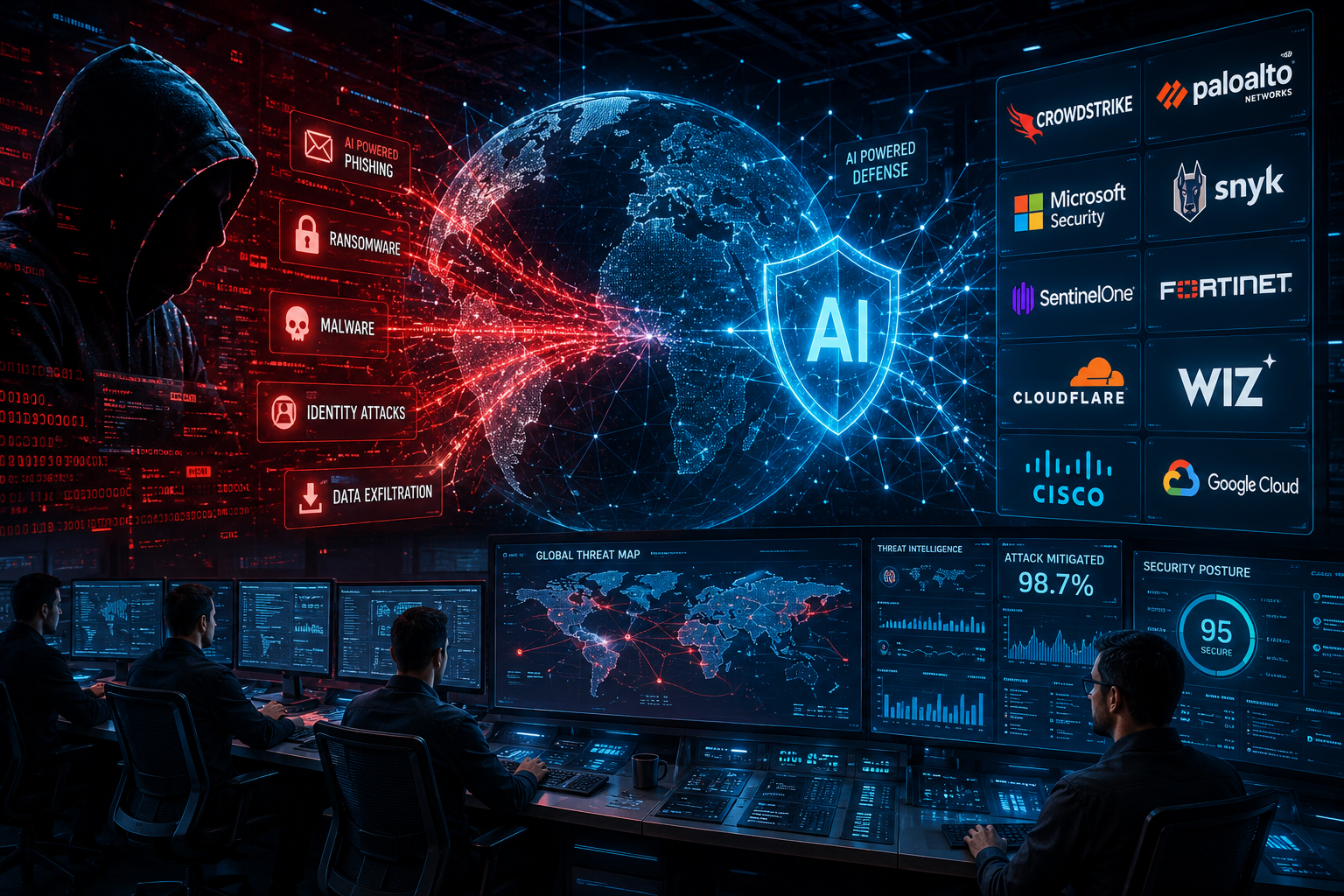
AI vs. Hackers: The Cybersecurity Arms Race in 2026
Artificial intelligence has transformed nearly every industry, but perhaps nowhere is the battle more intense than in cybersecurity. AI vs. Hackers has become one of the defining technology stories of 2026 as cybercriminals embrace artificial intelligence to launch attacks faster, smarter, and at a scale never seen before. In response, cybersecurity companies are deploying AI-powered defenses capable of detecting threats in seconds instead of hours.
The result is an unprecedented digital arms race. Every advancement made by security vendors is quickly studied and challenged by attackers using the same technologies. Businesses can no longer rely solely on traditional antivirus software or manual security operations. They need intelligent systems capable of learning, adapting, and responding in real time.
As organizations continue their digital transformation, understanding how this battle is unfolding has become essential for protecting data, customers, and critical infrastructure.
AI vs. Hackers: Why the Threat Landscape Has Changed
Cyberattacks are no longer the work of a single hacker writing code in a basement. Today’s attackers operate like sophisticated businesses with dedicated teams, customer support, affiliate programs, and automated AI-powered tools.
Artificial intelligence allows attackers to:
- Generate convincing phishing emails in seconds
- Create malware that constantly changes its behavior
- Scan millions of systems for vulnerabilities automatically
- Produce realistic deepfake voices and videos
- Identify weak passwords through intelligent analysis
- Launch highly targeted social engineering attacks
What once required weeks of preparation can now be accomplished in minutes.
Organizations are finding themselves under continuous attack from automated systems that never sleep.
AI vs. Hackers: AI Is Supercharging Cybercrime
Generative AI has lowered the barrier for cybercriminals.
Attackers can now use AI assistants to generate malicious scripts, improve ransomware code, translate phishing campaigns into multiple languages, and customize attacks for specific industries.
Instead of sending generic spam emails, AI creates personalized messages based on publicly available information. These emails often include accurate company names, executive details, and industry terminology, making them significantly more convincing.
Voice cloning technology has also become a growing concern. Criminals can now imitate executives or family members during fraudulent phone calls, increasing the success rate of financial scams.
AI has dramatically reduced both the time and expertise needed to launch sophisticated attacks.
AI vs. Hackers: How CrowdStrike and Other Security Companies Are Responding
Security companies are responding by embedding artificial intelligence directly into their platforms.
CrowdStrike uses AI to analyze billions of security events, helping identify suspicious behavior before malware spreads throughout an organization. Rather than relying solely on known malware signatures, AI looks for unusual activity that could indicate an attack in progress.
Modern endpoint protection platforms continuously monitor:
- User behavior
- Network activity
- File changes
- Application execution
- Identity usage
- Cloud workloads
Machine learning models compare current activity against billions of previous events, allowing suspicious behavior to be detected almost instantly.
This proactive approach significantly reduces response times while helping security teams focus on the most critical threats.
AI vs. Hackers: Why Snyk Is Protecting Software Before It’s Deployed
Cybersecurity no longer begins after software is released.
Companies like Snyk focus on securing applications during development by identifying vulnerabilities before they reach production environments.
AI analyzes:
- Source code
- Open-source dependencies
- Infrastructure-as-Code
- Containers
- Kubernetes configurations
Developers receive recommendations while writing code, allowing vulnerabilities to be corrected before attackers ever have the opportunity to exploit them.
This “shift-left” security approach has become increasingly important as organizations release software more frequently through DevOps and CI/CD pipelines.
AI vs. Hackers: Microsoft, Palo Alto Networks, and Google Are Investing Heavily in AI Security
The world’s largest technology companies recognize that artificial intelligence will define the future of cybersecurity.
Microsoft Security has expanded AI-powered security copilots that help analysts investigate incidents, summarize alerts, and recommend remediation steps.
Palo Alto Networks continues integrating AI into network security, cloud protection, and threat intelligence platforms to automate detection across hybrid environments.
Google Cloud Security leverages AI to improve cloud monitoring, identity protection, and threat hunting while helping organizations respond to emerging attacks more efficiently.
These investments demonstrate that AI is becoming a core component of enterprise security rather than an optional feature.
AI vs. Hackers: Autonomous Security Operations Are Becoming Reality
Security Operations Centers (SOCs) generate enormous amounts of data every day.
Many enterprises process millions of security events daily, making manual investigation nearly impossible.
Artificial intelligence now assists analysts by:
- Prioritizing alerts
- Eliminating false positives
- Correlating events
- Investigating suspicious behavior
- Recommending responses
- Automatically isolating compromised devices
Instead of replacing analysts, AI enables security teams to spend more time investigating genuine threats and less time reviewing routine alerts.
The combination of automation and human expertise is proving far more effective than either approach alone.
AI vs. Hackers: Cloud Security Has Become the New Front Line
As organizations migrate workloads to the cloud, attackers have shifted their attention accordingly.
Misconfigured cloud storage, exposed APIs, excessive user permissions, and vulnerable containers create new opportunities for cybercriminals.
Security vendors including Wiz, Zscaler, Cloudflare, and Fortinet increasingly rely on AI to identify cloud risks before they can be exploited.
These platforms continuously analyze cloud environments for:
- Misconfigurations
- Identity risks
- Publicly exposed resources
- Vulnerable workloads
- Compliance violations
- Suspicious network behavior
Continuous AI-driven monitoring has become essential as cloud environments grow larger and more complex.
AI vs. Hackers: Identity Has Become the Primary Target
Passwords alone are no longer sufficient.
Attackers increasingly target user identities through phishing, credential theft, session hijacking, and multi-factor authentication bypass techniques.
Companies like Okta use AI to identify unusual login behavior by evaluating factors such as device reputation, geographic location, login timing, and user activity patterns.
Adaptive authentication powered by AI helps stop compromised accounts before attackers gain access to sensitive systems.
Identity security has become one of the fastest-growing areas of enterprise cybersecurity.
AI vs. Hackers: Businesses Must Prepare for AI-Powered Threats
Organizations cannot assume that traditional security tools will be enough.
Businesses should prioritize:
- Multi-factor authentication
- Zero Trust security architectures
- Employee cybersecurity awareness training
- Continuous vulnerability management
- AI-assisted endpoint protection
- Secure software development
- Cloud security posture management
- Regular incident response exercises
Technology alone cannot solve cybersecurity challenges. People, processes, and AI must work together.
AI vs. Hackers: The Future of Cybersecurity
The battle between artificial intelligence and cybercriminals is only beginning.
Future attacks will become more autonomous, more personalized, and increasingly difficult to distinguish from legitimate activity. At the same time, defensive AI will continue improving through faster detection, better behavioral analysis, and greater automation.
The organizations that succeed will be those that embrace AI responsibly while maintaining skilled cybersecurity professionals capable of making informed decisions during complex incidents.
Artificial intelligence is not replacing cybersecurity experts—it is becoming one of their most powerful tools.
The AI vs. Hackers arms race will continue shaping enterprise security for years to come. Companies that invest in AI-powered defense platforms, modern security practices, and continuous employee education will be far better positioned to withstand tomorrow’s threats than those relying on yesterday’s technology.
In 2026, cybersecurity is no longer simply about building stronger walls. It is about creating intelligent defenses capable of learning, adapting, and responding just as quickly as the attackers they are designed to stop. For businesses of every size, that may be the single most important investment they make in the AI era.
Related Articles
- The AI Cybersecurity Arms Race: When Intelligent Threats Meet Intelligent Defenses
- AI Without Supervision: The Autonomous AI Agent Security Crisis of 2026
- AI Security in 2026: How AWS Is Building Defenses Before Attacks Even Begin
- Cloud Security in 2026: Protecting AI Workloads, APIs, and Data