
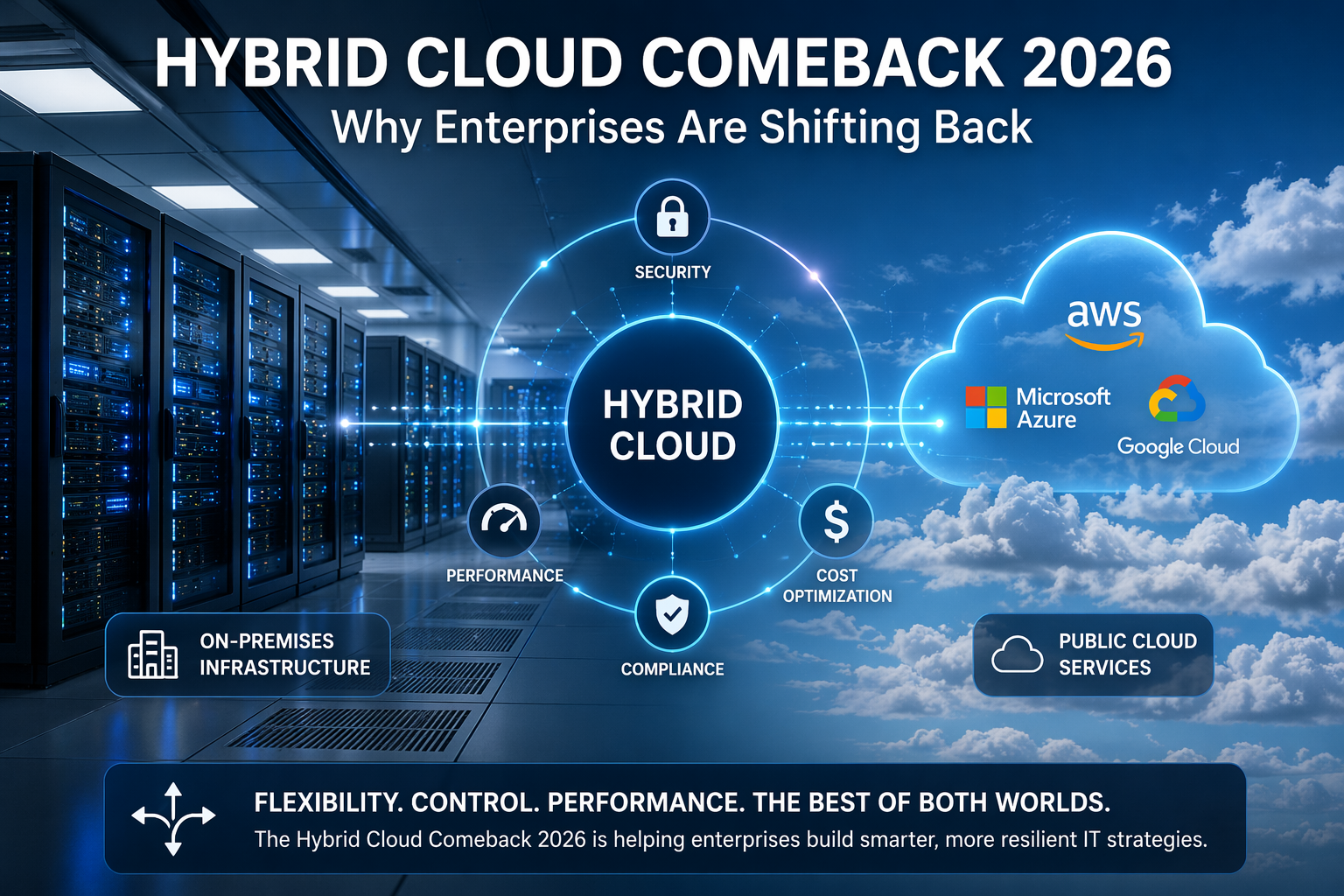
Hybrid Cloud Comeback 2026 Is Accelerating Across Enterprises
The hybrid cloud comeback 2026 is gaining serious momentum as enterprises reevaluate their long-term cloud strategies. For years, organizations aggressively pursued full cloud adoption, driven by promises of scalability, flexibility, and cost efficiency. However, as real-world challenges have emerged, many companies are now realizing that a cloud-only approach is not always the best solution. Instead, hybrid cloud models—combining on-premises infrastructure with public and private cloud environments—are making a strong and strategic return.
This shift is not about abandoning the cloud, but about finding balance. Organizations are recognizing that different workloads have different requirements, and a one-size-fits-all cloud strategy often leads to inefficiencies, higher costs, and performance limitations.
How the Hybrid Cloud Comeback 2026 Is Reshaping IT Strategy
The hybrid cloud comeback 2026 is forcing IT leaders to rethink how infrastructure is designed and managed. Rather than pushing all workloads into the public cloud, companies are adopting a more flexible approach that allows them to place workloads where they make the most sense. Critical applications that require low latency or strict compliance controls are often kept on-premises, while scalable and less sensitive workloads are deployed in the cloud.
This shift provides organizations with greater control over their environments while still benefiting from the agility of cloud platforms. It also allows businesses to optimize performance by reducing dependency on centralized cloud regions, which can introduce latency and reliability challenges.
As enterprises continue to modernize their infrastructure, hybrid cloud is emerging as a practical and sustainable model that aligns with real-world operational needs.
The Cost Reality Driving the Hybrid Shift
One of the biggest drivers behind the hybrid cloud comeback 2026 is cost. As discussed in our analysis of cloud cost explosion 2026, many organizations are struggling with unpredictable and rapidly increasing cloud bills. While cloud services offer flexibility, they can also become expensive when not carefully managed.
Hybrid cloud allows companies to regain control over costs by keeping predictable workloads on-premises, where expenses are more stable. This approach reduces reliance on usage-based pricing models and helps organizations avoid unnecessary spending on cloud resources that may not deliver proportional value.
By strategically balancing cloud and on-premises infrastructure, businesses can achieve a more cost-efficient model that supports long-term growth without constant financial surprises.
Performance and Latency Are Forcing Change
Performance is another critical factor driving the hybrid cloud comeback 2026. Not all applications perform optimally in the public cloud, particularly those that require real-time processing or operate in latency-sensitive environments. For industries such as finance, healthcare, and manufacturing, even small delays can have significant consequences.
Hybrid cloud architectures allow organizations to keep latency-sensitive workloads closer to the source, reducing delays and improving overall performance. At the same time, cloud resources can still be leveraged for tasks that benefit from scalability, such as data analytics and AI processing.
This ability to optimize performance across environments is one of the key reasons why hybrid cloud is becoming increasingly attractive in 2026.

Security and Compliance Are Still Major Concerns
Security remains a top priority for organizations, and it is playing a significant role in the resurgence of hybrid cloud. While public cloud providers offer strong security capabilities, many companies are not comfortable placing all their sensitive data and critical systems in external environments.
The hybrid cloud comeback 2026 reflects a growing desire for greater control over security and compliance. By maintaining certain workloads on-premises, organizations can enforce stricter security policies and ensure compliance with regulatory requirements. This is particularly important in industries with strict data protection laws.
As highlighted in our coverage of the AI threat landscape 2026, the increasing sophistication of cyber threats is pushing companies to adopt more resilient and controlled infrastructure strategies.
Why Multi-Cloud Alone Isn’t Enough
While multi-cloud strategies have gained popularity, they do not fully address the challenges organizations are facing. Managing multiple cloud providers can introduce complexity, increase operational overhead, and create new security risks. Without a clear strategy, multi-cloud environments can become fragmented and difficult to control.
Hybrid cloud offers a more balanced approach by combining the strengths of on-premises infrastructure with the flexibility of cloud platforms. This model reduces dependency on any single provider while maintaining a level of control that is often missing in pure multi-cloud setups.
In many cases, hybrid cloud is not replacing multi-cloud, but complementing it as part of a broader, more strategic infrastructure approach.
The Future of Hybrid Cloud in 2026 and Beyond
The hybrid cloud comeback 2026 is not a temporary trend—it represents a fundamental shift in how organizations think about infrastructure. As businesses continue to adopt AI, process larger volumes of data, and operate in increasingly complex environments, the need for flexible and adaptable infrastructure will only grow.
Hybrid cloud provides the foundation for this flexibility. It allows organizations to innovate without being constrained by the limitations of a single environment, while also maintaining control over critical systems and data.
Looking ahead, we can expect hybrid cloud strategies to become even more sophisticated, with improved integration, automation, and management tools that make it easier to operate across environments. The companies that succeed will be those that embrace this hybrid approach and build infrastructure strategies that are both flexible and resilient.
The Bottom Line
The hybrid cloud comeback 2026 is a direct response to the challenges organizations have faced with cloud-only strategies. Rising costs, performance limitations, security concerns, and operational complexity are all driving businesses to reconsider how they manage their infrastructure.
Rather than abandoning the cloud, companies are evolving their strategies to create a more balanced and efficient model. Hybrid cloud is emerging as the solution that delivers both flexibility and control, making it one of the most important trends in enterprise IT today.