
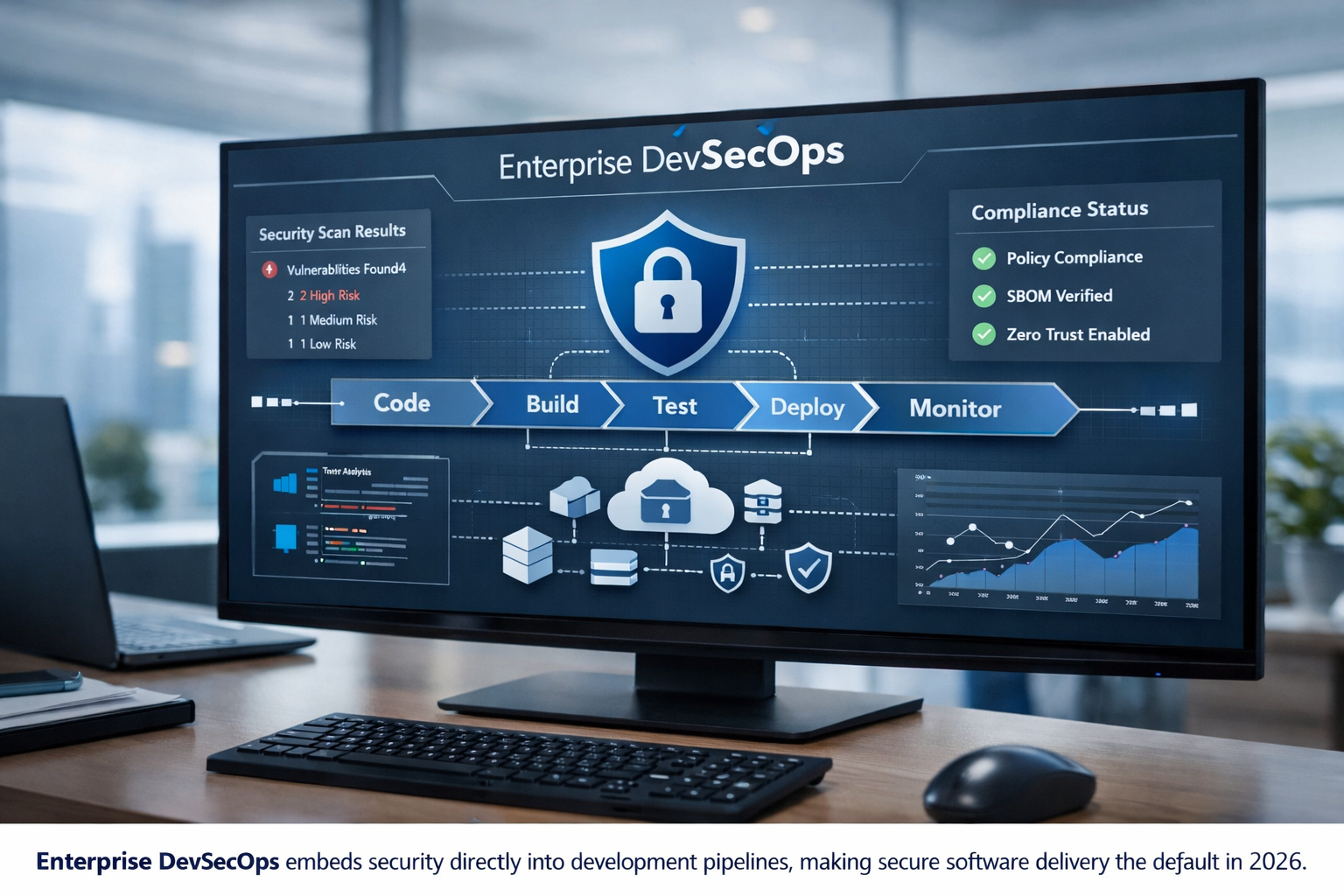
For years, DevSecOps was treated as an evolution of DevOps — an improvement, a best practice, an aspirational maturity goal. In 2026, that narrative has fundamentally shifted. Enterprise DevSecOps is no longer a forward-thinking initiative. It is becoming the default operating model for modern organizations.
The reason is simple: speed without security is no longer survivable.
Enterprises today are deploying software at a velocity unimaginable five years ago. Cloud-native architectures, AI-integrated applications, distributed teams, and continuous delivery pipelines have created unprecedented agility. But this velocity has introduced systemic risk. Security can no longer operate as an external checkpoint or downstream approval function. It must be embedded directly into the engineering lifecycle.
That is the defining principle of Enterprise DevSecOps in 2026.
The Collapse of the “Security as a Gate” Model
Traditional enterprise security operated on gates — compliance reviews, manual approvals, quarterly audits, penetration testing cycles. That structure worked in slower IT environments where release cycles spanned months.
In today’s enterprise, code ships daily — sometimes hourly.
A gate-based model introduces friction. Friction introduces delay. Delay encourages workarounds. And workarounds create shadow IT, unmanaged dependencies, and security blind spots.
Enterprise DevSecOps replaces gates with guardrails.
Instead of asking, “Has security approved this?” organizations now ask, “Is security automated within this pipeline?”
Security becomes code. Policies become enforceable controls embedded into CI/CD systems. Risk is evaluated continuously rather than periodically.
This shift is not theoretical. It is operational reality.
The Scale Problem Driving Enterprise DevSecOps
Enterprise environments are no longer monolithic. They are:
-
Multi-cloud
-
Multi-team
-
Microservices-based
-
AI-augmented
-
API-heavy
-
Globally distributed
Every component introduces potential vulnerabilities: container images, open-source dependencies, infrastructure-as-code templates, AI models, runtime configurations.
Manual security review cannot scale across thousands of microservices and millions of daily API calls.
Enterprise DevSecOps introduces automation at scale:
-
Automated SAST and DAST scanning
-
Software composition analysis (SCA)
-
Container vulnerability scanning
-
Infrastructure-as-code validation
-
Policy-as-code enforcement
-
Runtime anomaly detection
Security shifts from reactive to proactive. And in 2026, that shift is becoming mandatory.
Enterprise DevSecOps and Regulatory Pressure
Regulation is accelerating the shift.
Across industries — finance, healthcare, government, critical infrastructure — regulators are increasing expectations for continuous monitoring and secure development practices.
It is no longer sufficient to demonstrate compliance through documentation alone. Enterprises must prove:
-
Continuous vulnerability management
-
Secure supply chain controls
-
Software bill of materials (SBOM) tracking
-
Zero-trust enforcement models
-
Secure CI/CD governance
Enterprise DevSecOps provides the framework to meet these requirements without slowing innovation.
When security is embedded into the pipeline, compliance artifacts are generated automatically. Audit trails become byproducts of engineering workflows rather than separate exercises.
This dramatically reduces both risk and compliance overhead.
The Supply Chain Wake-Up Call
High-profile software supply chain attacks over the past several years reshaped executive thinking.
Enterprise leaders now understand that the risk does not only come from their own code. It comes from:
-
Open-source dependencies
-
Third-party libraries
-
CI/CD tooling
-
Container registries
-
Infrastructure modules
-
AI model training data
Enterprise DevSecOps addresses this risk holistically.
Instead of securing only application code, it secures:
-
The pipeline
-
The dependencies
-
The build systems
-
The deployment configurations
-
The runtime environment
Security becomes ecosystem-aware.
And in 2026, ecosystem security is non-negotiable.
Cultural Evolution: From Blame to Shared Responsibility
One of the most underestimated aspects of Enterprise DevSecOps is cultural transformation.
In legacy models, security and development teams operated in tension. Developers optimized for speed. Security optimized for risk reduction. The result was friction, escalation, and delayed releases.
Enterprise DevSecOps redefines ownership.
Security becomes a shared engineering responsibility. Developers are empowered with:
-
Real-time vulnerability feedback
-
Integrated security testing in IDEs
-
Pre-configured secure templates
-
Automated remediation suggestions
Instead of blocking releases, security enables safer releases.
This shift improves morale, reduces internal conflict, and accelerates delivery.
In 2026, enterprises are discovering that DevSecOps is as much a people strategy as it is a technical one.
AI Is Accelerating Enterprise DevSecOps
Artificial intelligence is now embedded into modern DevSecOps workflows.
AI-driven systems can:
-
Detect anomalous build patterns
-
Identify risky dependency chains
-
Recommend patch prioritization
-
Predict exploit likelihood
-
Suggest secure code fixes
Enterprise DevSecOps platforms are increasingly integrating AI models to prioritize risk intelligently rather than treating every vulnerability as equal.
This reduces alert fatigue and improves focus on critical threats.
As AI-generated code increases across enterprises, automated security validation becomes even more important. Machine-generated software must be validated continuously.
Enterprise DevSecOps is the only scalable framework capable of handling this reality.
The Financial Argument
Beyond risk and compliance, Enterprise DevSecOps is now a financial strategy.
Security incidents are expensive. But so is slow software delivery.
Organizations that embed security early in the lifecycle experience:
-
Fewer production vulnerabilities
-
Reduced breach exposure
-
Lower remediation costs
-
Faster recovery times
-
Improved developer productivity
Fixing vulnerabilities in production can cost exponentially more than fixing them during development. Enterprise DevSecOps shifts detection left — reducing both cost and impact.
In an era where budgets are scrutinized and boards demand ROI transparency, DevSecOps is increasingly framed as a cost-optimization model.
Platform Engineering and the Rise of Internal Developer Platforms
Another driver of Enterprise DevSecOps in 2026 is platform engineering.
Enterprises are building internal developer platforms (IDPs) that provide standardized pipelines, secure templates, and pre-approved tooling.
Security policies are baked into these platforms by default.
Developers no longer need to manually configure security controls. They inherit them automatically.
This is Enterprise DevSecOps at scale — security by design, not by exception.
Why 2026 Marks the Tipping Point
Several forces are converging simultaneously:
-
Cloud-native complexity
-
AI-generated code
-
Software supply chain risk
-
Regulatory pressure
-
Platform engineering maturity
-
Executive demand for resilience
Together, they make Enterprise DevSecOps not optional — but foundational.
Enterprises that fail to adopt this operating model will struggle with:
-
Slower releases
-
Higher breach risk
-
Compliance gaps
-
Developer friction
-
Escalating security costs
Those that adopt it will gain:
-
Continuous resilience
-
Accelerated delivery
-
Embedded governance
-
Predictable compliance
-
Stronger customer trust
The Future of Enterprise DevSecOps
Looking ahead, Enterprise DevSecOps will continue evolving toward:
-
Fully automated policy enforcement
-
Real-time risk scoring across the SDLC
-
AI-assisted secure coding
-
Deeper runtime intelligence
-
Cross-cloud unified security orchestration
The separation between “DevOps” and “Security” will disappear entirely.
Security will not be an overlay. It will be inseparable from the software lifecycle itself.
That is why Enterprise DevSecOps is becoming the default operating model in 2026.
Not because it is trendy.
Not because vendors promote it.
But because modern enterprises cannot operate safely, compliantly, and competitively without it.