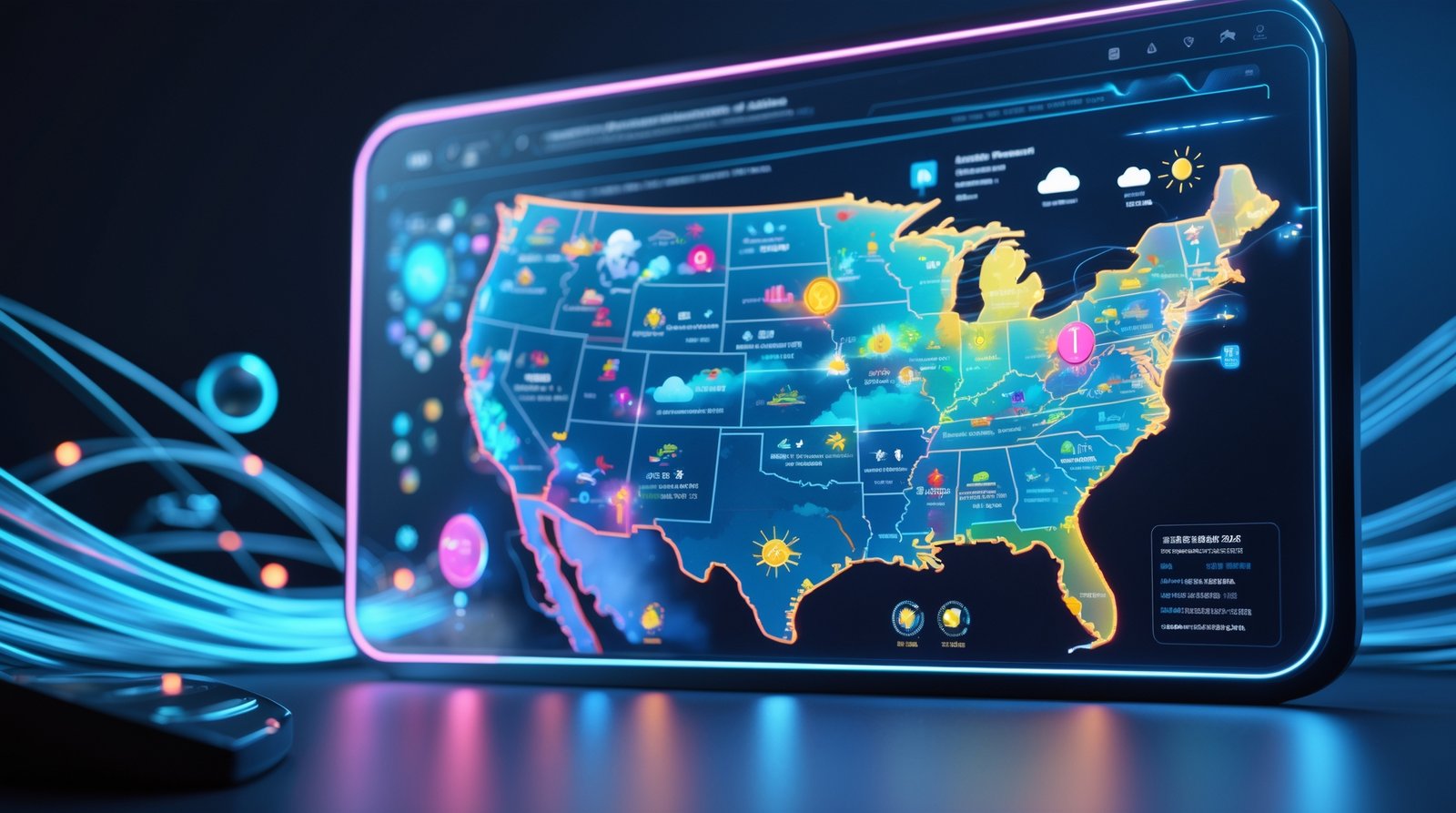
Recent advancements in artificial intelligence have led to a groundbreaking shift in weather prediction accuracy and efficiency, marking a significant milestone in meteorological science. Researchers and scientists have reported substantial improvements in weather forecasting capabilities through AI-driven models, revolutionizing how we predict weather patterns and natural phenomena.
Traditional weather forecasting, reliant heavily upon mathematical models and extensive computational resources, has long faced limitations in accuracy, especially in predicting short-term weather events and extreme phenomena. However, recent developments leveraging artificial intelligence have drastically changed this scenario. AI-driven systems now provide forecasts that are not only significantly faster but also notably more precise.
One of the major breakthroughs in AI weather prediction is attributed to sophisticated machine learning models, particularly deep neural networks, trained on vast amounts of historical weather data. These advanced models can rapidly identify complex patterns and subtle signals that traditional forecasting methods typically overlook. This has resulted in forecasts with reduced uncertainty, particularly valuable for predicting extreme weather events such as hurricanes, tornadoes, floods, and severe storms.
In one notable development, AI systems successfully predicted severe weather incidents several days in advance, providing timely warnings and enabling better preparedness and risk mitigation. These systems utilize data from diverse sources, including satellite imagery, radar signals, ground sensors, and historical weather databases, integrating this information seamlessly to generate highly accurate predictive models.
The adoption of AI-driven weather prediction tools has significant practical implications across multiple sectors. In agriculture, precise weather forecasting enables better crop management, guiding planting and harvesting decisions, optimizing water usage, and reducing crop losses due to unforeseen weather disruptions. Similarly, energy sectors, particularly renewable energy industries such as wind and solar power, greatly benefit from improved forecasts. Accurate predictions help optimize energy production and distribution, thus enhancing efficiency and reliability.
Furthermore, the transportation industry has also felt substantial benefits from these advancements. Improved weather prediction significantly enhances safety and operational efficiency across aviation, maritime, and road transport by enabling operators to anticipate adverse conditions and adjust routes or schedules proactively.
Moreover, AI-driven weather forecasting can potentially mitigate the economic and human impacts of severe weather. Accurate early warnings provide crucial lead times for communities in disaster-prone areas to evacuate or implement protective measures, thus saving lives and reducing economic losses.
Despite the impressive progress, experts acknowledge that AI-driven models still face challenges, primarily related to the availability and quality of training data. Areas with sparse weather-monitoring infrastructure continue to experience forecast inaccuracies due to insufficient local data. Additionally, the interpretability of AI models remains an issue—meteorologists and scientists need to understand the underlying decision-making processes of these algorithms to validate and trust their predictions fully.
Looking forward, the future of AI in weather forecasting holds immense potential. Researchers are actively developing hybrid models that combine AI techniques with traditional physics-based approaches, aiming for enhanced accuracy and interpretability. Ongoing innovations also focus on real-time data assimilation, further refining prediction capabilities and reducing the latency between data collection and actionable insights.
In conclusion, the AI-driven breakthrough in weather prediction signifies a transformative advancement in meteorology, enhancing our ability to forecast and respond to weather-related threats effectively. As these technologies evolve, their integration into everyday forecasting operations promises not only improved safety and economic efficiency but also greater resilience against the uncertainties of climate change and extreme weather conditions.