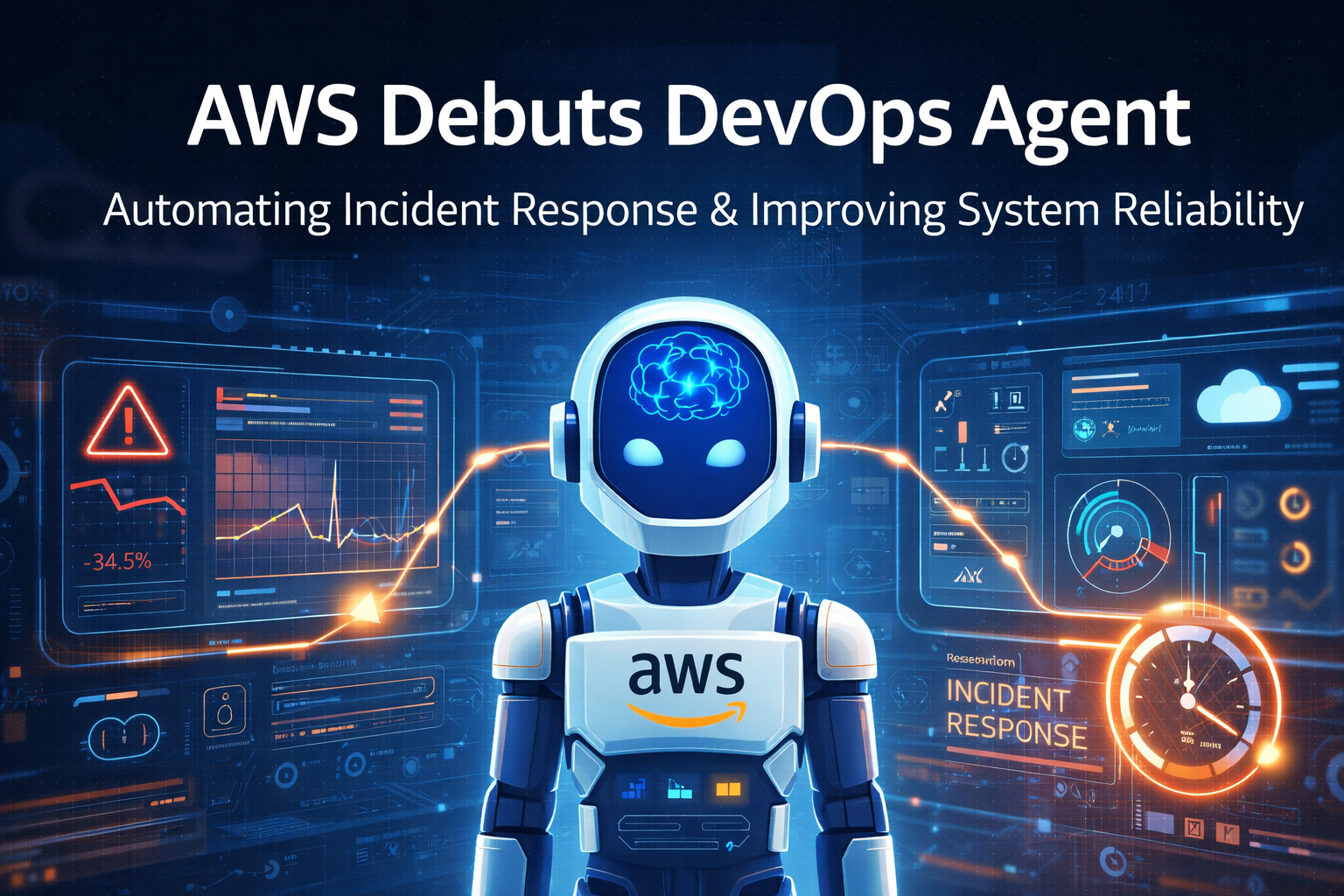
Amazon Web Services is taking a decisive step toward autonomous operations with the introduction of DevOps Agent, a new AI-powered capability designed to help teams detect, diagnose, and respond to incidents faster—with far less manual intervention.
As cloud environments grow more complex and distributed, traditional DevOps and SRE models are struggling to keep up. Alert fatigue, fragmented tooling, and human-dependent response workflows continue to slow recovery times. AWS’s DevOps Agent is positioned as a response to that reality: an intelligent system that can reason about incidents, recommend actions, and in some cases execute remediation automatically.
If successful, this marks a meaningful shift in how cloud reliability is managed.
Why Incident Response Has Become a Breaking Point
Modern cloud-native systems operate across:
-
Microservices
-
Managed cloud services
-
Event-driven architectures
-
Multi-region deployments
When something fails, the blast radius is often unclear, alerts arrive simultaneously from multiple systems, and responders must manually correlate logs, metrics, and traces under pressure.
Even mature organizations face challenges such as:
-
Long mean time to resolution (MTTR)
-
Over-reliance on senior engineers
-
Inconsistent runbooks
-
Slow root-cause analysis
-
Human error during high-stress events
AWS DevOps Agent is designed to reduce these friction points by embedding AI reasoning directly into operational workflows.
What AWS DevOps Agent Is (and Isn’t)
AWS DevOps Agent is not a replacement for engineers, and it’s not a generic chatbot bolted onto monitoring data.
Instead, it functions as an agentic system that:
-
Continuously observes signals across AWS services
-
Correlates events and telemetry
-
Identifies likely root causes
-
Suggests or executes remediation steps
-
Learns from previous incidents and outcomes
This places it in a new category: autonomous operational assistance, rather than passive observability or alerting.
How DevOps Agent Works
While AWS has not disclosed every internal mechanism, the model is built around several key capabilities:
1. Intelligent Signal Correlation
Rather than firing alerts in isolation, DevOps Agent analyzes:
-
Metrics
-
Logs
-
Traces
-
Configuration changes
-
Deployment activity
This allows it to recognize patterns that typically require human intuition—such as linking a performance regression to a recent infrastructure or application change.
2. Context-Aware Diagnosis
DevOps Agent reasons about:
-
Service dependencies
-
Historical incident patterns
-
Known failure modes
-
Environment-specific configurations
This context is critical. Two identical alerts may require very different responses depending on workload type, region, or business criticality.
3. Automated and Semi-Automated Remediation
Depending on configuration and confidence levels, the agent can:
-
Recommend corrective actions
-
Trigger predefined runbooks
-
Roll back recent changes
-
Scale resources
-
Restart services
Organizations retain control over how autonomous the agent is allowed to be, which is essential for trust and governance.
4. Learning Over Time
Each incident becomes training data.
As the agent observes outcomes, it refines:
-
Which signals matter most
-
Which actions are effective
-
Which responses should require human approval
This continuous improvement loop is where AI-driven operations begin to show compounding value.
Why This Matters for Reliability Engineering
AWS DevOps Agent reflects a broader shift in the industry: reliability can no longer depend solely on human response speed.
As systems scale, reliability must be:
-
Predictive rather than reactive
-
Automated rather than manual
-
Systemic rather than individual-driven
For SRE and DevOps teams, this means:
-
Less time firefighting
-
Faster incident containment
-
More consistent outcomes
-
Reduced dependency on hero engineers
It also allows teams to focus on prevention, architecture, and resilience, rather than constant incident response.
The Business Impact Goes Beyond Uptime
Incident response is not just a technical concern—it’s a financial and operational one.
Faster and more consistent resolution translates to:
-
Reduced downtime costs
-
Lower operational risk
-
Improved customer experience
-
Better compliance and auditability
-
More predictable service delivery
For organizations running revenue-generating or mission-critical workloads on AWS, even small improvements in MTTR can have outsized business impact.
Where Human Oversight Still Matters
Despite its promise, DevOps Agent is not a “set it and forget it” solution.
Teams will still need to:
-
Define remediation boundaries
-
Validate recommended actions
-
Review automated decisions
-
Train the system with accurate runbooks and data
-
Establish governance and approval workflows
The most successful deployments will treat DevOps Agent as a co-pilot, not an autopilot.
A Signal of Where Cloud Operations Are Headed
AWS DevOps Agent is part of a larger trend toward agentic AI in infrastructure and operations.
Rather than static tools that surface data, platforms are evolving into systems that:
-
Understand intent
-
Reason about state
-
Take action
-
Learn from outcomes
This represents a fundamental change in how reliability, operations, and DevOps are practiced.
Final Thoughts
AWS’s debut of DevOps Agent is less about a single feature and more about a shift in philosophy.
As cloud environments continue to grow in scale and complexity, automation alone is no longer enough. The future of reliability lies in intelligent systems that can reason, decide, and act alongside humans.
For DevOps and SRE teams, the question is no longer whether AI will be part of operations—but how quickly organizations are prepared to trust and govern it.