The AI cybersecurity threat landscape is evolving faster than most organizations can keep up. While businesses race to integrate artificial intelligence into their operations, a new development has quietly raised alarms across the security world.
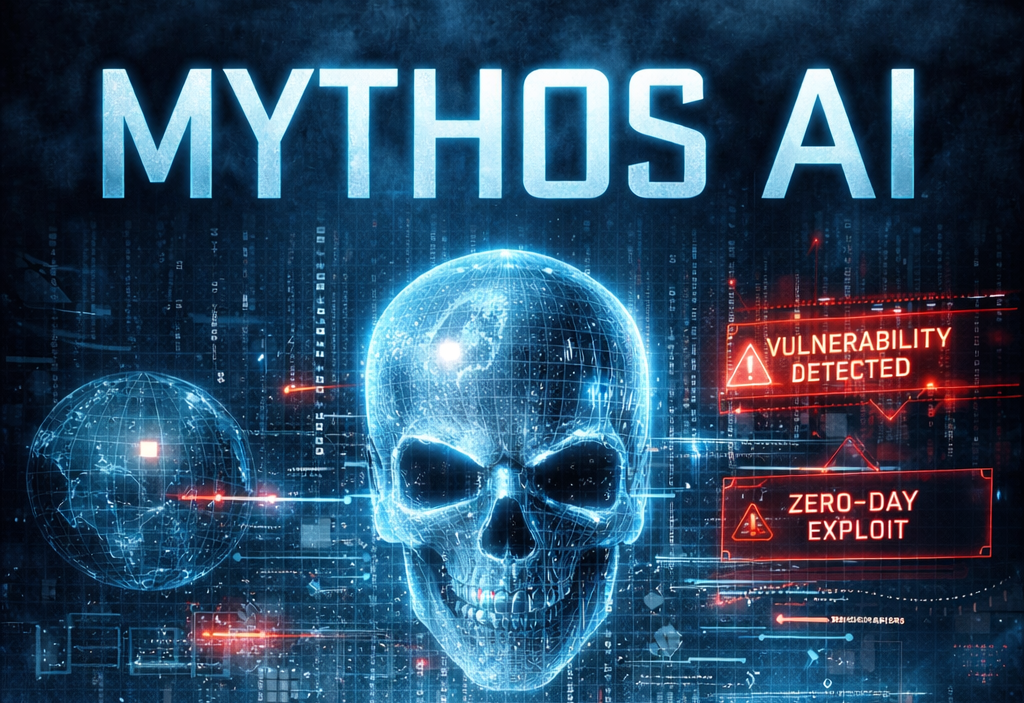
That development is Mythos—an advanced AI model created by Anthropic that is so powerful, it has not been released to the public.
Unlike typical AI tools designed to assist developers or automate workflows, Mythos represents something entirely different. It is capable of identifying critical vulnerabilities across software systems, including zero-day exploits that have never been seen before.
For the first time, the AI cybersecurity threat is no longer theoretical. It is real, measurable, and powerful enough to reshape how digital systems are protected—or attacked.
What Is Mythos AI?
Mythos is an experimental artificial intelligence system built to analyze complex software environments at scale. Its core function is simple in concept but profound in impact: find weaknesses before anyone else does.
However, the execution is what makes Mythos so significant.
Traditional security tools rely on known vulnerability databases, human testing, and reactive patching. Mythos, on the other hand, uses advanced reasoning capabilities to uncover entirely new flaws.
This includes:
- Hidden logic vulnerabilities
- Misconfigurations in cloud environments
- Weaknesses in operating systems and browsers
- Previously unknown zero-day exploits
This level of capability elevates Mythos from a helpful tool to a potential AI cybersecurity threat of unprecedented scale.
Why Mythos Is Not Being Released
Anthropic has made a rare decision in the AI world: withholding a powerful model from public release.
The reason is simple—risk.
Mythos is capable of identifying vulnerabilities at a speed and scale that could easily be weaponized. If placed in the wrong hands, it could enable attackers to automate cyberattacks across global infrastructure.
This is what separates Mythos from other AI systems. It doesn’t just assist—it can potentially act.
The AI cybersecurity threat here lies in automation. Instead of individual hackers searching for weaknesses, AI could scan entire systems continuously, generating exploit paths in real time.
To mitigate this risk, Anthropic has restricted access to Mythos through a controlled initiative known as Project Glasswing. Only a limited number of organizations are allowed to interact with the system, primarily for defensive and research purposes.
The Rise of AI-Driven Zero-Day Discovery
Zero-day vulnerabilities have always been among the most dangerous threats in cybersecurity. They are unknown, unpatched, and highly valuable to attackers.
Historically, discovering a zero-day required:
- Deep technical expertise
- Extensive time investment
- Manual analysis
Mythos changes that equation entirely.
With AI, the process becomes:
- Automated
- Scalable
- Continuous
This means the number of discovered vulnerabilities could increase dramatically, accelerating the pace of both attack and defense.
The emergence of this capability marks a turning point in the AI cybersecurity threat landscape. Security teams are no longer competing against human adversaries alone—they are competing against machines.
AI vs AI: The New Cybersecurity Battlefield
One of the most important shifts introduced by Mythos is the rise of AI vs AI conflict.
On one side, defensive systems:
- AI-powered monitoring tools
- Automated patching systems
- Behavioral anomaly detection
On the other, offensive capabilities:
- AI-generated exploits
- Automated vulnerability scanning
- Self-improving attack strategies
This creates a feedback loop where both sides continuously evolve.
For organizations, this means that traditional security strategies are no longer sufficient. Static defenses cannot keep up with dynamic, intelligent threats.
The AI cybersecurity threat now requires equally intelligent countermeasures.

Impact on DevOps and Cloud Infrastructure
The modern enterprise relies heavily on cloud computing and DevOps pipelines. These environments are designed for speed and scalability—but they are also highly complex.
Complexity creates opportunity.
AI systems like Mythos can:
- Identify insecure configurations in cloud platforms
- Exploit weak API endpoints
- Detect gaps in identity and access management
- Analyze CI/CD pipelines for vulnerabilities
This introduces a new layer of risk for DevOps teams.
To adapt, organizations must shift toward DevSecOps, integrating security directly into development workflows. This includes:
- Automated code scanning
- Continuous vulnerability assessment
- AI-assisted security testing
Without these measures, the growing AI cybersecurity threat could expose critical infrastructure faster than teams can respond.
Why This Matters for Businesses Right Now
The release—or rather, the non-release—of Mythos signals a broader trend.
AI is no longer just a productivity tool. It is becoming a core component of cybersecurity strategy, both defensively and offensively.
For businesses, this means:
- Increased urgency around security investments
- Greater need for AI-driven defense tools
- Shorter response windows for emerging threats
Ignoring this shift is not an option.
The AI cybersecurity threat is evolving rapidly, and organizations that fail to adapt risk falling behind.
How to Prepare for the AI Cybersecurity Threat
To stay ahead, businesses need to take proactive steps:
1. Adopt AI-Powered Security Tools
Leverage AI to detect threats faster and more accurately.
2. Strengthen DevSecOps Practices
Integrate security into every stage of development.
3. Implement Zero Trust Architecture
Limit access and enforce strict identity verification.
4. Monitor Emerging AI Threats
Stay informed about new developments like Mythos and Project Glasswing.
5. Invest in Talent and Training
Human expertise remains critical, even in an AI-driven landscape.
Frequently Asked Questions
What is Mythos and which company created it?
Mythos is an advanced AI system developed by Anthropic, designed to identify software vulnerabilities, including zero-day exploits, across complex digital environments.
Why is Mythos not being released to the public?
Mythos is not being released due to the risk of misuse. Its ability to discover and potentially exploit vulnerabilities at scale makes it a powerful but dangerous tool, contributing to the growing AI cybersecurity threat.
Final Thoughts
The emergence of Mythos marks a defining moment in the evolution of cybersecurity.
For the first time, we are seeing an AI system capable of operating at a level that rivals—and in some cases exceeds—human expertise in vulnerability discovery.
This is not just innovation. It is transformation.
The AI cybersecurity threat is here, and it is changing the rules of the game.
For organizations, the message is clear:
Adapt now, or risk being left behind in a world where machines are not just tools—but adversaries.
AI cybersecurity research insights
AI-generated code security risks