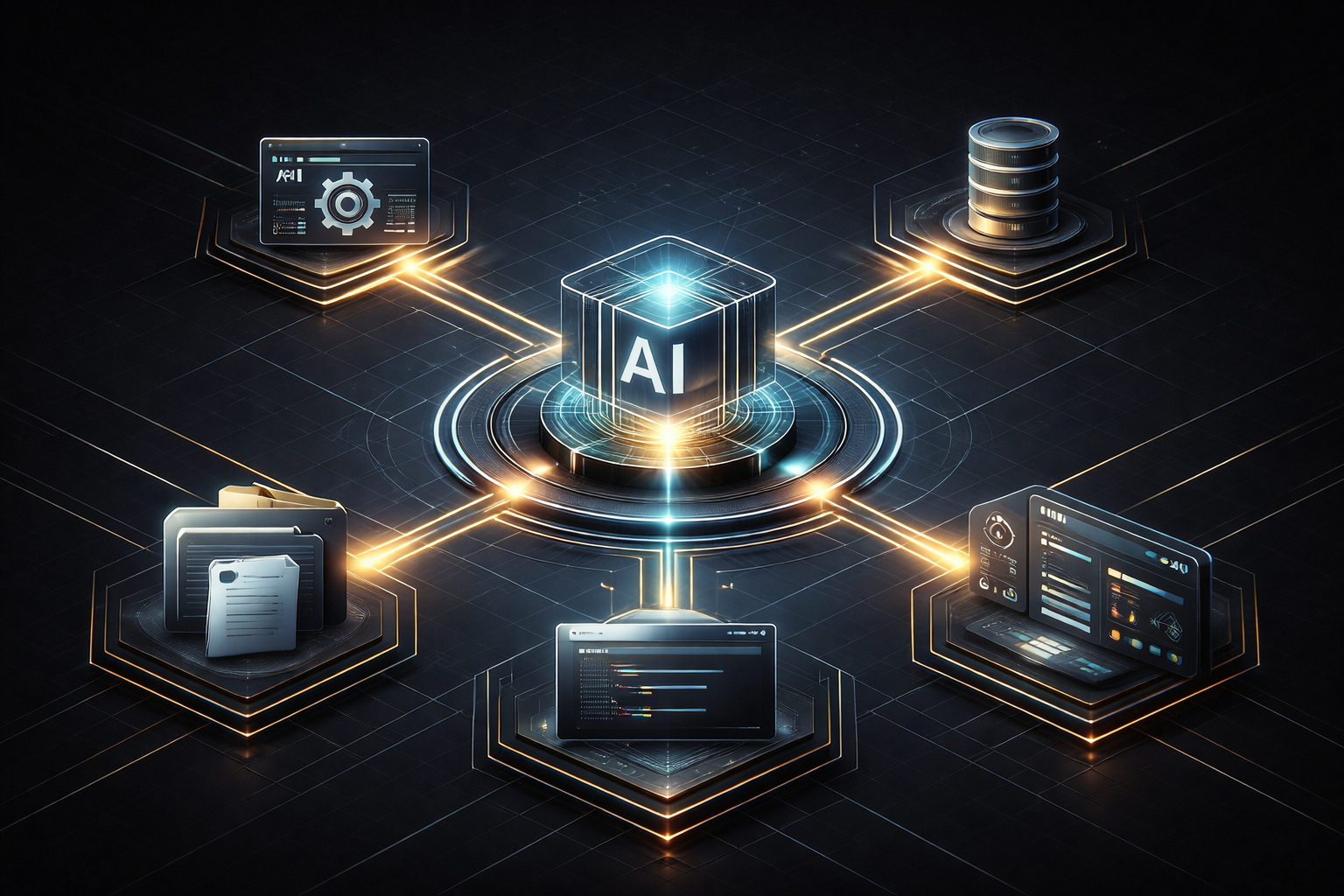
Artificial intelligence is becoming more capable by the month, but raw intelligence is only part of the story. A model can generate content, summarize information, write code, and answer questions, yet its real value increases dramatically when it can interact with the systems where work actually happens. That includes documents, APIs, databases, cloud platforms, internal tools, developer environments, and business workflows.
That is exactly why Model Context Protocol is getting attention.
At its core, Model Context Protocol, or MCP, is a structured way for AI applications to connect with outside systems. Instead of every AI tool inventing its own one-off connector for every file system, application, or service, MCP creates a more organized framework for how those interactions happen. It is basically an attempt to make AI integration less messy, less fragile, and more reusable.
That matters because the next phase of AI is not just about better models. It is about better connections.
Why AI integration has been such a mess
One of the biggest problems in modern AI is that models often live in one world while business systems live in another. The model may be powerful, but it cannot do much unless someone builds the bridge between the model and the tools, data, or workflows it needs to access.
In many environments, those bridges have been built manually. One team writes a connector for a database. Another creates a plugin for an internal dashboard. Another wires an assistant into a ticketing tool. Another builds custom logic so an agent can pull from a document store. Over time, this creates a pile of separate integrations that are hard to maintain, hard to secure, and hard to reuse across different AI applications.
That is where Model Context Protocol becomes valuable.
Instead of treating every integration as a one-off engineering project, MCP offers a common structure for how AI systems and external services can talk to each other. That does not eliminate all complexity, but it brings more consistency to a part of AI architecture that has often been chaotic.
What Model Context Protocol actually does
The easiest way to understand MCP is to think of it as a standard interaction layer between AI applications and external capabilities.
An AI system usually needs three kinds of things from the outside world:
-
access to information
-
access to actions
-
access to structured guidance
MCP helps separate those things into clear categories. A connected service can expose data the model can read, functions the model can call, or reusable interaction patterns the model can follow. That is a cleaner approach than forcing every outside connection into the same rough shape.
In practical terms, Model Context Protocol helps AI apps discover what is available, understand how to use it, and interact with outside systems in a more predictable way. That makes it easier to build assistants, agents, and AI-enabled tools that can do more than just generate text.
Why MCP matters for AI agents
This topic becomes even more important when people start talking about AI agents.
A simple chatbot can still be useful without deep integration. An agent cannot.
If a team wants an AI agent to inspect logs, look up a ticket, retrieve a document, query a system, or trigger a workflow, the model needs controlled access to those outside resources. Without a clean integration layer, agent development becomes slow, inconsistent, and risky. Every new connection becomes another custom build.
That is why Model Context Protocol matters so much right now. It fits the moment.
The AI market is moving beyond isolated assistants and into systems that are expected to do real work. That means models need structured access to real environments. The value of MCP is that it helps create a more disciplined way to make those connections happen.
Why standardization is such a big deal
Standards often sound boring until you realize how much time they save.
When every integration follows a different pattern, teams waste energy rebuilding the same ideas over and over. One group invents its own schema. Another group uses a completely different method. Another builds an internal wrapper no one else can use. That kind of fragmentation slows adoption and creates long-term maintenance pain.
Model Context Protocol offers a path toward standardization.
If developers can build around a shared model for exposing tools, resources, and workflows, AI integration becomes more portable. One integration can support multiple AI experiences. One service can be reused instead of rewritten. One structure can be understood by multiple teams.
That does not just improve efficiency. It also improves design quality.
A shared protocol encourages people to think more clearly about what should be exposed, how it should be described, and how access should be managed. In that sense, MCP is not just about interoperability. It is also about discipline.
Why this matters for enterprise AI
Enterprise AI does not fail because of weak demos. It usually struggles because of real-world complexity.
A model may work beautifully in a controlled setting, but production environments involve permissions, workflow rules, system boundaries, compliance concerns, and tool sprawl. The more systems an AI application touches, the more important the connection layer becomes.
That is why Model Context Protocol is especially relevant for enterprises.
Businesses want AI tools that can help with real operations, not just generate nice answers. They want systems that can retrieve internal knowledge, work across business apps, assist employees, and support automation without requiring a brand-new integration strategy every time. MCP is appealing because it offers a framework for that kind of connected environment.
For enterprise teams, the question is not just whether a model is smart. The question is whether the model can plug into the organization in a practical and manageable way.
That is exactly the type of problem MCP is designed to address.
Why DevOps and platform teams should care
This is not just an AI application topic. It is also a platform and operations topic.
If AI is going to become part of developer workflows, incident response, internal tooling, infrastructure automation, or engineering support, then DevOps and platform teams are going to be involved. They are the people who think about safe access, service boundaries, workflow control, observability, and system reliability.
From that perspective, Model Context Protocol is important because it creates a more structured way to expose capabilities to AI systems.
Instead of random point integrations spreading across the environment, teams can move toward a more intentional connection model. That makes governance easier. It makes reuse easier. It makes it easier to understand what an AI system can reach and what it should never touch.
That is why MCP fits naturally into conversations about internal platforms, AI-enabled operations, and the future of engineering workflows.
The security side of MCP
Of course, no connection layer is useful if it becomes a security problem.
The moment an AI system can reach external tools or internal resources, the stakes rise. Access controls matter. Scope matters. Approval flows matter. Logging matters. Audit trails matter. It is not enough to make AI connected. It also has to be controlled.
Model Context Protocol does not magically solve security, but it does make the structure of interaction more explicit. That helps teams reason more clearly about what is being exposed and how models are expected to use it.
In many ways, the protocol is only the beginning. Real safety comes from how organizations implement it. Teams still need to decide which capabilities are read-only, which actions require human review, what data should never be exposed, and how to prevent AI systems from overreaching.
So while MCP is exciting, it also pushes security and governance higher up the priority list.
Why MCP could become a foundational layer
The most interesting thing about Model Context Protocol is that it reflects where AI is heading.
The first generation of AI enthusiasm focused heavily on the model itself. The next generation is focusing more on the system around the model. That includes orchestration, memory, tools, workflows, permissions, and the way AI fits into real software environments.
That is why MCP could become much more important than it looks at first glance.
It is not just a technical spec. It is part of a larger shift toward making AI more operational. If AI is going to become deeply embedded in products, enterprises, and engineering systems, then the connection layer must become more mature. MCP is one of the clearest signs that the industry is beginning to treat that layer seriously.
In simple terms, it helps move AI from isolated intelligence to connected utility.
And that is a major step forward.
Final thoughts
Model Context Protocol matters because AI without context is limited, and AI without clean integration is hard to scale.
The real future of AI will not be shaped only by bigger models or better reasoning. It will also be shaped by how well those models connect to the outside world. Businesses need AI systems that can work with real data, real tools, and real workflows. Developers need a cleaner way to build those connections. Platform teams need a more manageable structure for governing them.
That is why MCP is getting attention.
It is trying to solve one of the most important practical problems in AI today: how to connect intelligence to action in a way that is structured, reusable, and easier to manage.
That may not sound flashy.
But it could end up being one of the most important building blocks in the next phase of AI adoption.