For years, the cloud promised efficiency, scalability, and cost savings. Pay only for what you use. Scale on demand. Eliminate wasted infrastructure.
But in 2026, that promise is under serious pressure.
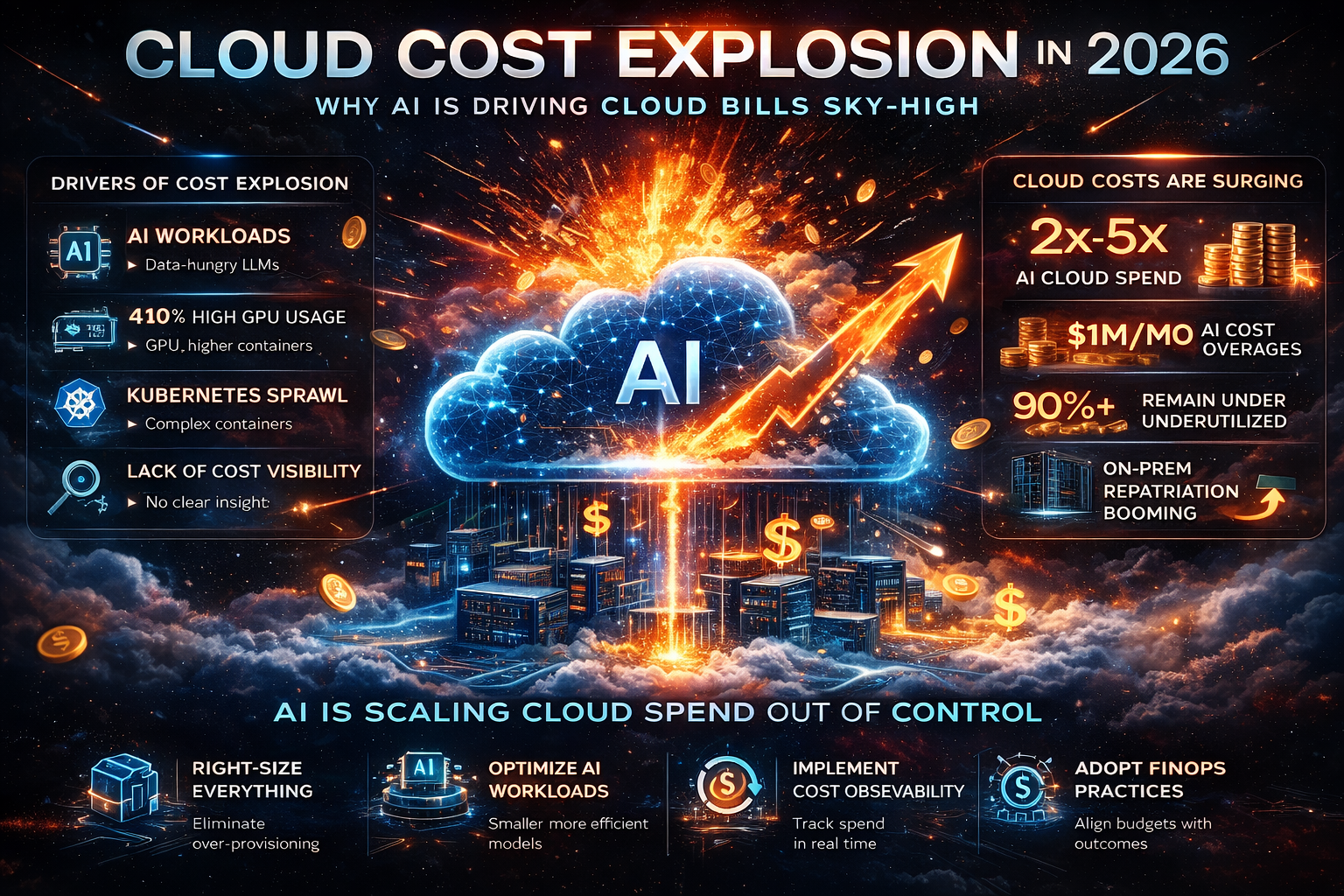
Enterprises are now facing a new reality: a cloud cost explosion driven by AI workloads, unpredictable scaling, and inefficient resource management. What once felt like a cost-saving strategy is quickly becoming one of the largest line items in IT budgets.
And for many organizations, the numbers are no longer sustainable.
The Perfect Storm Behind the Cloud Cost Explosion
The rise in cloud spending isn’t happening by accident. It’s the result of multiple forces converging at once.
1. AI Workloads Are Inherently Expensive
AI—especially large language models and generative systems—demands massive compute power.
Training models requires:
- GPUs or specialized accelerators
- High-performance storage
- Continuous data pipelines
Even inference (running models in production) can be costly at scale.
Unlike traditional workloads, AI systems are:
- compute-intensive
- memory-heavy
- always-on
This makes them significantly more expensive to operate in the cloud.
2. Over-Provisioning Is Out of Control
To avoid performance issues, teams often over-provision resources.
They:
- allocate more compute than needed
- leave instances running 24/7
- fail to scale down after peak usage
In traditional systems, this was manageable.
With AI, it becomes catastrophic.
Because the baseline cost is already high, over-provisioning multiplies the problem.
3. Kubernetes Sprawl Is Making It Worse
Modern applications run on containerized platforms like Kubernetes.
While powerful, Kubernetes introduces:
- complex scaling behavior
- hidden resource consumption
- lack of visibility
Clusters grow. Services multiply. Costs become harder to track.
This phenomenon—often called Kubernetes sprawl—is a major contributor to cloud waste.
4. Lack of Cost Visibility
One of the biggest issues is simple:
👉 Most teams don’t know where their money is going.
Cloud bills are:
- complex
- fragmented
- difficult to interpret
Costs are spread across:
- compute
- storage
- networking
- third-party services
Without clear visibility, optimization becomes guesswork.
Why Traditional Cost Optimization No Longer Works
For years, cloud cost optimization focused on:
- Reserved instances
- Spot pricing
- Basic monitoring
But these approaches are no longer enough.
AI workloads introduce:
- dynamic usage patterns
- unpredictable scaling
- real-time processing demands
Static optimization strategies simply can’t keep up.
The Rise of FinOps in the AI Era
To address the cloud cost explosion, organizations are turning to FinOps—a discipline that brings financial accountability to cloud spending.
FinOps is not just about saving money. It’s about:
- understanding cost drivers
- aligning spend with business value
- enabling smarter decision-making
In the AI era, FinOps becomes critical.
Because every query, every model run, every API call has a cost.
Real-World Impact: Budgets Are Breaking
Across industries, companies are reporting:
- 2x to 5x increases in cloud spending
- AI projects exceeding budget expectations
- difficulty forecasting future costs
What started as innovation is quickly turning into financial strain.
And leadership is taking notice.
CIOs and CFOs are now asking hard questions:
- Why are costs rising so fast?
- What is the ROI of our AI investments?
- How do we control this before it spirals further?
The Hidden Cost of AI Inference
Most discussions focus on training costs.
But the real long-term expense is inference.
Every time a user:
- queries a chatbot
- generates content
- runs an AI-powered feature
It triggers compute usage.
At scale, this becomes enormous.
Millions of requests per day = massive ongoing cost.
This is where many organizations get caught off guard.
Strategies to Control the Cloud Cost Explosion
The situation is serious—but not hopeless.
Here’s how teams are regaining control.
1. Right-Size Everything
Stop over-provisioning.
Use:
- auto-scaling
- workload profiling
- real-time monitoring
Only pay for what you actually need.
2. Optimize AI Workloads
Not all AI tasks require maximum compute.
Consider:
- smaller models
- model quantization
- batching requests
Efficiency matters more than raw power.
3. Implement Cost Observability
You can’t fix what you can’t see.
Invest in tools that provide:
- real-time cost tracking
- per-service breakdowns
- anomaly detection
Make cost a first-class metric.
4. Adopt FinOps Practices
Bring engineering and finance together.
Create:
- shared accountability
- cost-aware development practices
- budget guardrails
This is cultural—not just technical.
5. Reevaluate Cloud vs. On-Prem
In some cases, moving workloads off the cloud makes sense.
This trend—known as cloud repatriation—is gaining traction.
Especially for:
- predictable workloads
- high-volume AI inference
The cloud is not always the cheapest option anymore.
The Future: Smarter, Not Bigger
The next phase of cloud computing is not about scaling endlessly.
It’s about efficiency.
Organizations that succeed will:
- optimize every workload
- control every cost
- align spending with outcomes
Those that don’t will continue to see budgets spiral out of control.
The Bottom Line
The cloud cost explosion is real—and AI is accelerating it.
What was once a flexible, cost-effective model is now a complex financial challenge.
But with the right strategies, tools, and mindset, organizations can regain control.
Final Thought
The question is no longer:
👉 “How fast can we scale?”
It’s:
👉 “Can we afford to?”
And in 2026, that question matters more than ever.
FinOps framework for managing cloud costs