AI security is rapidly becoming one of the most critical areas in modern cybersecurity, and in 2026, the shift is no longer theoretical—it’s operational.
As organizations adopt AI across development, infrastructure, and automation pipelines, attackers are doing the same. The result is a new kind of arms race—one where speed, scale, and intelligence determine who wins.
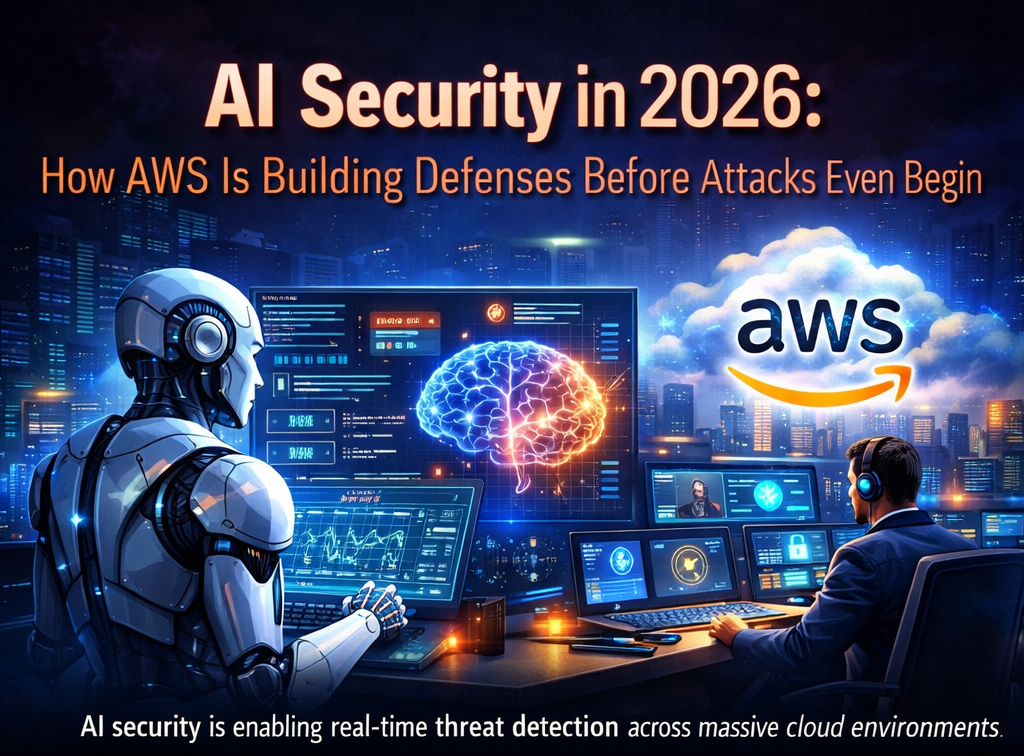
Amazon Web Services (AWS) is taking a bold approach to this challenge by building AI-driven defenses designed to identify and neutralize threats before they ever reach production environments.
For DevOps teams, this shift changes everything.
🔥 The New Reality: AI vs AI in Cybersecurity
Cybersecurity used to be reactive.
A vulnerability would be discovered, a patch would be released, and teams would scramble to fix the issue. That model no longer works in an AI-driven world.
Today’s threats are:
- Automated
- Adaptive
- Scalable
Attackers are using AI to:
- Generate malicious code
- Probe systems continuously
- Identify weak configurations in seconds
This means defenders must move faster than ever before.
That’s where AI security comes in.
⚡ AWS’s Approach to AI Security at Scale
AWS processes an enormous amount of data across its global infrastructure. Security signals are measured not in millions or billions—but in hundreds of trillions of events per day.
Human teams cannot analyze this volume of data in real time.
AI can.
AWS is leveraging AI models to:
- Detect anomalies across massive datasets
- Identify suspicious patterns instantly
- Prioritize threats based on risk
This allows AWS to move from:
👉 Reactive defense → Proactive threat prevention
🧠 From Hours to Minutes: The Power of AI Analysis
One of the most significant breakthroughs in AI security is speed.
Traditional security investigations could take:
- Hours
- Sometimes days
With AI-powered systems, that time can be reduced dramatically.
AWS has demonstrated scenarios where:
👉 Security analysis dropped from 6 hours to just minutes
This isn’t just an efficiency gain—it’s a fundamental shift in how security operates.
Faster detection means:
- Faster response
- Reduced damage
- Lower operational risk
💥 Why DevOps Teams Must Pay Attention
AI security is not just a concern for security teams—it directly impacts DevOps workflows.
As AI-generated code becomes more common, DevOps pipelines must handle:
- Increased code volume
- Higher variability
- New types of vulnerabilities
This creates new responsibilities.
1. DevOps as the First Line of Defense
In modern environments, security starts in the pipeline.
DevOps teams must ensure:
- Code is scanned automatically
- Dependencies are verified
- Infrastructure is secure by default
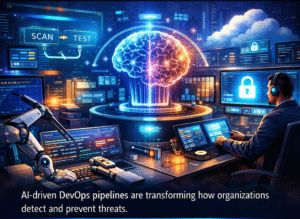
AI security tools can integrate directly into CI/CD pipelines, providing continuous monitoring and validation.
2. Infrastructure as a Security Control Point
Cloud environments are complex and dynamic.
AI can analyze:
- Configuration changes
- Network behavior
- Access patterns
This allows teams to detect misconfigurations before they become vulnerabilities.
3. Continuous Compliance and Monitoring
Regulatory requirements are increasing across industries.
AI security systems can:
- Monitor compliance in real time
- Flag violations automatically
- Generate audit-ready reports
This reduces the burden on DevOps teams while improving overall security posture.
🚀 The Rise of Predictive Security
The most powerful aspect of AI security is prediction.
Instead of waiting for attacks, AI systems can:
- Identify potential attack paths
- Simulate threat scenarios
- Recommend preventative actions
This is often referred to as predictive security.
For example:
- AI can detect unusual login behavior before a breach occurs
- It can flag abnormal API usage patterns
- It can identify risky deployments before they go live
This proactive approach significantly reduces risk.
⚠️ The Challenges of AI Security
While AI security offers massive advantages, it also introduces new challenges.
🔴 False Positives
AI systems can sometimes flag legitimate activity as suspicious.
This can:
- Slow down workflows
- Create alert fatigue
Teams must balance automation with human oversight.
🔴 Model Bias and Blind Spots
AI models are only as good as the data they are trained on.
If data is incomplete or biased:
- Threat detection may be inaccurate
- Certain attack vectors may be missed
🔴 Over-Reliance on Automation
Automation is powerful—but dangerous if misused.
Organizations must ensure:
- Human validation remains part of the process
- Critical decisions are not fully delegated to AI
💰 Business Impact: Why Companies Are Investing Now
AI security is not just a technical advantage—it’s a business imperative.
Companies adopting AI-driven security are seeing:
- Reduced breach risk
- Faster incident response
- Lower operational costs
- Increased trust from customers
For enterprises operating at scale, these benefits are significant.
🔥 The Future of AI Security in DevOps
Looking ahead, AI security will become deeply embedded in DevOps workflows.
We can expect:
- Fully automated security pipelines
- Real-time threat simulation during development
- AI-driven policy enforcement
- Continuous risk scoring for applications
DevOps teams will evolve into:
👉 Security-first automation engineers
🧠 Final Thoughts
AI security is no longer optional—it is essential.
AWS’s approach demonstrates what is possible when AI is applied at scale to cybersecurity challenges. By shifting from reactive to proactive defense, organizations can stay ahead of increasingly sophisticated threats.
For DevOps professionals, this represents both a challenge and an opportunity.
Those who embrace AI security will:
- Build more resilient systems
- Deliver faster and safer software
- Play a critical role in the future of technology
Those who ignore it risk falling behind.