🚨 Quick Answer
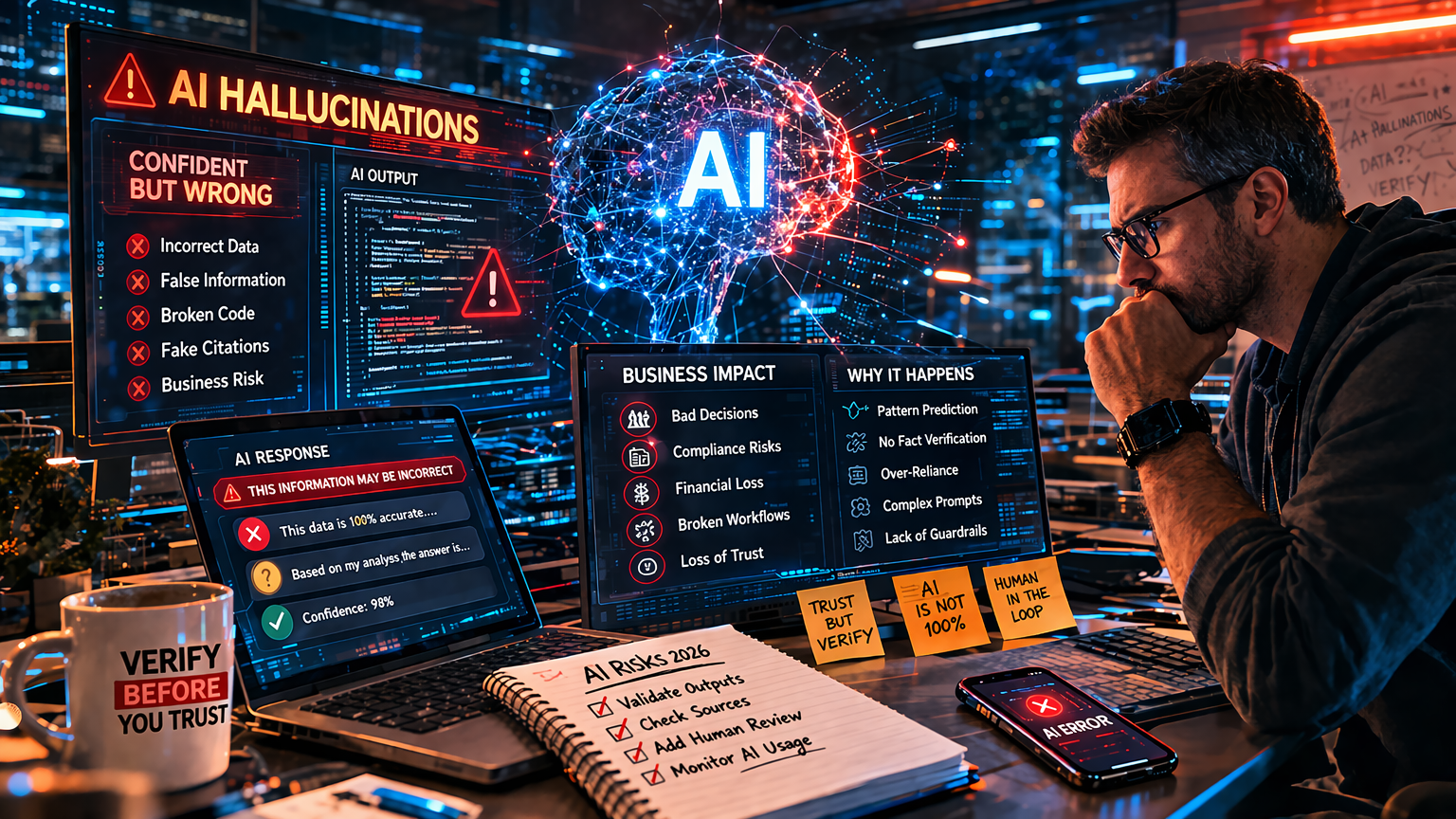
AI hallucinations occur when AI systems generate incorrect or fabricated information that appears accurate. In 2026, these errors are causing real business risks, including bad decisions, compliance issues, and financial loss.
What Are AI Hallucinations?
→ AI hallucinations are incorrect or made-up responses generated by AI systems that sound believable but are factually wrong.
Why Do AI Hallucinations Happen?
→ They occur because AI models predict patterns in data rather than verify facts, leading to confident but incorrect outputs.
Why Are AI Hallucinations Dangerous?
→ They can lead to bad business decisions, data errors, compliance violations, and loss of trust.
The Problem Is Bigger Than People Think
AI is now deeply embedded in business operations.
Companies rely on AI for:
-
Content generation
-
Code development
-
Data analysis
-
Customer interactions
But here’s the issue:
👉 AI does not know when it’s wrong.
It generates answers based on probability — not truth.
And in many cases, those answers are:
-
Convincing
-
Detailed
-
Completely incorrect
Real-World Examples of AI Hallucinations
This isn’t theoretical. It’s happening now.
📉 Business Decision Errors
AI-generated reports may include:
-
Incorrect metrics
-
Fabricated trends
-
Misinterpreted data
💻 Development Risks
Developers using AI tools may receive:
-
Broken code
-
Insecure implementations
-
Non-existent libraries
⚖️ Legal and Compliance Issues
AI can generate:
-
Fake legal citations
-
Incorrect regulatory guidance
-
Misleading documentation
🧾 Customer-Facing Mistakes
AI chatbots may:
-
Provide wrong information
-
Misrepresent products
-
Create inconsistent messaging
Why AI Hallucinations Are Getting Worse in 2026
1. Increased AI Adoption
More companies = more usage = more errors.
2. Over-Reliance on AI
Teams trust AI outputs without validation.
3. Complex Workflows
AI is now integrated into:
-
DevOps pipelines
-
Business intelligence systems
-
Automation tools
4. Lack of Guardrails
Many organizations deploy AI without:
-
Validation systems
-
Monitoring
-
Governance
The Hidden Risk: Confidence
The most dangerous part of AI hallucinations is not the error.
It’s the confidence.
AI doesn’t say:
“I might be wrong.”
It says:
“This is the answer.”
That confidence leads to:
-
Blind trust
-
Reduced verification
-
Increased risk
How to Prevent AI Hallucinations (What Smart Teams Do)
✅ 1. Human-in-the-Loop Validation
Always verify AI outputs before using them.
✅ 2. Grounding AI with Real Data
Use:
-
Verified datasets
-
Retrieval-augmented generation (RAG)
-
Controlled knowledge sources
✅ 3. Limit AI Scope
Don’t let AI:
-
Make final decisions
-
Access sensitive systems directly
✅ 4. Monitor AI Outputs
Track:
-
Accuracy
-
Anomalies
-
Patterns of failure
✅ 5. Train Teams Properly
Employees must understand:
-
AI limitations
-
Verification processes
-
Risk awareness
How to Reduce AI Risk (Step-by-Step)
Step 1: Identify Where AI Is Used
Map all AI touchpoints across your organization.
Step 2: Add Validation Layers
Require checks before AI outputs are used.
Step 3: Implement Monitoring
Track errors and continuously improve systems.
Step 4: Define Usage Policies
Set rules for:
-
Acceptable AI usage
-
Data handling
-
Risk management
Step 5: Build Accountability
Assign ownership for AI-driven decisions.
The Future of AI Reliability
AI is not going away.
But neither are hallucinations.
The companies that succeed will not be the ones that avoid AI.
They will be the ones that:
-
Understand its limitations
-
Build safeguards
-
Use it responsibly
Final Thoughts
AI hallucinations are not just a technical issue.
They are a business risk.
And in 2026, that risk is becoming impossible to ignore.
Because the biggest danger isn’t that AI is wrong.
It’s that people believe it’s right.