
🚀 Quick Answer
AI agents are quickly moving beyond chatbots and into real enterprise systems—executing tasks, accessing data, and automating workflows. But most organizations are deploying them without proper controls, creating serious risks around security, compliance, and system integrity.
The Shift From AI Assistants to Autonomous Operators
For the past few years, enterprise AI has largely been about assistance.
Tools like chatbots, copilots, and generative AI interfaces helped employees:
- write code
- draft emails
- analyze data
But they didn’t act on behalf of users.
That’s now changing—fast.
A new class of systems, often referred to as AI agents, is emerging across the enterprise stack. These agents are not just generating responses—they are:
- executing commands
- interacting with APIs
- moving data between systems
- triggering workflows automatically
In other words, they are becoming operators, not assistants.
And companies are racing to adopt them.
Why Everyone Is Betting on AI Agents
Major technology players and startups alike are pushing aggressively into this space, and for good reason.
AI agents promise something organizations have been chasing for decades:
true workflow automation without rigid scripting
Instead of building complex rule-based systems, teams can now:
- describe a task in natural language
- let an agent interpret it
- and have it execute across multiple systems
This unlocks massive potential:
- DevOps teams can automate infrastructure changes
- Support teams can resolve tickets end-to-end
- Finance teams can reconcile systems without manual input
- Security teams can triage alerts automatically
The value is obvious.
But so is the risk.
The Hidden Problem: Most AI Agents Are Over-Permissioned
Here’s where things start to break.
To be useful, AI agents need access:
- APIs
- databases
- SaaS platforms
- internal tools
And in many deployments, they are given far more access than they should have.
This creates a dangerous situation:
AI agents are becoming some of the most privileged “users” in the enterprise—without the oversight of a human.
Unlike traditional automation scripts, these agents:
- make decisions dynamically
- interpret ambiguous instructions
- adapt behavior in real time
That means small misconfigurations can lead to:
- unintended data exposure
- incorrect system changes
- compliance violations
- or even full system compromise
And the worst part?
Most teams don’t even realize it yet.
Why Traditional Security Models Don’t Work Here
The rise of AI agents is exposing a major flaw in how enterprise security is designed.
Most security frameworks assume:
- predictable behavior
- clearly defined workflows
- static permissions
AI agents break all three.
They operate in environments where:
- actions are not fully pre-defined
- decisions are influenced by context
- behavior evolves over time
This makes traditional approaches like:
- role-based access control
- static policy enforcement
- manual approval workflows
far less effective.
You can’t simply “lock down” an AI agent the same way you would a human user or a script.
Because it’s not just executing—it’s deciding.
The DevOps Explosion: Automation Without Guardrails
In DevOps environments, the impact is even more dramatic.
AI agents are already being used to:
- provision infrastructure
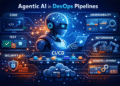
- modify CI/CD pipelines
- deploy applications
- troubleshoot production issues
This introduces a new kind of risk:
automation at scale without deterministic control
A misconfigured pipeline used to be a problem.
Now imagine:
- an AI agent modifying that pipeline dynamically
- based on incomplete or misinterpreted context
That’s how outages—and security incidents—start.
And because these systems move fast, issues can propagate before anyone notices.
The Rise of “Non-Human Identity Risk”
Security teams are starting to realize something important:
The biggest identity risk in modern systems is no longer human users.
It’s non-human identities:
- service accounts
- APIs
- automation tools
- and now… AI agents
AI agents combine:
- machine-level speed
- broad system access
- decision-making capabilities
This makes them uniquely powerful—and uniquely dangerous.
If compromised or misconfigured, they can:
- move laterally across systems
- access sensitive data
- execute actions at scale
All without raising immediate red flags.
What Enterprises Must Do Next
Organizations don’t need to slow down AI adoption.
But they do need to rethink control.
Here’s where to start:
1. Treat AI Agents Like Privileged Identities
Every agent should be:
- tracked
- audited
- scoped to least privilege
If you wouldn’t give a human that level of access, don’t give it to an agent.
2. Implement Dynamic Policy Enforcement
Static rules won’t work.
You need systems that can:
- evaluate context in real time
- adjust permissions dynamically
- enforce boundaries as agents operate
3. Introduce Observability for Agent Behavior
You can’t secure what you can’t see.
Track:
- what agents are doing
- what systems they touch
- what decisions they make
And more importantly—why.
4. Build Guardrails Into DevOps Pipelines
AI-driven automation must be:
- constrained
- monitored
- and reversible
This means:
- approval layers where needed
- rollback capabilities
- anomaly detection
5. Align Security With AI Innovation
Security can’t be an afterthought.
It needs to be part of:
- AI design
- deployment
- and scaling strategies
Otherwise, organizations will move fast—and break things in ways they can’t easily fix.
The Bottom Line
AI agents are not a future concept.
They are here now—and they are rapidly becoming embedded in enterprise workflows.
They represent one of the biggest shifts in how work gets done:
- from manual execution
- to assisted workflows
- to fully autonomous operations
But with that shift comes a new reality:
The same systems that drive efficiency can also introduce unprecedented risk.
Organizations that succeed in this new era will not be the ones that adopt AI agents the fastest.
They’ll be the ones that control them the best.