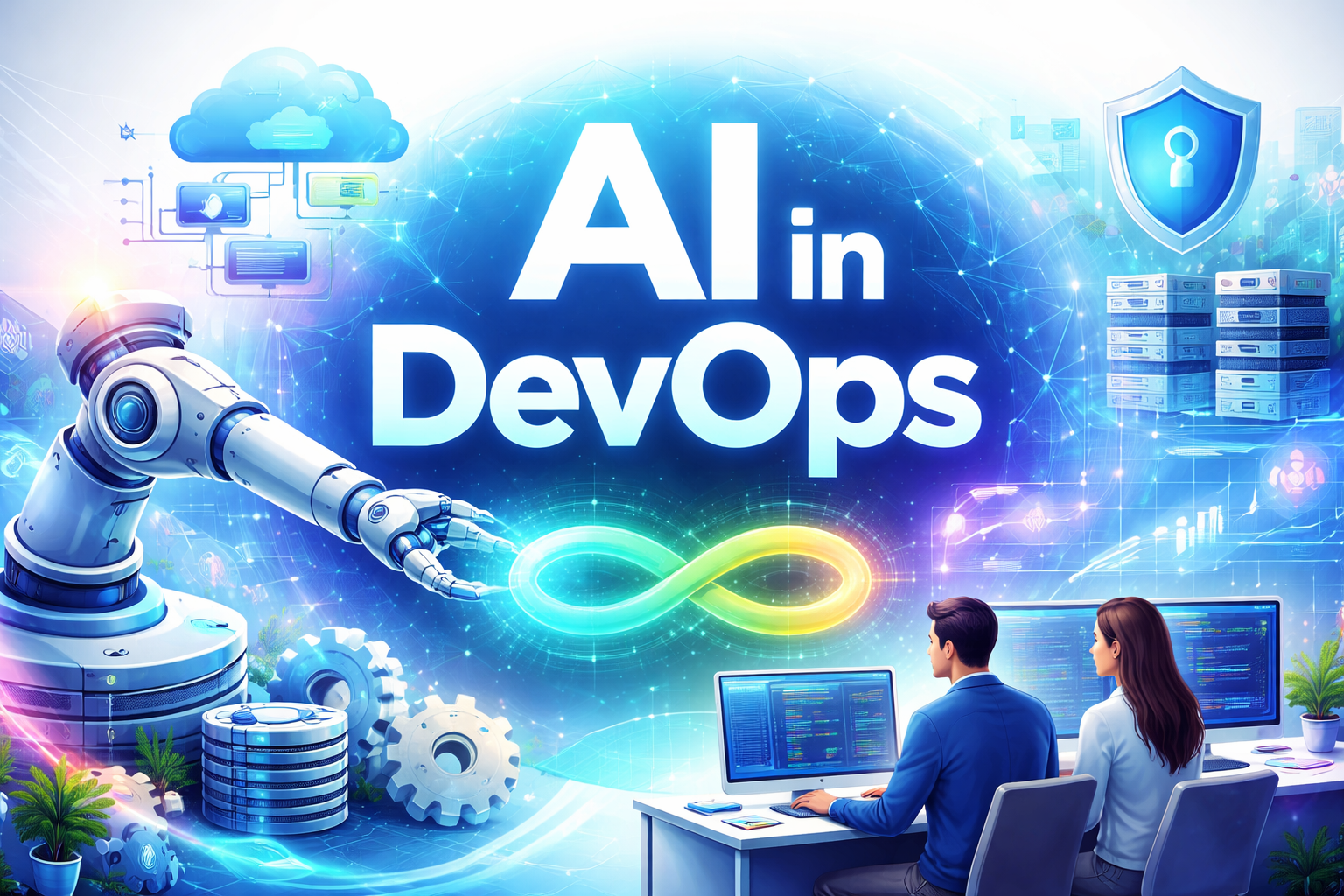
AI in DevOps is transforming how software is built, deployed, and secured in modern environments.
A major shift is unfolding across the tech industry—one that goes far beyond traditional automation. The rise of agentic AI is beginning to transform how software is built, deployed, secured, and maintained.
Unlike earlier generations of AI that primarily assisted humans, agentic AI systems are designed to act independently. They can make decisions, execute tasks, and adapt in real time across complex environments. In 2026, this evolution is quickly becoming one of the most important developments in DevOps, cloud infrastructure, and enterprise technology.
For organizations that rely on speed, scale, and reliability, the implications are massive.
🧠 From Assistance to Autonomy
For years, AI in DevOps has been focused on assistance:
-
suggesting code
-
detecting anomalies
-
optimizing workflows
These capabilities were valuable—but they still required human direction at every step.
Agentic AI changes that model entirely.
Instead of waiting for instructions, these systems can:
-
analyze system state
-
determine the next action
-
execute tasks across pipelines
-
learn from outcomes and improve
This shift—from reactive assistance to proactive autonomy—is what defines agentic AI.
In practical terms, it means moving from “AI helps developers” to “AI operates alongside developers.”
⚙️ What Agentic AI Looks Like in DevOps
In modern DevOps environments, agentic AI is already beginning to take shape.
Imagine a pipeline where:
-
An AI agent detects a failing build
-
Identifies the root cause
-
Applies a fix
-
reruns the pipeline
-
validates the result
All without human intervention.
Or consider security:
-
An AI agent detects suspicious behavior
-
isolates the affected system
-
rotates credentials
-
patches vulnerabilities
-
logs and reports the incident
Again—automatically.
This is not theoretical. These capabilities are emerging now through a combination of large language models, orchestration frameworks, and integrated toolchains.
🔐 Security Becomes Autonomous
One of the most powerful applications of agentic AI is in cybersecurity.
Traditional security models rely heavily on detection and response. Even with automation, human analysts are often required to investigate and act.
Agentic AI introduces a new model: autonomous security operations.
These systems can:
-
continuously monitor environments
-
detect anomalies in real time
-
initiate containment actions
-
enforce policies dynamically
This drastically reduces response times and limits the window of exposure.
In a world where attacks are increasingly automated, defensive systems must evolve at the same pace.
Agentic AI is how that happens.
☁️ Cloud Operations at Machine Speed
Cloud environments are growing more complex by the day.
Multi-cloud architectures, containerized workloads, and distributed systems all require constant monitoring and adjustment.
Agentic AI enables cloud systems to operate at machine speed.
Instead of waiting for alerts, these systems can:
-
rebalance workloads
-
optimize resource usage
-
reduce costs automatically
-
respond to failures instantly
This leads to:
-
improved performance
-
lower operational overhead
-
greater resilience
For enterprises managing large-scale infrastructure, the benefits are immediate and measurable.
🧩 The Integration Challenge
Despite its potential, adopting agentic AI is not without challenges.
One of the biggest hurdles is integration.
Most organizations already have:
-
CI/CD pipelines
-
monitoring tools
-
security platforms
-
cloud services
Integrating AI agents across these systems requires:
-
standardized interfaces
-
shared context
-
secure communication
This is where emerging frameworks and protocols are beginning to play a role.
Technologies that enable systems to share context and coordinate actions will be critical in unlocking the full value of agentic AI.
⚠️ Risks and Considerations
As with any powerful technology, agentic AI introduces new risks.
Autonomous systems must be:
-
properly governed
-
carefully monitored
-
aligned with business objectives
Without safeguards, there is potential for:
-
unintended actions
-
cascading failures
-
security vulnerabilities
Organizations must implement:
-
guardrails
-
audit mechanisms
-
human oversight
The goal is not to remove humans entirely—but to enable them to focus on higher-value tasks while AI handles execution.
📈 Why This Matters Now
The timing of this shift is not accidental.
Several factors are converging:
-
advances in large language models
-
improved orchestration capabilities
-
growing complexity of systems
-
increasing pressure for speed and efficiency
Together, these forces are creating the perfect environment for agentic AI to thrive.
Companies that adopt early will gain a significant advantage.
Those that wait may find themselves struggling to keep up.
💡 The Future of DevOps
Looking ahead, DevOps will become increasingly autonomous.
Human roles will shift toward:
-
strategy
-
architecture
-
oversight
While AI systems handle:
-
execution
-
optimization
-
incident response
This does not replace DevOps teams—it amplifies them.
The result is faster delivery, stronger security, and more efficient operations.
🧠 Final Thoughts
Agentic AI represents a fundamental shift in how technology systems operate.
It moves beyond automation into autonomy—unlocking new levels of efficiency and capability.
For DevOps teams, cloud engineers, and security professionals, this is a moment of transformation.
The question is no longer whether AI will be part of the workflow.
It’s how much control organizations are willing to give it.
Those who strike the right balance will define the next generation of software and infrastructure.