DevOps Enters the Agentic Era
For more than a decade, DevOps has focused on automation. Continuous Integration and Continuous Delivery (CI/CD) pipelines automated testing, building, and deployment workflows to accelerate software delivery. Yet even with sophisticated automation tools, most pipelines still require significant human oversight. Engineers must interpret alerts, analyze logs, fix failed builds, and determine the next steps when issues occur.
A new paradigm is now emerging: Agentic AI in DevOps.
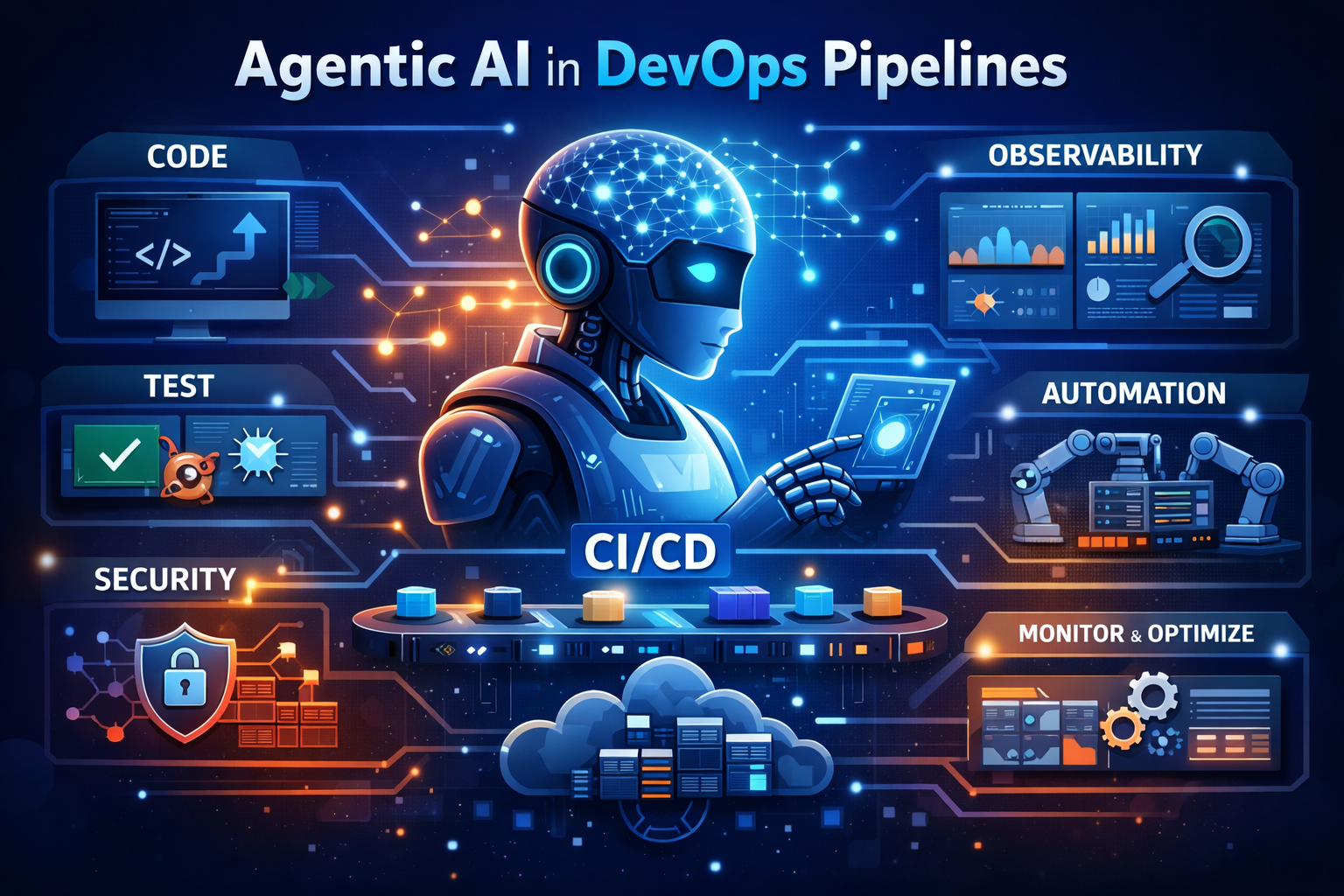
Instead of simply assisting engineers, agentic AI systems are designed to reason, plan, and execute actions autonomously inside software delivery pipelines. These systems operate more like intelligent collaborators than static automation scripts.
Agentic AI introduces the concept of autonomous CI/CD pipelines—systems that can diagnose failures, optimize workflows, and even implement fixes without direct human intervention. For organizations managing complex cloud-native infrastructures, this shift could dramatically change how software is built, tested, and deployed.
What Is Agentic AI?
Agentic AI refers to artificial intelligence systems capable of goal-oriented behavior and decision-making. Unlike traditional AI assistants that respond to prompts, agentic systems can:
-
Analyze complex system states
-
Plan actions to achieve objectives
-
Execute tasks across tools and environments
-
Continuously evaluate outcomes
In DevOps environments, this means AI can move beyond simple code suggestions or monitoring alerts. Instead, agentic AI can actively participate in pipeline workflows.
For example, an agentic system might:
-
Detect a failing test suite
-
Analyze commit history to identify likely root causes
-
Generate a patch suggestion
-
Execute validation tests
-
Propose or apply a fix
This kind of behavior transforms pipelines into self-managing delivery systems.
The Evolution of DevOps Automation
To understand why agentic AI matters, it helps to look at how DevOps automation has evolved.
Phase 1: Manual Operations
Before DevOps practices became mainstream, software delivery involved manual deployment processes and large operations teams responsible for managing infrastructure.
Phase 2: Script-Based Automation
Tools such as Jenkins, GitLab CI, and CircleCI introduced automated build and testing pipelines. Scripts handled repeatable tasks but still required engineers to respond when failures occurred.
Phase 3: Observability and Intelligent Monitoring
The rise of observability platforms brought machine learning into DevOps environments. Tools began identifying anomalies in metrics and logs, helping teams detect issues earlier.
Phase 4: Agentic DevOps
Agentic AI represents the next step in this evolution. Instead of simply reporting problems, AI systems can take corrective actions automatically.
The result is a pipeline that behaves less like a static workflow and more like a dynamic system capable of adapting to changing conditions.
How Agentic AI Works Inside CI/CD Pipelines
Agentic AI systems rely on several technical components to operate effectively within DevOps environments.
Context Awareness
AI agents need access to pipeline data, including:
-
source code repositories
-
commit histories
-
test results
-
infrastructure metrics
-
deployment logs
This context allows AI systems to understand the state of the pipeline and identify patterns associated with failures.
Reasoning Engines
Modern agentic AI platforms use large language models and reasoning engines to analyze problems and determine possible solutions. These systems can generate hypotheses about why a pipeline failed and propose steps to fix it.
Tool Integration
DevOps pipelines rely on numerous tools, including version control platforms, CI/CD systems, infrastructure automation frameworks, and observability platforms. Agentic AI integrates with these systems through APIs to execute actions.
For example, an AI agent might:
-
trigger a rollback
-
create a pull request
-
modify pipeline configurations
-
restart failing services
Continuous Feedback Loops
Agentic systems continuously monitor the outcomes of their actions. If a proposed solution does not resolve the issue, the system can adapt and attempt alternative strategies.
This feedback loop enables progressive improvement of pipeline reliability.
Real-World Use Cases for Agentic DevOps
Several practical applications for agentic AI are already emerging within modern DevOps workflows.
Autonomous Pipeline Failure Recovery
One of the most common challenges in CI/CD environments is pipeline failures caused by flaky tests, dependency conflicts, or infrastructure issues.
Agentic AI can:
-
identify root causes
-
isolate failing components
-
re-run specific pipeline stages
-
propose fixes
Instead of waiting for engineers to investigate, the pipeline can recover automatically.
Intelligent Code Review Assistance
Agentic AI systems can analyze code changes during pull requests and identify potential security vulnerabilities, performance issues, or architectural concerns.
Unlike static analysis tools, agentic systems can explain the reasoning behind their recommendations and even generate corrected code.
Automated Infrastructure Optimization
Cloud-native environments often experience configuration drift and inefficient resource utilization. Agentic AI can monitor infrastructure patterns and recommend improvements to scaling policies, container configurations, or deployment strategies.
Incident Response Automation
When outages occur, agentic AI can analyze logs, correlate metrics across services, and identify root causes faster than traditional monitoring systems.
In some cases, AI can even initiate remediation steps such as rolling back deployments or restarting services.
Benefits of Agentic AI in DevOps
The shift toward agentic DevOps pipelines offers several potential advantages for engineering teams.
Faster Mean Time to Resolution
By diagnosing and resolving pipeline failures automatically, agentic AI significantly reduces the time required to recover from issues.
Increased Developer Productivity
Engineers spend less time troubleshooting pipelines and more time focusing on building features and improving systems.
Improved Pipeline Reliability
Autonomous monitoring and remediation reduce the likelihood of repeated failures caused by common configuration errors or environmental inconsistencies.
Scalability for Large Engineering Organizations
As software systems grow more complex, manual pipeline management becomes increasingly difficult. Agentic AI enables organizations to scale DevOps practices without dramatically increasing operational overhead.
Challenges and Risks
Despite its promise, agentic AI introduces new challenges that organizations must consider.
Trust and Governance
Autonomous systems making deployment decisions raise important questions about governance and oversight. Organizations must establish clear policies defining which actions AI agents are allowed to perform.
Security Concerns
Granting AI systems access to infrastructure APIs and deployment pipelines introduces potential security risks. Proper authentication and permission management are essential.
Model Reliability
Agentic AI systems rely on complex models that may occasionally produce incorrect recommendations. Safeguards must ensure that critical production changes require appropriate validation.
The Future of Autonomous DevOps
As AI technologies continue to evolve, DevOps pipelines are likely to become increasingly autonomous. Future systems may include networks of specialized AI agents responsible for different aspects of the delivery lifecycle.
Examples could include:
-
Testing agents that design and execute test strategies
-
Security agents that continuously scan dependencies and configurations
-
Optimization agents that refine infrastructure usage
-
Deployment agents that determine optimal release strategies
Together, these systems could form a self-managing software delivery ecosystem.
Conclusion
The emergence of agentic AI in DevOps pipelines represents one of the most significant shifts in software engineering since the rise of CI/CD automation. By enabling AI systems to reason, plan, and act within delivery pipelines, organizations can move closer to fully autonomous software delivery.
While challenges remain around governance, security, and trust, the potential benefits are enormous. Autonomous pipelines promise faster deployments, reduced operational overhead, and more resilient software systems.
For DevOps teams navigating increasingly complex cloud-native environments, agentic AI may soon become not just an enhancement—but a necessity for maintaining velocity and reliability at scale.