AI Infrastructure Demand Is Exploding
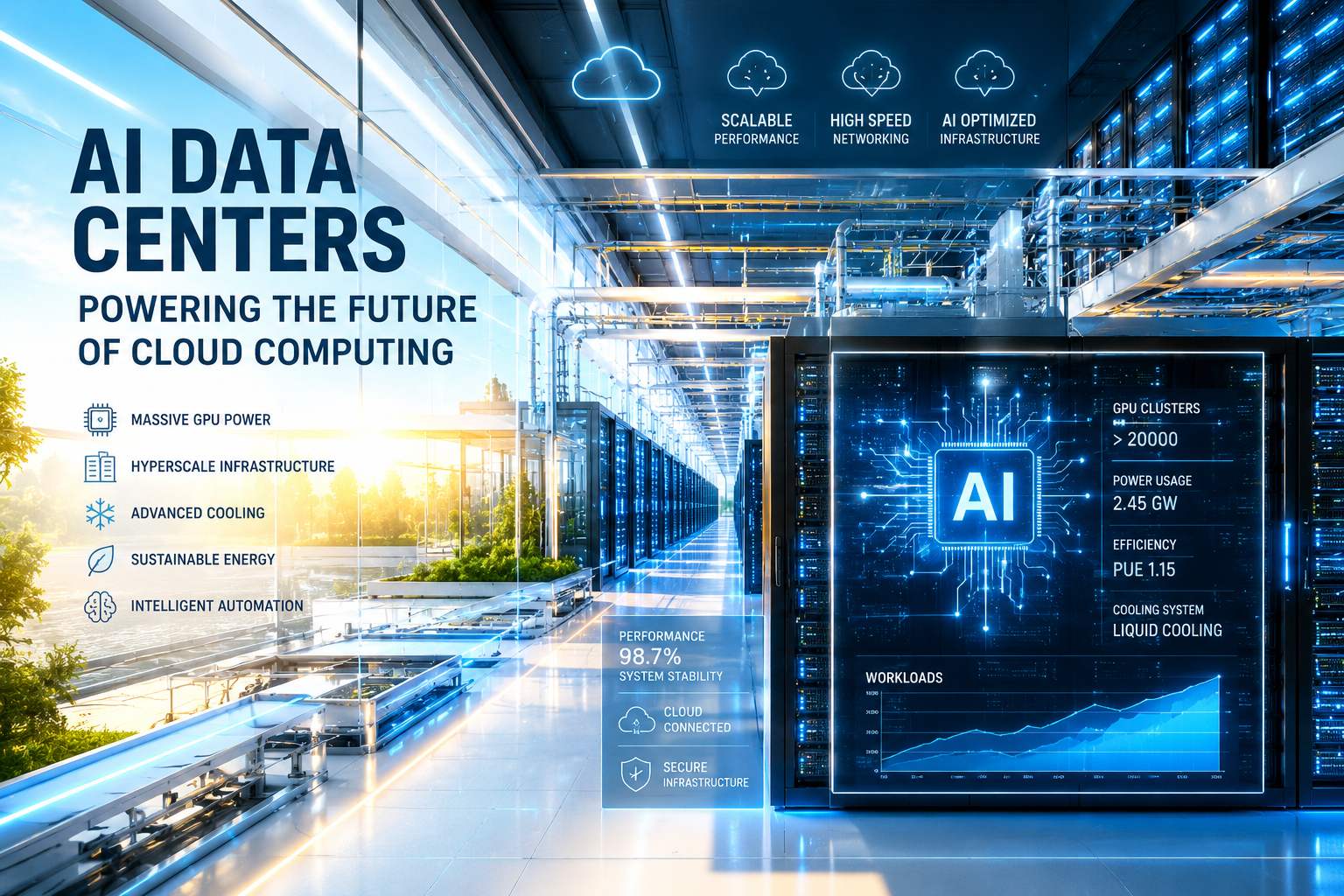
AI data centers are rapidly transforming the future of cloud computing as hyperscalers race to build the infrastructure required to support generative AI, enterprise automation, and large-scale AI workloads. From GPU clusters and liquid cooling systems to AI-optimized networking and hyperscale facilities, the next generation of cloud infrastructure is being designed specifically for artificial intelligence.
The explosive growth of generative AI has fundamentally changed the way enterprises think about cloud infrastructure. Traditional data centers built for web hosting, virtualization, and standard enterprise workloads are no longer sufficient for the computational demands created by modern AI systems.
Today’s AI applications require enormous processing power, ultra-fast networking, massive data throughput, and specialized hardware environments capable of supporting thousands of GPUs simultaneously. As organizations deploy increasingly advanced AI models, cloud providers are being forced to redesign infrastructure from the ground up.
This shift is creating one of the largest infrastructure transformations the technology industry has seen in decades.
Why Traditional Data Centers Can No Longer Keep Up
For years, enterprise cloud infrastructure focused primarily on scalability, virtualization efficiency, and storage optimization. AI workloads have changed those priorities entirely.
Large language models and enterprise AI systems consume dramatically more computational resources than traditional applications. Training AI models requires parallel processing across massive GPU clusters, while inference workloads generate continuous demand for high-performance computing resources.
Traditional data centers face several limitations when supporting modern AI environments:
- Insufficient power density
- Cooling limitations
- Networking bottlenecks
- Space constraints
- GPU scalability challenges
As a result, cloud providers are now building AI-specific facilities optimized for:
- Dense GPU deployments
- Advanced cooling systems
- AI networking fabrics
- Low-latency data movement
- AI training and inference acceleration
This transformation is redefining the future of digital infrastructure.
GPUs Have Become the New Gold Rush
At the center of the AI infrastructure boom sits one critical technology: GPUs.
AI model training and inference workloads rely heavily on graphics processing units capable of handling parallel computation at enormous scale. Demand for GPUs has surged dramatically as enterprises rush to deploy generative AI systems across nearly every industry.
The rapid rise of AI has created:
- GPU shortages
- Rising hardware costs
- Extended procurement timelines
- Aggressive hyperscaler investments
- Intense competition for compute capacity
NVIDIA has emerged as one of the biggest winners of the AI infrastructure race, with its high-performance GPU platforms powering many of the world’s largest AI deployments.
Hyperscalers are now spending billions to secure access to advanced GPU hardware as demand continues accelerating.

Hyperscalers Are Spending Billions on AI Infrastructure
The global AI race has triggered unprecedented investment from major cloud providers including Amazon Web Services, Google Cloud, and Microsoft Azure.
Each provider is rapidly expanding its AI infrastructure footprint through:
- New hyperscale facilities
- Dedicated AI cloud regions
- GPU mega-clusters
- AI networking upgrades
- Custom AI chip development
The growing competition between hyperscalers has accelerated the global expansion of AI-ready facilities, as explored in our coverage of <a href=”https://levelact.com/ai-infrastructure-wars-aws-google-cloud-azure/”>AI Infrastructure Wars between AWS, Google Cloud, and Azure</a>.
AWS continues leveraging its massive global footprint and AI chip strategy through Trainium and Inferentia processors. Google Cloud is pushing forward with TPU-based infrastructure and Vertex AI services. Microsoft Azure continues expanding its AI capabilities through OpenAI integration and enterprise AI deployment platforms.
The battle is no longer simply about cloud hosting. It is about controlling the infrastructure layer powering the future of artificial intelligence.
Power Consumption Is Becoming a Global Challenge
One of the biggest concerns surrounding AI data centers is energy consumption.
AI infrastructure requires enormous amounts of electricity to power GPU clusters, storage systems, networking equipment, and cooling technologies. As hyperscalers continue expanding AI operations, energy demand is rising at an unprecedented pace.
Some analysts believe AI infrastructure growth could significantly reshape global energy markets over the next decade.
Modern AI facilities require:
- High-density power distribution
- Redundant energy systems
- Advanced cooling operations
- Continuous infrastructure optimization
Rising GPU demand and energy consumption are also contributing to escalating operational expenses highlighted in our recent article on Cloud Cost Explosion 2026.
The long-term sustainability of AI infrastructure is quickly becoming both a business challenge and an environmental conversation.
Liquid Cooling and AI-Optimized Facilities
Traditional air-cooled data centers are increasingly struggling to handle the heat generated by dense GPU deployments.
To solve this problem, hyperscalers are investing heavily in liquid cooling technologies capable of supporting high-performance AI infrastructure.
Liquid cooling systems provide several advantages:
- Improved thermal efficiency
- Higher GPU density
- Reduced operational costs
- Better performance stability
- Lower energy waste
Modern AI data centers are now being designed around AI-specific operational requirements instead of retrofitting older infrastructure.
This includes:
- AI networking fabrics
- Advanced thermal management
- AI-optimized storage systems
- High-bandwidth interconnects
- Intelligent infrastructure automation
The architecture of cloud computing itself is beginning to evolve around artificial intelligence.
Enterprise AI Workloads Are Reshaping Cloud Strategy
Enterprises are increasingly redesigning cloud strategies specifically around AI deployment requirements.
Organizations are now evaluating:
- GPU availability
- AI inference costs
- AI security
- Data sovereignty
- AI scalability
- Hybrid AI infrastructure
The growing competition between hyperscalers has accelerated the global expansion of AI-ready facilities, as explored in our coverage of AI Infrastructure Wars between AWS, Google Cloud, and Azure.
Security teams are increasingly adopting modern protection models similar to the strategies discussed in our Zero Trust for DevOps Pipelines analysis.
Many enterprises are also exploring:
- Private AI environments
- Sovereign AI infrastructure
- AI workload repatriation
- Hybrid cloud AI deployments
AI infrastructure decisions are rapidly becoming core business strategy decisions.
AI Data Centers and the Future of Cloud Computing
AI data centers are no longer simply an extension of traditional cloud computing infrastructure. They are becoming the foundation of the next generation of enterprise technology.
Over the next several years, AI infrastructure will likely drive:
- New data center architectures
- Increased automation
- AI-native cloud services
- Global infrastructure expansion
- Advanced semiconductor innovation
- Energy infrastructure modernization
The future of cloud computing is increasingly tied directly to artificial intelligence.
Organizations that successfully adapt to this new AI-driven infrastructure era will gain major competitive advantages in scalability, automation, analytics, and operational efficiency.
The companies building the world’s AI infrastructure today are not simply expanding cloud capacity. They are building the digital backbone of the future global economy.