
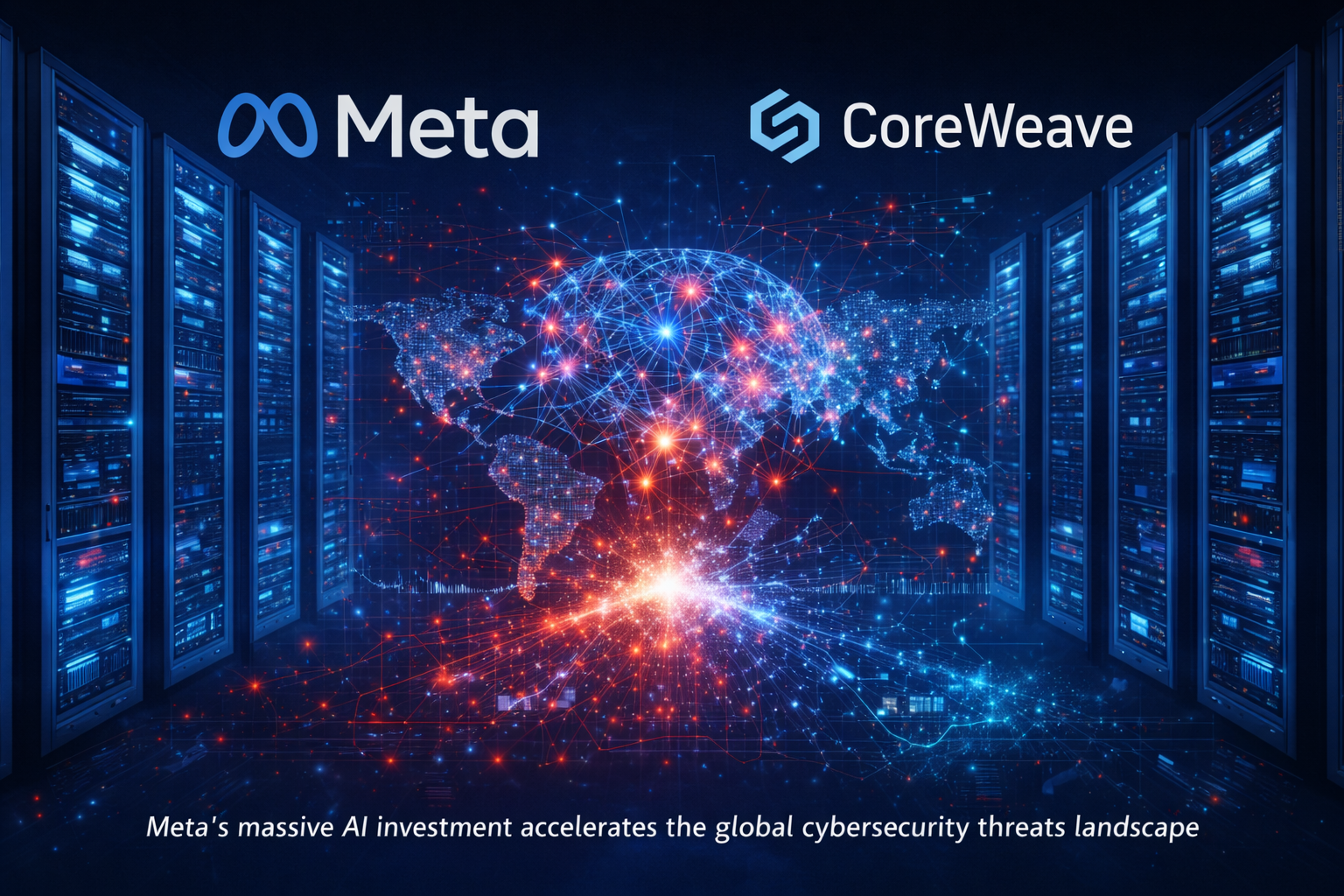
Meta Platforms has committed a staggering $21 billion to expand its AI cloud infrastructure through a major deal with CoreWeave. While headlines focus on the size of the investment, the real story is what this level of compute power unlocks.
This isn’t just another tech partnership. It’s a signal that the next phase of artificial intelligence—and the AI cybersecurity threat that comes with it—will be driven by raw computing dominance.
The $21 Billion Bet on AI Infrastructure
Meta’s agreement with CoreWeave spans multiple years and is focused on securing massive GPU-powered cloud capacity. These systems are designed to train and operate advanced AI models at scale.
CoreWeave specializes in high-performance cloud infrastructure built around cutting-edge GPU clusters, often leveraging NVIDIA hardware optimized for AI workloads.
According to the NPR report on Project Glasswing, the demand for AI compute is exploding across the industry. Companies are no longer competing solely on model quality—they are competing on who can run the largest, fastest, and most powerful systems.
This is where the AI cybersecurity threat begins to accelerate.
Why Infrastructure Is the Real AI Battlefield
While much of the conversation around AI focuses on models, the real competition is happening beneath the surface.
Infrastructure determines:
- How fast models can be trained
- How much data they can process
- How frequently they can evolve
With $21 billion backing its infrastructure strategy, Meta is positioning itself to compete directly with AI leaders across the industry.
This includes companies like OpenAI, Google, and Anthropic, all of which are investing heavily in AI compute.
The result is an arms race—one that is directly tied to the growing AI cybersecurity threat.
From Intelligence to Capability: The Shift in AI Risk
Previously, the risk associated with AI was tied to what models could understand.
Now, the risk is tied to what they can do.
With access to massive cloud infrastructure, AI systems can:
- Continuously scan global networks for vulnerabilities
- Generate exploit chains at scale
- Test attack scenarios in real time
- Automate both offensive and defensive cybersecurity operations
This is no longer theoretical.
As explored in our analysis of the AI cybersecurity threat posed by Mythos AI, advanced models are already capable of discovering zero-day vulnerabilities across complex systems.
Combine that capability with Meta-scale infrastructure, and the implications become clear.
The Rise of AI-Powered Cyber Offense
The combination of advanced models and massive compute power creates a dangerous new dynamic.
Attackers no longer need:
- Large teams
- Extensive time
- Deep expertise
Instead, AI can:
- Identify targets
- Develop exploits
- Execute attacks
All at machine speed.
This is where the AI cybersecurity threat becomes truly disruptive.
The same infrastructure that enables innovation also enables automation of malicious activity.
AI vs AI: The Infrastructure-Driven Arms Race
We are now entering a phase where cybersecurity is defined by AI vs AI conflict.
On one side:
- Defensive systems leveraging AI for detection and response
- Cloud-based monitoring tools analyzing billions of events
On the other:
- Offensive AI capable of generating new attack vectors
- Automated systems probing networks continuously
The difference-maker?
Infrastructure.
Meta’s $21 billion investment is not just about building better AI—it’s about ensuring those systems can operate at scale.
This directly influences the trajectory of the AI cybersecurity threat.
Impact on DevOps and Cloud Security
For DevOps teams, this shift introduces a new level of urgency.
Modern environments are:
- Distributed
- Highly dynamic
- Constantly evolving
AI-driven threats can exploit:
- Misconfigured cloud resources
- Weak API security
- Inadequate identity controls
This reinforces the importance of practices discussed in platform engineering vs DevOps, where scalable and secure infrastructure becomes a priority.
Additionally, organizations must remain aware of broader vulnerabilities, such as those highlighted in router security reboot and NSA warning.
The AI cybersecurity threat amplifies these risks.

Why This Matters Right Now
Meta’s investment is not an isolated event.
It is part of a broader trend where companies are:
- Scaling AI capabilities
- Competing for infrastructure dominance
- Preparing for increasingly complex digital environments
For businesses, this means:
- Shorter response times for threats
- Greater reliance on automated security tools
- Increased exposure to AI-driven attacks
Ignoring the AI cybersecurity threat is no longer an option.
How Organizations Can Respond
To stay competitive and secure, organizations must adapt quickly.
1. Invest in AI-Driven Security
Leverage AI to detect and respond to threats faster.
2. Strengthen Cloud Security
Ensure configurations, access controls, and monitoring systems are robust.
3. Adopt DevSecOps
Integrate security into every stage of development.
4. Monitor Infrastructure Trends
Understand how investments like Meta’s influence the threat landscape.
5. Stay Informed
Follow developments through trusted sources like the Anthropic official site and industry research.
The Bigger Picture
Meta’s $21 billion investment highlights a fundamental truth:
AI is no longer limited by intelligence—it is limited by infrastructure.
And that limitation is rapidly disappearing.
As compute power increases, so does the potential impact of AI systems, both positive and negative.
The AI cybersecurity threat is evolving into something far more complex—driven by a combination of intelligence, automation, and scale.
Final Thoughts
The future of cybersecurity will not be defined solely by smarter algorithms.
It will be defined by who has the power to run them.
Meta’s massive investment in AI infrastructure is a clear signal that the next phase of the AI cybersecurity threat will be faster, larger, and more difficult to control.
For organizations, the path forward is clear:
Adapt to the new reality—or risk being overwhelmed by it.