
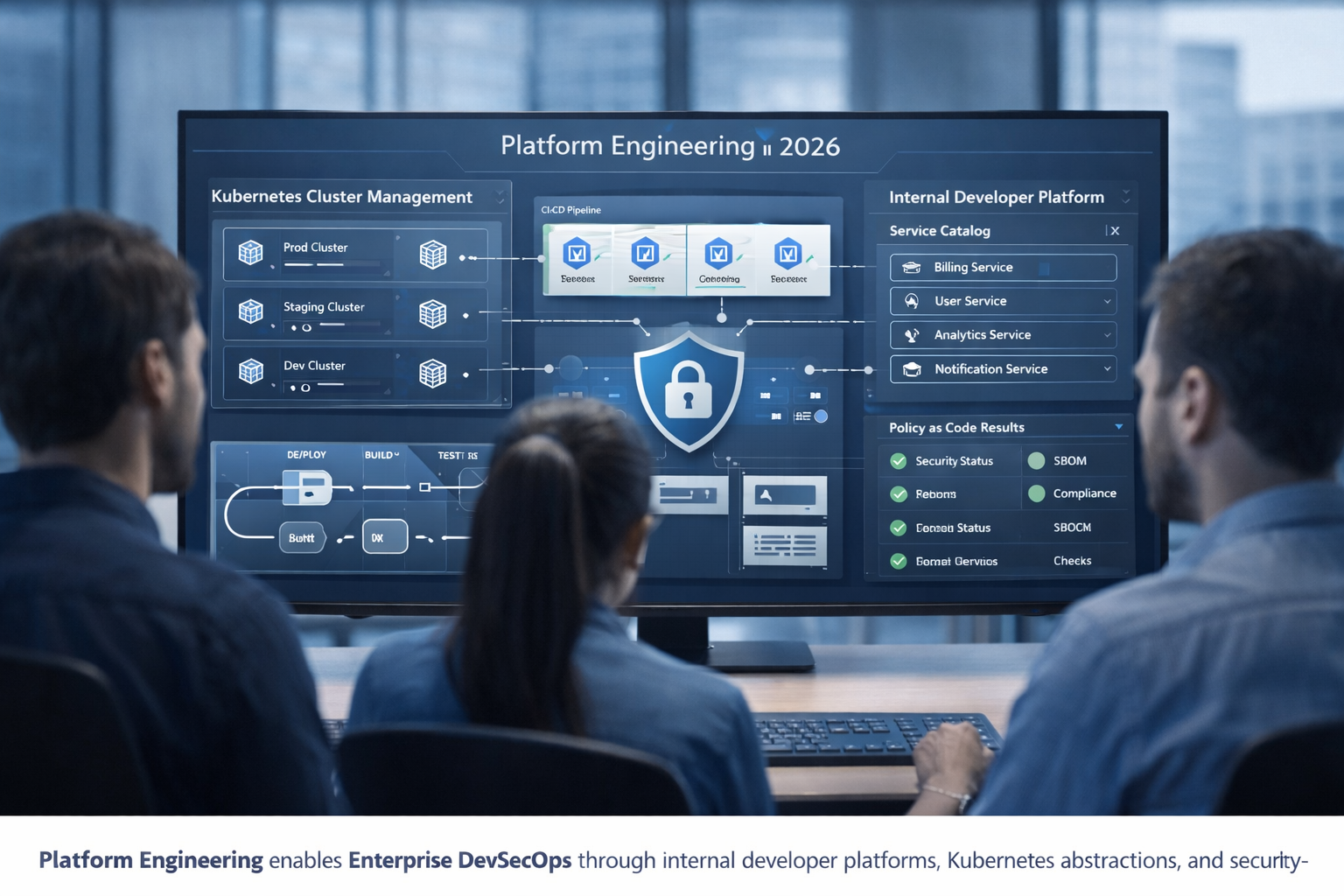
Platform Engineering has evolved from an emerging concept into a foundational discipline for modern enterprise software delivery. In 2026, it is no longer simply about improving developer experience. It has become the structural backbone of Enterprise DevSecOps — enabling secure, scalable, and standardized software delivery across increasingly complex environments.
As organizations scale microservices, multi-cloud infrastructure, Kubernetes clusters, and AI-enabled workloads, the traditional DevOps model begins to fracture. The cognitive load on developers grows. Security policies become inconsistent. Infrastructure configuration drifts across teams.
Platform Engineering addresses this fragmentation by creating a centralized, product-oriented internal platform that abstracts complexity while enforcing secure defaults.
The Rise of Internal Developer Platforms (IDPs)
At the heart of modern Platform Engineering is the Internal Developer Platform (IDP). An IDP is not a tool — it is a curated ecosystem of tools, workflows, templates, and automation designed to enable developers to ship software quickly and securely.
An effective IDP provides:
-
Self-service environment provisioning
-
Pre-configured CI/CD pipelines
-
Integrated security scanning
-
Standardized infrastructure templates
-
Observability and logging by default
-
Cost monitoring dashboards
-
Policy-as-code enforcement
Instead of forcing every team to reinvent pipelines and infrastructure definitions, the platform team builds reusable patterns.
Developers consume the platform as a product.
In 2026, mature enterprises treat their platform team as a product organization — complete with roadmaps, user feedback loops, SLAs, and versioned releases.
Golden Paths: Reducing Cognitive Load
One of the most powerful concepts in Platform Engineering is the “golden path.”
A golden path defines the recommended way to build, test, deploy, and monitor a service within the organization. It provides:
-
Opinionated templates
-
Approved toolchains
-
Secure base container images
-
Pre-wired monitoring
-
Policy enforcement baked in
Golden paths dramatically reduce cognitive load. Developers do not need to make dozens of infrastructure decisions. They start with secure, optimized defaults.
In 2026, golden paths are often integrated directly into scaffolding tools like Backstage or custom IDP portals. When a developer creates a new microservice, the platform automatically provisions:
-
A Git repository
-
A standardized CI/CD pipeline
-
Kubernetes manifests
-
Security scanning workflows
-
Deployment targets
Security and compliance are inherited automatically.
This is where Platform Engineering becomes the operational engine of Enterprise DevSecOps.
Kubernetes Abstractions at Scale
Kubernetes remains the dominant orchestration layer for cloud-native workloads, but its complexity presents real challenges.
Direct Kubernetes management requires deep expertise:
-
Cluster configuration
-
RBAC policies
-
Network policies
-
Storage classes
-
Multi-cluster federation
-
Upgrade orchestration
Platform Engineering introduces abstraction layers that simplify Kubernetes consumption.
Instead of exposing raw YAML configuration, platform teams create higher-level interfaces:
-
Custom Resource Definitions (CRDs)
-
Service catalogs
-
Deployment templates
-
Managed namespaces
-
Infrastructure APIs
Developers interact with simplified deployment contracts, while the platform handles:
-
Secure cluster configuration
-
Policy enforcement
-
Admission controls
-
Secret management
-
Runtime scanning
This abstraction enables scale without sacrificing governance.
Backstage and the Service Catalog Model
Open-source frameworks like Backstage have become foundational components in many Platform Engineering strategies.
Backstage acts as a centralized developer portal — providing:
-
Service catalogs
-
Documentation
-
API references
-
Deployment status
-
Dependency graphs
-
Ownership tracking
In 2026, service catalogs are tightly integrated with DevSecOps workflows. Each service entry may display:
-
Security scan results
-
SBOM data
-
Compliance status
-
Deployment history
-
Incident records
This visibility transforms Platform Engineering from a provisioning layer into an operational intelligence layer.
Developers no longer operate blindly. They see the full lifecycle health of their services.
Policy-as-Code and Automated Governance
Enterprise DevSecOps depends on consistent policy enforcement. Platform Engineering provides the control plane for that enforcement.
Policy-as-code frameworks such as:
-
Open Policy Agent (OPA)
-
Kyverno
-
Terraform Cloud policies
-
Admission controllers
are integrated directly into platform pipelines.
Every deployment request is evaluated automatically:
-
Does it use approved base images?
-
Are resource limits defined?
-
Are security contexts configured?
-
Are network policies applied?
-
Is encryption enabled?
Instead of relying on manual review, the platform enforces standards programmatically.
In 2026, governance is no longer advisory. It is embedded.
Multi-Cluster and Multi-Cloud Strategy
Enterprises rarely operate a single Kubernetes cluster. They manage:
-
Production clusters
-
Staging clusters
-
Regional clusters
-
Compliance-isolated clusters
-
Edge clusters
Platform Engineering teams now build unified control layers across these environments.
Tools like GitOps controllers, multi-cluster managers, and centralized observability stacks allow enterprises to:
-
Maintain consistent configuration
-
Roll out updates globally
-
Monitor runtime anomalies
-
Enforce policy uniformly
This consistency is critical for Enterprise DevSecOps at scale.
Secure Supply Chain Integration
Platform Engineering also integrates secure supply chain practices directly into pipelines.
This includes:
-
Signed container images
-
Verified dependency chains
-
SBOM generation
-
Artifact integrity validation
-
Provenance tracking
Rather than treating supply chain security as an external concern, the platform enforces it as part of the build process.
Every artifact produced within the enterprise is traceable.
Developer Experience as a Security Strategy
Improved developer experience (DevEx) is not cosmetic — it is strategic.
When developers face friction, they bypass guardrails. When security is automated and invisible, compliance improves naturally.
Platform Engineering reduces friction by:
-
Standardizing tooling
-
Eliminating repetitive configuration
-
Automating provisioning
-
Providing real-time feedback
This alignment between usability and governance is what makes Platform Engineering indispensable to Enterprise DevSecOps.
The 2026 Reality
By 2026, enterprises that succeed in Platform Engineering demonstrate:
-
Secure-by-default infrastructure
-
Scalable Kubernetes abstractions
-
Unified service catalogs
-
Embedded compliance automation
-
Reduced cognitive load
-
Faster software delivery
Platform Engineering is no longer optional infrastructure glue. It is a strategic capability that determines whether Enterprise DevSecOps succeeds or fails.
As software complexity grows and AI-driven development accelerates, the need for standardized, secure, and abstracted platforms will only intensify.
In the modern enterprise, Platform Engineering is the backbone.